
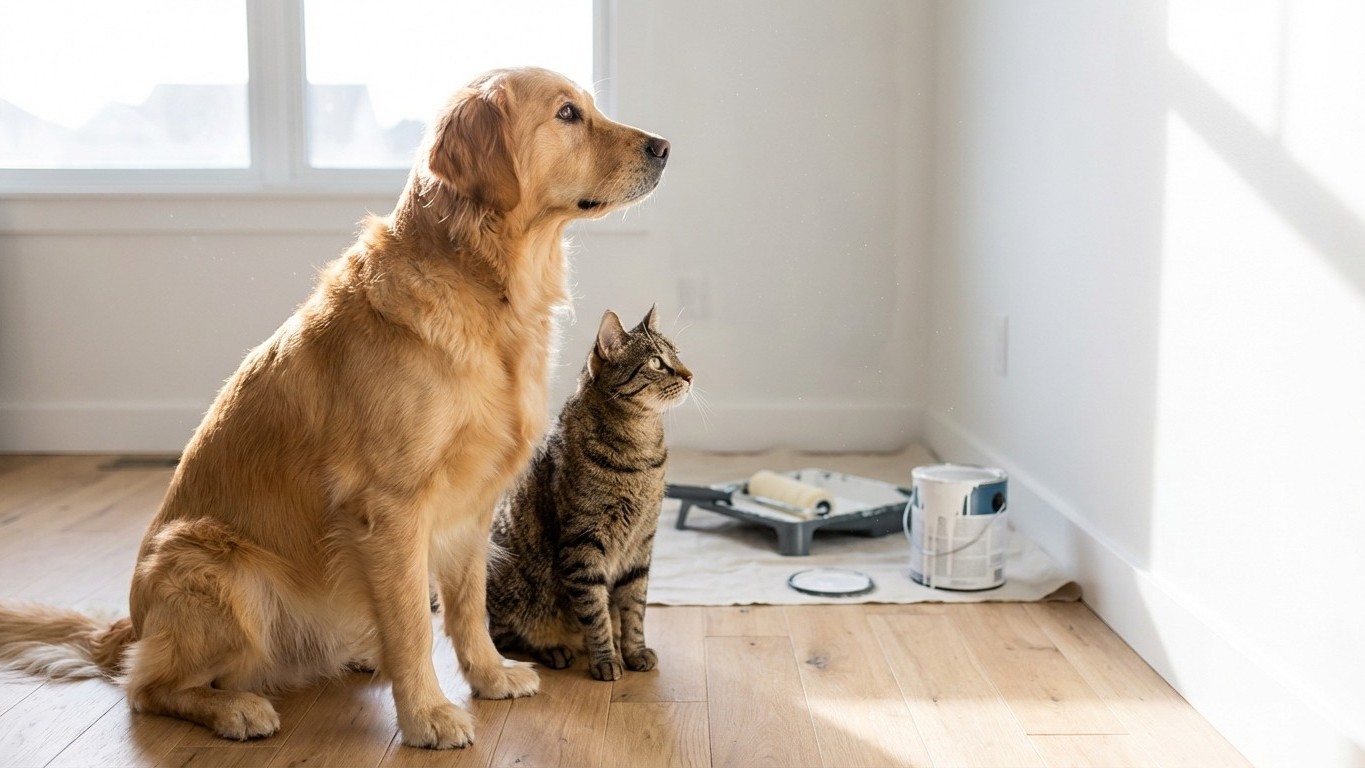
Your cat just woke up from a three-hour nap pressed against a freshly painted wall. Your dog did what dogs do: sniffed every corner, then licked the baseboard. You’ve been airing out the room all day, but are you sure the paint is actually safe? Most pet owners never think to ask that question. They choose a color, roll it on, and move on. But the chemistry inside a paint can, and what it releases into the air for weeks, sometimes months, afterward — can have real consequences for animals that live much closer to surfaces than we do.
This guide is not about finding a cute, labeled “pet-safe” product on a shelf. It goes deeper: which compounds to actively avoid, how to decode certifications that actually mean something, what finishes make sense for floors versus walls versus furniture, and how to manage the application process when there’s a dog snoring three rooms over.
Why Non-Toxic Paints and Finishes Matter When You Live With Cats and Dogs
The Real Risks: Toxicity and Harmful Emissions
Paint fumes are primarily composed of volatile organic compounds (VOCs), which can be released into the air during the painting process.
That much most people know. What fewer people realize is that
emissions are strongest in the days and weeks following application, but paints can continue to emit VOCs for months after application.
The most toxic VOC is formaldehyde, which has been declared carcinogenic by the WHO.
Benzene and toluene are among the most common VOCs found in conventional paint products.
Paint fumes are risky for animals because of their size. Since pets are smaller, it takes a lower concentration of fumes to make them ill.
Think about it: your 12-pound cat breathing the same air as you, but proportionally ingesting far more of it.
Short-term exposure to paint fumes can lead to symptoms like eye irritation, coughing, sneezing, and mild respiratory discomfort in pets.
And in more serious cases?
Symptoms of paint poisoning include trouble breathing, vomiting, hair loss, and dizziness.
Oil-based paints and varnishes contain solvents that can be inhaled into the lungs and cause difficulty breathing.
Some latex paints contain low concentrations of ethylene glycol. Ingestion of very large amounts of these paints can cause gastrointestinal upset, neurologic signs, and even kidney failure.
The risk is not theoretical. It’s chemical, and it’s proportional.
Animal Behaviors That Increase Exposure
Pets may walk through freshly painted or varnished areas and chew on or lick paint and supplies. If paint or varnish gets on a pet’s skin, fur, or paws, small amounts can be ingested while self-grooming.
Cats are fastidious groomers, which makes them especially vulnerable. Dogs lean against walls, press their noses into baseboards, and sleep pressed to the floor.
Furry family members spend their lives much closer to the floor, constantly breathing whatever’s off-gassing from your finish.
That’s not abstract poetry, it’s the physical reality of sharing a home with an animal.
Older homes add another layer of concern.
If you’re removing old paint, be extra cautious: lead-based paints, banned in the U.S. in 1978, are extremely toxic, and pets can ingest flakes from old trim or baseboards.
Poisoning most commonly occurs when pets chew on surfaces containing lead-based paint or ingest flakes or chips of peeling paint. While a single ingestion can result in clinical signs, repeatedly ingesting dried paint is more likely to result in serious effects.
If your home was built before 1980, test before you scrape anything.
For a broader view of how material choices across your entire interior affect your animals’ health, the guide on pet friendly home design materials covers everything from flooring to upholstery with the same lens.
Key Criteria for Choosing a Pet-Safe Paint or Finish
What to Avoid: VOCs, Formaldehyde, Heavy Metals, and Plasticizers
Problematic paints for pets include those containing polyurethane, formaldehyde, ammonia, acetone, fungicides, and biocides, all of which are toxic.
Reading the ingredient list is non-negotiable.
Paints that claim to have a VOC-free base might still use a VOC pigment
— a detail that manufacturers don’t always advertise prominently.
A paint labeled “without VOCs” can still contain co-solvents and heavy metals, which also impact indoor air quality.
Pigments containing heavy metals such as cadmium, chrome, and mercury are to be avoided.
The toxic compounds in a paint’s pigments must be listed in the product’s safety data sheet (SDS)
— always request it if it’s not visible on the label. A fragrance-free, apparently odorless formula is not a safety guarantee.
A paint with no odor is not necessarily safe.
Odor masks nothing about the underlying chemistry.
Labels and Certifications Worth Your Trust
Not all certifications are equal. In the U.S.,
GREENGUARD Gold sets even lower VOC emission limits, making it the optimal certification for products in nurseries, schools, healthcare facilities, and homes where children’s safety is paramount.
In addition to limiting emissions of more than 360 VOCs and total chemical emissions, GREENGUARD Gold Certified products must comply with the California Department of Public Health’s Standard Method for testing volatile organic chemical emissions.
For pet owners, it’s the closest thing to a reliable benchmark currently available.
In Europe,
the European Ecolabel guarantees that a paint respects criteria related to limiting heavy metals and toxic or hazardous substances like formaldehyde.
The Blue Angel label excludes any component considered dangerous as well as biocides. Ecocert prohibits heavy metals, nanoparticles, and sets a maximum VOC content of 3 g/L.
Below 1 g/L of VOCs, a paint can genuinely be considered healthy.
Some brands go even further:
there are paints that emit less than 0.1 g/L of VOCs.
One important nuance:
be cautious of products labeled “no VOC” or “low VOC.” These labels refer to a product’s chemical content, not to VOC emissions — the chemicals actually released into the air during or after use.
The A+ indoor air quality label, mandatory in France and common in Europe, is useful but
necessary but not sufficient, as the VOC emission limit to qualify for A+ is already quite high.
Wall Paint, Lacquer, Varnish, and Floor Finish: Not the Same Game
The type of surface being coated matters enormously.
Unlike older oil-based paints, latex paint contains far fewer harsh solvents and is generally safer for indoor use.
Once fully dry (typically within 24–48 hours), acrylic latex paint releases very few, if any, fumes. At that point, it is generally considered non-toxic.
Floor finishes are a different matter entirely: they cover larger surfaces, endure constant contact with paws, and are licked during grooming far more than walls.
Varnish and shellac may contain toxic substances like formaldehyde, which can be dangerous if ingested by pets.
For floors and furniture,
water-based polyurethanes offer incredible durability with minimal chemical exposure, while hardwax oils give an authentic, natural wood feel.
If you’ve got a dog who thinks your hallway is a racetrack, water-based polyurethane creates a tough, scratch-resistant surface that can handle the daily pitter-patter of pet feet.
Both options are dramatically safer than solvent-based products once cured.
The Best Pet-Safe Paint and Finish Options for Interiors
Water-Based Paints: Benefits and Limits
Water-based paints are the most accessible starting point.
Water-based paints are generally less toxic than solvent-based paints.
In most cases, water-based paints are unlikely to cause more than gastrointestinal upset or skin irritation
— and only if ingested in significant quantities.
Quick-drying paints also make great pet-safe options, because the shorter drying time reduces the amount of fumes being released.
For finish choices on walls,
satin, eggshell, or semi-gloss finishes are typically more washable than flat or matte paints. They also offer better resistance to moisture and odors.
A cat that rubs its face against a freshly marked corner, a dog that splashes water from its bowl onto the baseboard, these daily realities demand a surface you can actually clean without stripping the paint.
Natural, Mineral, and Eco-Certified Paints
Some eco-paints use natural ingredients like clay, chalk, or milk protein instead of petroleum-based binders.
A truly zero-VOC natural paint uses plant-based resins (sometimes from potatoes, vegetable oils, or corn starch) along with mineral pigments, and a composition guaranteed free from formaldehyde, biocides, plasticizers, and toxic agents.
These are not niche products anymore. They perform well,
with modern natural paints rivaling traditional brands in coverage, scratch resistance, and durability.
From an ecological standpoint, natural finishing products, for example casein-based paints or lime plasters, represent the best choice.
Lime-wash walls have become a design trend in their own right, and they happen to be among the lowest-emission options available. Brands that publish full ingredient transparency and voluntarily list VOC content below 1 g/L are the ones worth trusting, even if they don’t carry a formal certification.
Not every product marketed as “eco-friendly” or “natural” truly meets meaningful standards. Watch out for vague claims without verifiable certifications.
Floor and Furniture Finishes: Safe, Durable Alternatives
Floors are where the pet-safety question gets most critical.
Water-based finishes are recommended for pet owners due to their non-toxic nature and quick drying time, reducing harm to pets and maintaining a safe environment.
Hardwax oils are the more romantic option: for people who want floors to feel like real wood, not plastic.
They might show a scratch more easily, but spot repairs are a breeze. When a cat decides to use your floor as a scratching post, you don’t need professionals for a full refinish, just clean the area, do a light sand, apply more oil, and it blends right in.
For furniture, especially pieces that cats climb or dogs chew, water-based stains and finishes labeled with zero-VOC content and free from formaldehyde are the minimum standard.
Pets can be rough on furniture and floors, so it is essential to choose a coating that can withstand their claws or paws without chipping or peeling, peeling paint or finish is exactly how ingestion happens. Flakes become a hazard.
Choosing safe finishes for your floors pairs directly with choosing the right material underneath. The comparison guide on pet friendly flooring for dogs and cats covers scratch resistance, grip, and urine resistance across every major flooring type.
Application and Maintenance: Protecting Your Pets Throughout the Process
Preparation: Ventilation, Timing, and Keeping Animals Away
Even the safest paint on the market needs to be applied correctly.
Maintaining good ventilation throughout the painting process, from preparation to cleanup, will help dissipate paint fumes and reduce their concentration.
Relocate the pet to another room, keep them outside, or let them spend the day with a pet sitter or at doggy daycare
during the actual painting work. Not next door, not behind a baby gate, out.
Ensure the area where the paint or varnish was used is well ventilated and odor-free before allowing pets back into the area.
With water-based, low-VOC products, that window is considerably shorter than with oil-based paints.
Note that “low odor” is not the same as “low VOC.” Always read the label.
Smell is not your measurement tool here, off-gassing continues long after the pungent phase has passed.
Protect pet beds, toys, bowls, and any other surfaces your animals might touch. Always put lids back on paint cans, and clean brushes and rollers immediately.
Pets may be drawn to the smell of paint or water used for rinsing, it’s not worth the risk.
Maintenance: Cleaning Safely, Detecting Wear and Chips
Clean walls regularly with mild, non-toxic cleaning products, and repair scratches and stains quickly to prevent the paint from deteriorating and releasing potentially harmful particles.
Chipped or flaking paint is not a cosmetic problem in a home with animals — it’s a health risk, particularly with older coatings.
Home remodeling may expose lead-based paint dust and chips that animals may ingest. Prevention of lead poisoning from paint requires careful attention to the home environment. In older homes, be sure to remove any loose paint, chips, or paint dust from areas to which the pet will be exposed.
For cleaning finished floors, avoid products containing
ammonia, bleach, formaldehyde, or phenols, as these can be extremely harmful if ingested or even inhaled by pets.
The same logic applies to the walls. A satin or semi-gloss finish can handle a damp cloth with mild soap. Flat finishes on high-contact surfaces are a maintenance nightmare in a pet household, and they tend to chip first.
If you’re working on furniture or built-in cat furniture, the choice of surface coating connects directly to scratch resistance. The article on scratch resistant fabric for cats covers textiles, but the same principle of surface durability applies to painted or coated wooden structures. And for a complete overview of pet friendly home design cat dog furniture — from material choices to layout, the full design guide addresses how paints, finishes, fabrics, and furniture choices work together.
FAQ: Myths and Realities About Pet-Friendly Paint
Are all water-based paints safe for dogs and cats? Not automatically.
In most cases, water-based paints are unlikely to cause more than gastrointestinal upset or skin irritation.
But water-based doesn’t mean zero-VOC, and some formulas still contain plasticizers and biocides. Always check the full composition.
How do I know if a paint is toxic to my animals?
The toxic compounds entering into a paint’s composition must be listed in the product’s safety data sheet (SDS).
Request it if it’s not available. Look for the absence of formaldehyde, heavy metal pigments, ammonia, acetone, and biocides. A third-party certification such as GREENGUARD Gold or the European Ecolabel is the most reliable shortcut.
Does “zero-VOC” on the label mean the paint is completely safe?
Paints described as “without VOCs” are often associated with ecological and healthy products. However, “without VOCs” is not enough to guarantee healthy air, and a zero-VOC paint is not necessarily natural.
Check for heavy metals, biocides, and plasticizers separately.
What is the best label to look for in the U.S.?
GREENGUARD Gold is one of the highest levels of environmental certification available and is awarded to products that meet the most stringent standards for indoor air quality. It helps you quickly identify products that won’t fill your home with harmful chemicals.
For paints specifically, zero-VOC formulas with GREENGUARD Gold certification, such as Benjamin Moore Natura or Clare Paint, offer the strongest combination of safety and performance.
Quick Reference: Safe Choices vs. What to Avoid
Below is a synthesized breakdown to guide purchasing decisions at a glance:
- Wall paints to choose: Zero-VOC or low-VOC water-based latex/acrylic, GREENGUARD Gold certified, A+ rating with VOC content below 1 g/L, natural clay or mineral-based paints
- Wall paints to avoid: Oil-based/alkyd paints, formulas containing formaldehyde, biocides, ammonia, acetone, heavy metal pigments (cadmium, chrome, mercury)
- Floor finishes to choose: Water-based polyurethane (zero-VOC), hardwax oils (natural, no solvents), water-based stains with full ingredient transparency
- Floor finishes to avoid: Solvent-based varnishes and lacquers, oil-based polyurethane (high-VOC, long off-gassing), traditional shellac (formaldehyde risk)
- Furniture coatings to choose: Water-based, non-toxic, zero-VOC certified finishes, natural waxes or oils once fully cured
The real shift happening in interior design is that
modern paint technologies make it possible to not sacrifice performance for safety.
A chalky sage-green lime wash. A deep navy satin on trim that wipes clean. A hardwax oil floor that feels like walking on the earth. None of these require compromise, they just require knowing what’s actually in the can. Which raises the question worth sitting with: if the certifications exist, if the formulas exist, and if the information is available, why do so many renovation projects still default to the cheapest paint on the shelf? The answer probably has more to do with habit than with cost.