
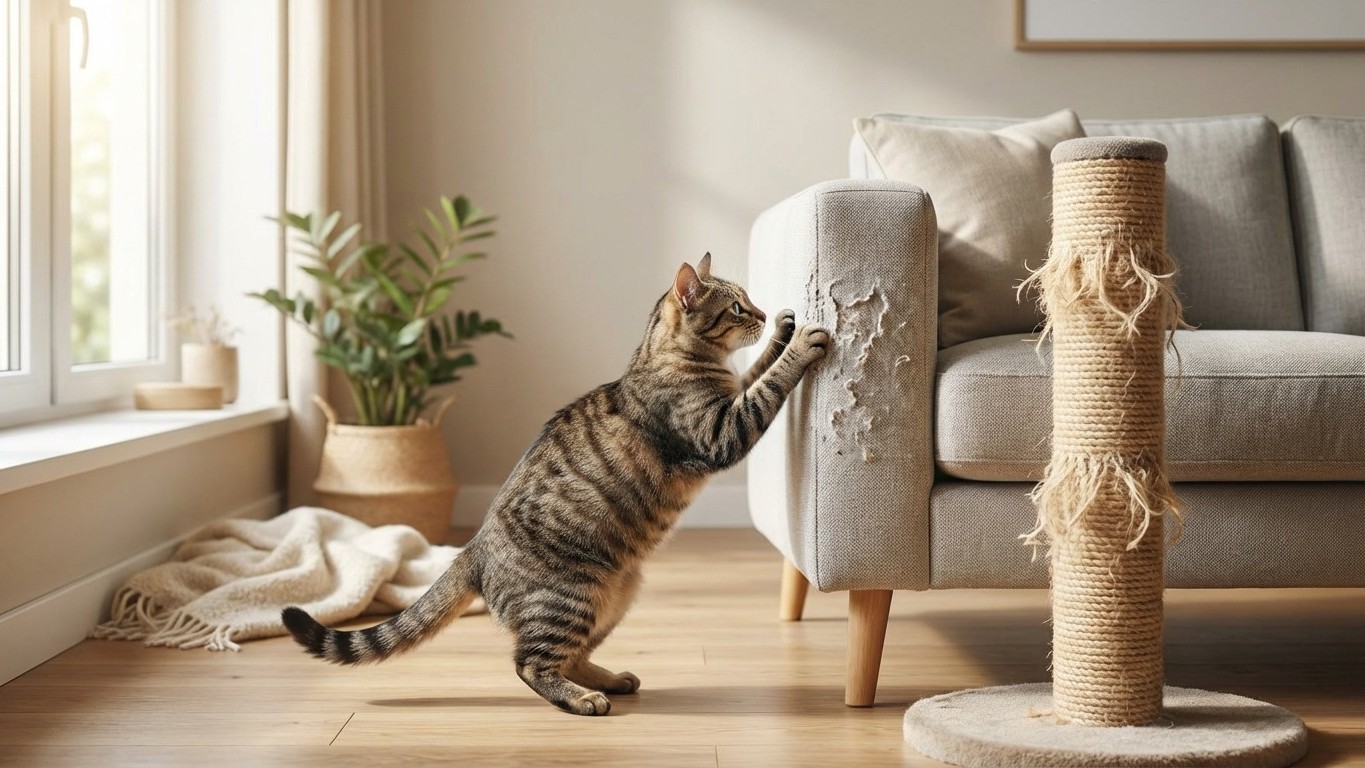
Your couch. Your cat. A daily standoff that ends the same way, every time, with fresh scratch marks along the armrest and a creeping sense of resignation. But here’s what the scratching actually tells you: your cat is healthy, territorial, and doing exactly what millions of years of evolution designed them to do. The real question isn’t how to stop them, it’s how to redirect them, protect your furniture, and make the whole system beautiful enough to actually live with.
Why Cats Scratch the Couch: Understanding Before Acting
The Natural Behavior Behind the Damage
Cats don’t scratch furniture to be mischievous — they do it because it fulfills several biological and psychological needs. This behavior is deeply rooted in feline instinct, serving a variety of purposes that benefit their well-being.
Think of it as a full-body ritual:
scratching provides an excellent stretch for the muscles, tendons, and joints in a cat’s toes, feet, legs, shoulders, and back.
Then there’s the claw maintenance angle:
cats scratch on things to remove frayed, worn outer claws and expose new, sharper claws.
And, perhaps most importantly for understanding why your sofa is the preferred target,
cats’ paws contain scent glands, and when they scratch objects, they release a visible and chemical scent marker that identifies their territory in the home.
Cats don’t scratch out of malice or a need to destroy the furniture. They scratch because it’s a primal instinct that has several possible causes.
Knowing this changes everything. You stop seeing destruction and start seeing communication, which opens the door to genuinely effective solutions.
Why the Couch Specifically (and What Stress Has to Do With It)
Cats are most likely to target prominent and frequently used areas such as carpets or sofas. This is because scratching these areas will make them feel more secure and relieve stress by putting their scent on things, making them feel more like their home.
Your sofa, smells like the entire household, exactly what a territorial animal wants to claim.
Research adds another dimension to this.
Scientists found a relationship between scratching and environmental factors like loud noises or kids. This highlights the importance of shielding your cat from these stressors when crafting a plan to solve your cat’s furniture-scratching habit.
Much like humans chew on their nails or fidget when anxious, cats scratch as a way to relieve stress. If your cat is scratching the furniture more than usual, it may be experiencing anxiety due to changes in the household, such as a new pet, a move, or alterations in routine.
Solve the stressor, and you often reduce the scratching without doing anything else.
Choosing the Right Materials: A Scratch-Resistant Sofa That Still Looks Good
What Fabrics Actually Hold Up to Cat Claws
Not all upholstery is created equal when claws enter the equation.
The best materials share a tight weave and smooth texture that claws slide off rather than sinking into.
This is the single most useful test you can apply when shopping: run your fingernail across a fabric sample.
If you can catch a thread, a cat claw will definitely catch it.
Microfiber is a great choice because it’s comfortable and stylish, yet sturdy. If your cat does claw at it, microfiber can stand up to a few scratches.
Performance velvet with a short, tight pile is another strong option —
it releases pet hair easily instead of trapping it, and its short threads and minimal pile resist snagging.
For a more premium investment,
Crypton is a nearly indestructible synthetic fabric that’s resistant to stains, smells, and scratches. Its tight weave and special coating make it an ideal choice for cat owners. It’s a bit on the pricier side but can be worth the investment for the longevity it provides.
A few materials to genuinely avoid:
velvet, brocade, embroidery, and damask fabrics are a definite no, as cats can sink their claws into these like a knife into butter.
Similarly,
avoid materials like textiles that can be easily snagged by cat claws, such as boucle, gauze, and some chenilles.
Beautiful fabrics, wrong context.
Protective Treatments for Furniture You Already Own
Already have a sofa you love? You don’t have to start over.
To choose the best cat-resistant approach for existing furniture, opt for fully washable or wipeable upholstery treatments, thick fabrics that won’t rip or shred, and options that are resistant to pilling and pulling.
Temporary adhesive panels, clear, furniture-shaped scratch guards that adhere to armrests — have become far more discreet and design-friendly. They create a surface claws can’t grip, while adding zero visual clutter to your room.
For complete coverage while you work on behavioral training,
having throws and covers can protect furniture and are easily removed and washed. This can be an immediate solution while you transition to more durable furniture options.
Pair your protection strategy with our guide to best couch covers for pets waterproof for a deeper look at design-forward slipcover options that won’t make your living room look like a waiting room. And if hair management is part of your daily battle alongside scratch prevention, the practical guide on how to get pet hair off couch fabric covers techniques tailored to each upholstery type.
Scratching Posts: The Architecture of Redirection
What Makes a Scratching Post Actually Work
The best approach for pet parents is not to stop cats from scratching, but instead to teach them where to scratch.
That shift in mindset is where most people start succeeding. A scratching post isn’t a concession to your cat, it’s a design element with a behavioral function. Choose it the way you’d choose any piece of furniture: with intention.
Size matters more than most people realize.
An ideal scratching post allows your cat to stretch fully, typically around 30 to 32 inches tall. This height provides a satisfying stretch and helps keep your cat’s muscles in good shape.
Stability is equally critical:
a flimsy post that tips over is a waste of money. Invest in a sturdy, well-made post that will actually get used.
For texture,
sisal rope is often preferred for scratchers because it offers a texture that cats enjoy and is more durable than carpet.
Cardboard is budget-friendly and beloved by many cats, though it needs replacing more often. The ideal setup: multiple posts with different materials and orientations.
Pay attention to what your cat pays attention to. Vertical scratchers are great for cats who like to stretch upward, posts, tall sisal towers, or corner scratchers. Horizontal scratchers are perfect for cats who claw at carpets or rugs — scratch mats, pads, or corrugated cardboard.
Some cats want both. Observe before investing.
Where to Place Scratching Posts for Maximum Effect
Placement is where most people get it wrong — tucking the scratching post into a corner, out of the way, where the cat never naturally goes.
Certified animal behaviorist Mikel Delgado says: “You need to have more than one scratching post, and you want to put them in locations that your cat is likely to use them. That might mean right next to your couch if the couch is a place that your cat really enjoys scratching.”
Cats like to scratch when they first wake up, so placing a post near a favorite napping spot is a good idea. You should also pay attention to what furniture your cat likes to scratch the most and place scratching posts as close to those locations as possible.
For cats that scratch after seeing something exciting outside, placing posts near windows and sliding doors can also be effective.
Once your cat reliably uses the post in its current location, you can slowly shift it a few inches per day toward a more convenient position in the room.
Providing cats with multiple scratching posts in different areas of your home increases the likelihood that your furniture and carpeting will be left alone.
Think of it the way you’d think about charging stations: you don’t put them all in one room and hope for the best.
Making the Scratching Post Irresistible
Catnip is your secret weapon. Sprinkle it generously on the base and fabric of the post.
If your cat is one of the 30% that doesn’t respond to catnip, try silver vine or valerian root instead. These alternatives can be just as effective.
Beyond scent, play is your other tool: dangle a wand toy near the post, let your cat chase it up and over the scratching surface, and let them discover on their own how satisfying it is to dig in.
Do not throw away a favorite scratching post when it becomes unsightly. Cats prefer shredded and torn objects because they can really get their claws into the material. Used posts will also appeal to your cat because they smell and look familiar.
Counterintuitive for the design-conscious, but behavioral science wins this round.
Building an Anti-Scratch Routine: Positive Reinforcement and Smart Habits
Training Without Stress or Punishment
The best way to train your cat to scratch more acceptable objects, such as a scratching post, is to reward the behavior you want to see. If you see your cat put its paws on a scratching post, reward them with a treat. The cat will begin to associate scratching the posts with rewards and will therefore be more likely to continue that behavior.
Redirect, don’t punish. When you catch your cat scratching furniture, don’t yell or spray them with water. Instead, calmly interrupt them and immediately guide them to the scratching post. The moment they interact with it, praise them enthusiastically. This teaches them “this spot is bad, that spot is great” without creating fear or stress.
Consistency is the variable most often underestimated.
Mixed signals confuse cats. If they’re sometimes allowed on the couch and sometimes not, they’ll ignore the rule. Be consistent in your training and environment.
Every member of the household needs to follow the same approach, otherwise the cat simply learns to wait for the most permissive person in the room.
Managing Relapses and Common Mistakes
Negative reinforcement techniques, squirting your cat with water, making loud noises, yelling, usually do not work with cats and, worse, they may completely backfire or cause injury. Many cats become stressed by such occurrences and, when that happens, they will react with behaviors that most humans won’t find acceptable.
Stress, remember, is one of the root causes of excessive scratching. Punishing it can create a self-reinforcing loop.
You may need to consider what is worrying your cat in order to permanently stop it from scratching your furniture. Don’t just provide another scratching surface without helping them feel more secure and less anxious.
Regular, structured play sessions help enormously here.
If your cat doesn’t get to catch its prey when playing, that pent-up energy can get released later on through scratching.
Give the hunt a satisfying conclusion, a toy they can physically “catch”, and you’ll see a measurable reduction in furniture targeting.
Regular nail trimming is another underused tool.
If you keep your cat’s nails trimmed, they may feel less of a need to scratch. Plus, if they do scratch, with trimmed nails the scratching may be less damaging.
It won’t replace behavioral training, but it buys time and reduces destruction during the transition period.
Design Solutions: Covers, Deterrents, and Designated Zones
Think of furniture protection as a layered system rather than a single fix. While you’re building new scratching habits, physical deterrents cover the gaps.
Placing plastic, double-sided sticky tape, sandpaper, or upside-down vinyl carpet runner on furniture or on the floor where your cat would stand to scratch can be effective short-term deterrents.
The texture is unpleasant to paws without causing any harm, a key distinction.
Using odor-neutralizing enzymatic cleaning products on your cat’s favorite pieces of furniture helps because cats are drawn to scratch areas where they have previously deposited their scent-gland pheromones.
Breaking that scent memory reduces the pull of the couch as a scratching target. You can also layer this with pheromone sprays that mimic the cat’s facial hormone, cats release this hormone when they rub their face against things to mark familiar surroundings, and they naturally have an aversion to scratching where they have rubbed their face.
The wider picture of how to protect furniture from cats and dogs covers both preventive and reactive strategies across different furniture types and pet situations. And if you’re thinking longer-term about your whole home’s layout, the approach detailed in pet friendly home design cat dog furniture offers an integrated framework for designing spaces where both aesthetic integrity and animal wellbeing genuinely coexist.
The Case Against Declawing: Ethics, Evidence, and Better Alternatives
Every conversation about stopping cats from scratching eventually arrives here. Declawing sounds surgical and final — but what it actually involves is far more extreme.
These groups emphasize that declawing removes not just the claw but also the last bone of each toe, which is equivalent to amputating human fingertips at the last joint, often resulting in chronic pain, behavioral issues, and mobility problems for cats.
The behavioral consequences deserve equal attention.
Declawing is not a simple nail trim; it’s a significant operation that can lead to various complications, including chronic post-operative pain that can persist long after surgery, increased aggression and litter box avoidance, and altered gait and back pain due to changes in weight distribution.
The ASPCA is strongly opposed to declawing cats. Because declawing has not been proven an effective method for improving behavioral issues, including aggression toward people or other cats, it should never be used as a behavioral remedy or as a preventative measure.
The legal landscape is shifting rapidly.
New York became the first state to ban declawing in 2019 except if medically necessary; Maryland became the second U.S. state to ban cat declawing in 2022; and Virginia enacted a similar ban in 2024.
The trend is clear.
Providing a cat with an abundance of more attractive clawing alternatives, like scratching posts, can minimize their desire to scratch other objects. This can be coupled with behavioral training, where cats are rewarded for clawing the right things.
The sofa-versus-cat problem has humane, effective solutions. Surgery isn’t one of them.
FAQ: Your Most Common Scratching Questions, Answered
How do I train my cat to stop scratching the couch without declawing?
Training your cat to use a scratching post isn’t about winning a battle of wills — it’s about understanding their needs and making the right choice more appealing than the wrong one. With the right post, strategic placement, positive reinforcement, and patience, you can save your furniture and keep your cat happy.
Place the scratching post directly next to the couch, reward every use with treats or praise, and use temporary deterrents (double-sided tape, scratch guards) on the couch surface while the new habit takes hold.
What materials are best for a scratch-resistant sofa?
Microfiber, Crypton, and performance fabrics are excellent choices due to their durability, stain resistance, and ability to withstand scratching.
Tight-weave synthetics and short-pile performance velvets also perform well. Avoid loose weaves, bouclé, linen, and traditional velvet, all of which give claws the texture they’re looking for.
Where should I place scratching posts to keep my cat away from the furniture?
Strategic positioning and positive reinforcement can guide scratching behavior away from your furniture. Place the post where your cat spends a lot of time, in a prominent position, and consider multiple posts if you have more than one cat.
Start directly beside the furniture they currently target. Proximity is what makes the difference, not aesthetics, at least in the beginning.
The scratching post tucked into a corner of a spare room is a decoration. The one placed deliberately next to the armrest your cat has already claimed? That’s a solution. Every strategy in this guide works by the same underlying logic: work with the cat’s instincts rather than against them, and build a home environment where the right choice is also the easiest one. What your cat does with your sofa is ultimately a design problem, and design problems have design answers.