
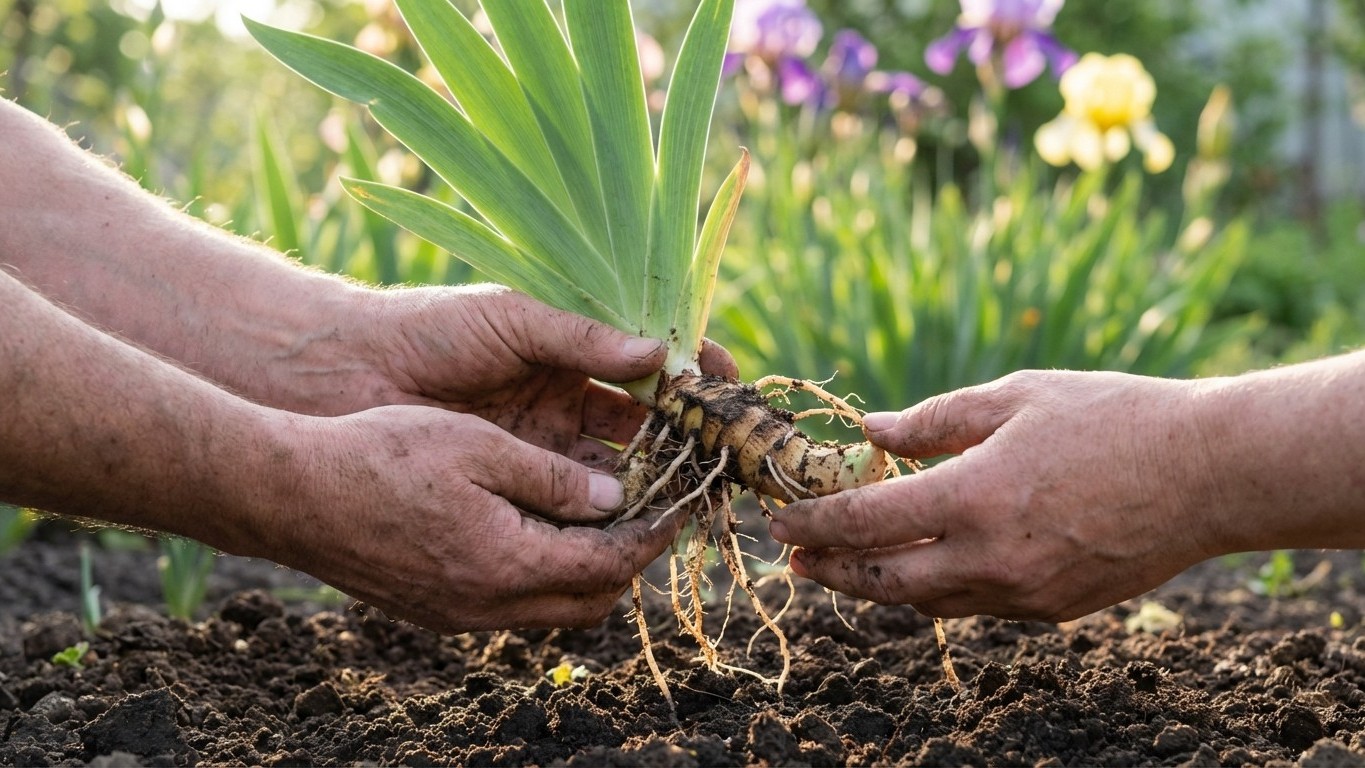
Splitting bearded irises in April felt like breaking every rule in the gardening book. Every guide I’d ever read pointed firmly to late summer, July through August, as the sacred window for division. So when I dug up a congested clump in early spring, green fans already pushing skyward, I half-expected to kill the whole lot. What happened instead made me question years of received wisdom.
The irises I divided in April bloomed the very next season. Full, lush, almost arrogant in their abundance. The ones I’d split the previous July, following the “correct” advice, sat sullen in the ground for a full year before mustering a single flower. Same garden. Same soil. Same care. The only variable was timing.
Key takeaways
- One gardener’s April iris division bloomed fully the next year, while traditional July divisions waited a full season for flowers
- Summer heat and dormancy create a deceptive trap: you’re dividing during the ‘right’ biological window but the worst environmental conditions
- Spring division catches irises at a precise moment when root energy is already moving—you redirect momentum rather than fighting dormancy
Why Everyone Tells You to Wait Until Summer
The conventional July-August advice exists for a real reason. After bloom, bearded irises enter a natural rest period. The rhizomes have finished their energy expenditure, the foliage starts to die back, and the plant is theoretically less stressed by division. Gardening books written decades ago locked this timing in as gospel, and it’s been repeated ever since, a perfect example of horticultural telephone, where advice gets passed along without anyone questioning whether it still holds in different climates or garden conditions.
The problem with summer division is the heat. In many parts of the United States, July and August mean baking soil, stressed plants, and rhizomes sitting in warm, moist conditions that invite iris borer and bacterial soft rot. You’re told to divide then precisely because the plant is dormant-ish, but you’re also dividing into the worst possible conditions for root establishment. The math doesn’t always add up.
What Actually Happens When You Divide in April
April division catches irises at a specific biological moment, they’ve broken dormancy, root activity is ramping up, and the soil temperature is climbing just enough to encourage fast healing without triggering rot. The rhizome’s energy is already moving upward into the fans and outward into new root growth. When you divide at this point, you’re essentially redirecting that existing momentum rather than interrupting dormancy or fighting summer heat.
The divisions I replanted in April established root contact with the surrounding soil within weeks. Cool nights slowed evaporation. Spring rains did half the watering work. By the time temperatures climbed into summer, those rhizomes had already anchored themselves firmly enough to store energy for the following spring’s bloom cycle. They didn’t skip a beat.
Compare that to July divisions, which spend their first weeks trying to survive rather than establish. They heal the cut surfaces slowly in heat, often produce little new root growth until September, and have only a short autumn window to store the energy needed for next year’s flowers. Many simply don’t have enough reserves. Result? You wait a full growing season for any payoff.
How to Actually Do It Without Losing Plants
The technique matters as much as the timing. April division requires some adjustments from the standard summer approach, mostly because the plant is already active and more vulnerable to transplant shock.
Dig generously around the clump, going wider than you think necessary to preserve as many feeder roots as possible. Lift the entire mass and rinse it with water so you can actually see what you’re working with, congested clumps become a puzzle of interlocked rhizomes that you’ll misread if caked in soil. Use a sharp, clean knife rather than a spade to make divisions; cleaner cuts heal faster and give rot less of an entry point.
Each division should have at least one healthy fan of leaves and a firm, solid rhizome section. Discard anything soft, hollow, or suspiciously lightweight. Trim the fans down to about four to five inches, not the aggressive fan-cutting you’d do in July, since the leaves are actively photosynthesizing and the plant needs that energy. Replant at the same depth the rhizomes were sitting before, which for bearded irises means the top of the rhizome should sit just at or barely below the soil surface. Deep planting is one of the most common reasons irises fail to bloom, regardless of when you divide them.
Water well at planting, then step back. Spring irrigation is usually generous enough on its own, and overwatering freshly divided rhizomes in cool soil is a fast path to rot. A light mulch around (never over) the rhizomes helps retain moisture without suffocating them.
The One Situation Where July Still Wins
There’s an honest caveat here. If your bearded irises are in active, severe bloom, flowers fully open, stems loaded, April division will cost you that year’s display. You’re essentially cutting the show short. For gardeners who grow irises primarily as a flowering spectacle, waiting until after the last petal drops makes sense, even if it means July’s heat and a slower recovery.
The sweet spot, if you can catch it, is very early spring before the first buds form, or immediately post-bloom if you’re in a cooler northern climate where July temperatures stay manageable. Gardeners in the Southeast or Southwest face a harder tradeoff because their summers are genuinely brutal, for them, late August into September may actually outperform both July and April simply by avoiding the worst heat.
Climate, as always, complicates the tidy rule. The gardening advice encoded in most American books was largely written for temperate mid-Atlantic and New England conditions. Your July in Phoenix and your July in Portland, Maine are two entirely different propositions.
The deeper lesson from that embarrassingly floriferous April experiment isn’t really about irises at all. Gardening wisdom accumulates slowly, often calcifies into dogma, and resists revision even when backyard evidence repeatedly contradicts it. The most productive question you can ask in any garden isn’t “what does the book say?” but “what does my specific plot of ground actually tell me?” Sometimes the answer involves digging up the rulebook along with the rhizomes.