
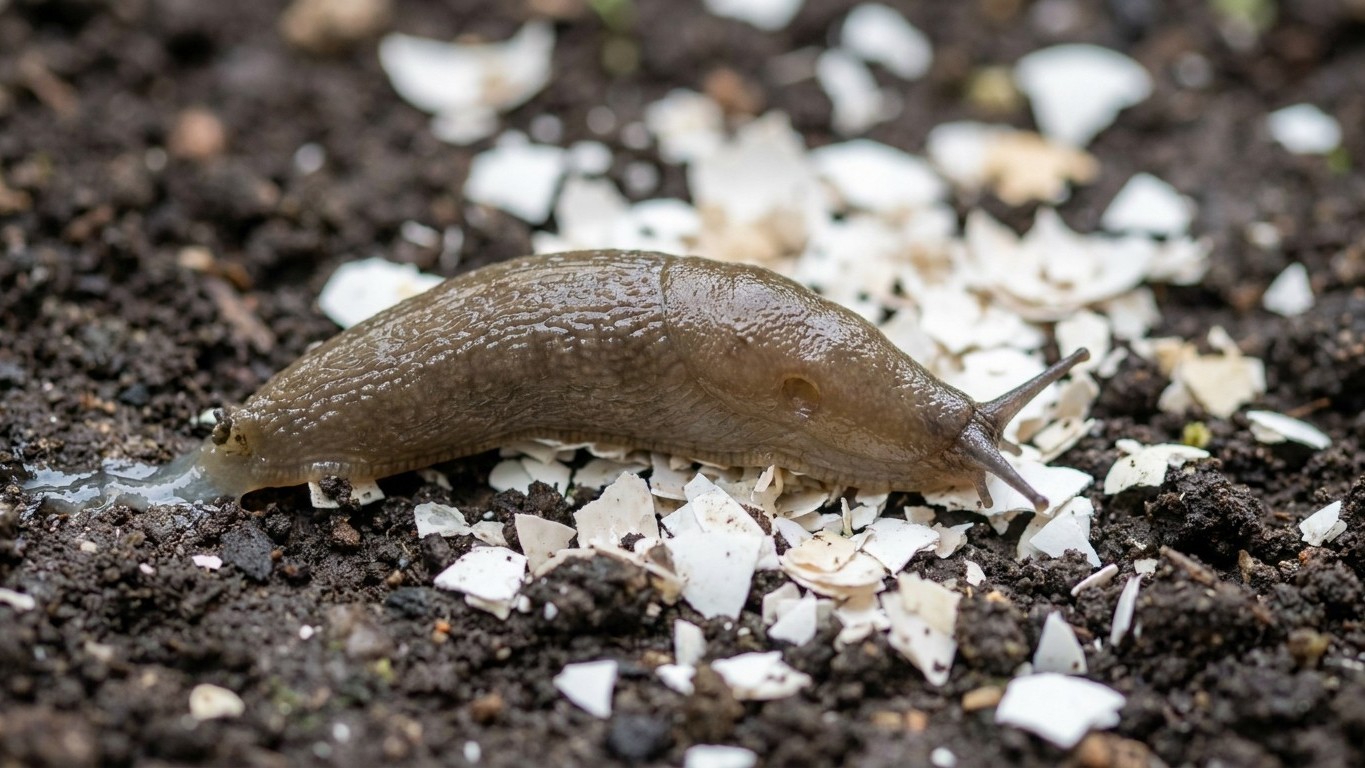
Millions of gardeners have done exactly this: crushed eggshells by hand, scattered them in a careful ring around lettuce and hostas, and trusted that the sharp edges would slice through any slug bold enough to try crossing. It feels logical. It feels like something your grandmother would have sworn by. And then one morning, watching closely, you see a slug glide over that supposedly lethal barrier without so much as a hitch in its pace. That single observation, it turns out, lines up perfectly with what researchers have been documenting for years.
Key takeaways
- A gardener watched a slug cross the eggshell barrier without hesitation, contradicting decades of gardening advice
- The Royal Horticultural Society’s six-week trial proved eggshells, copper tape, and other popular barriers actually prevent zero slug damage
- Slug slime is nature’s engineering marvel—it’s so effective that slugs can cross glass shards unharmed
Why the eggshell barrier never stood a chance
The theory behind eggshells sounds airtight until you understand slug biology. Slugs secrete slime, a mucus that protects them against cuts on rough surfaces, and this slime is so efficient they can even cross shards of glass without any damage. Crushed eggshells, however jagged they look to us, are nowhere near sharp enough to breach that defense. A slug’s underside isn’t skin the way we imagine it, it’s a muscular foot coated in a slippery secretion engineered by millions of years of evolution to handle exactly this kind of obstacle.
The experimental evidence backs this up directly. The slug-busters at the “All About Slugs” group put the theory to a test in a clever experiment where they surrounded lettuce leaves with egg shells, and found that the creatures had no trouble crashing the barrier to satisfy their appetite. Garden science communicators at McGill University’s Office for Science and Society reviewed the same results and reached the identical conclusion. The lettuce disappeared. The barrier didn’t matter.
What makes this worse than simple ineffectiveness is a detail most gardeners never consider. Eggshells, unless thoroughly cleaned to remove the inner membrane and rinsed to get rid of any remaining albumin, give off an odor that will actually attract slugs. That means the exact ring you built to protect your lettuce may have been quietly advertising a free meal. It’s one thing for a remedy to do nothing. It’s another for it to work against you while you assume it’s helping.
The Royal Horticultural Society settled the debate
This isn’t just anecdote piled on anecdote anymore. In a controlled trial that ran over six weeks, the Royal Horticultural Society tested a whole lineup of popular slug deterrents side by side in real garden conditions. A recent RHS study in a garden-realistic scenario found no reduction in slug damage from barriers made of copper tape, bark mulch, eggshells, sharp grit, or wool pellets. Copper tape, long marketed as a premium slug solution because of the mild electric charge it supposedly delivers, performed no better than crushed shells in that trial. Plants “protected” by crushed eggshells didn’t fare any better than those left with no barrier at all.
There’s a nuance worth adding here, because slugs aren’t a uniform species. Patents filed for commercial slug repellents note that certain invasive species like Arion vulgaris have developed strong resistance to dehydration and adapted to aggressive treatment methods, partly because gardeners have relied almost exclusively on salt-based preparations for decades. Even mechanical fences and copper barriers, the same patent documentation notes, provide only partial protection against this particularly resilient slug. If commercial researchers with lab budgets struggle to fully outsmart these mollusks, a handful of crushed shells was never going to cut it.
What actually reduces the damage
None of this means your garden is defenseless, it means the fight needs a different strategy. Timing turns out to matter more than texture. Research found that watering your garden in the morning, rather than later in the day, is as good as metaldehyde pellets for keeping slugs away. Slugs are creatures of humidity and darkness, and a garden that dries out during the day instead of staying damp overnight simply offers them less opportunity.
Chemical pellets deserve a mention too, mostly as a caution. Metaldehyde pellets were banned in the UK in 2022 because of their toxicity to birds, hedgehogs, and pets. Ferric phosphate pellets are still allowed, but even organic slug pellets have been shown to have negative effects on wildlife in the garden. That’s a real tradeoff worth weighing before reaching for any bag of pellets, organic label or not.
Physical barriers aren’t entirely useless, they just need to be built correctly. A proper slug collar with an angled overhang, rather than a flat ring of shells, forces the animal to physically arch over an edge it can’t grip, and that geometry does far more work than sharpness ever could. For plants placed directly in the ground, a slug fence or collar with roughly a 45 degree overhang works best. Container gardeners get an easier fix, since raising pots off the ground onto a stand removes the ground-level path slugs rely on entirely.
One home gardener who tested materials side by side found a telling contrast: used, dry coffee grounds actually gave a slug pause, deterring it to some extent and causing it to deflect its path toward a narrower section of the line. Salt worked even more decisively in that same informal trial, though it comes with its own downside of degrading soil over time and washing away in rain.
None of this means your eggshells were wasted, exactly. The calcium carbonate in eggshells does benefit soil chemistry over time, slowly breaking down and adding calcium to garden beds. That’s a legitimate reason to keep tossing them in the compost bin or working them into soil. Just stop expecting them to stand guard over your lettuce, because the slugs were never reading the same gardening blogs you were.
Sources : mcgill.ca | laidbackgardener.blog