
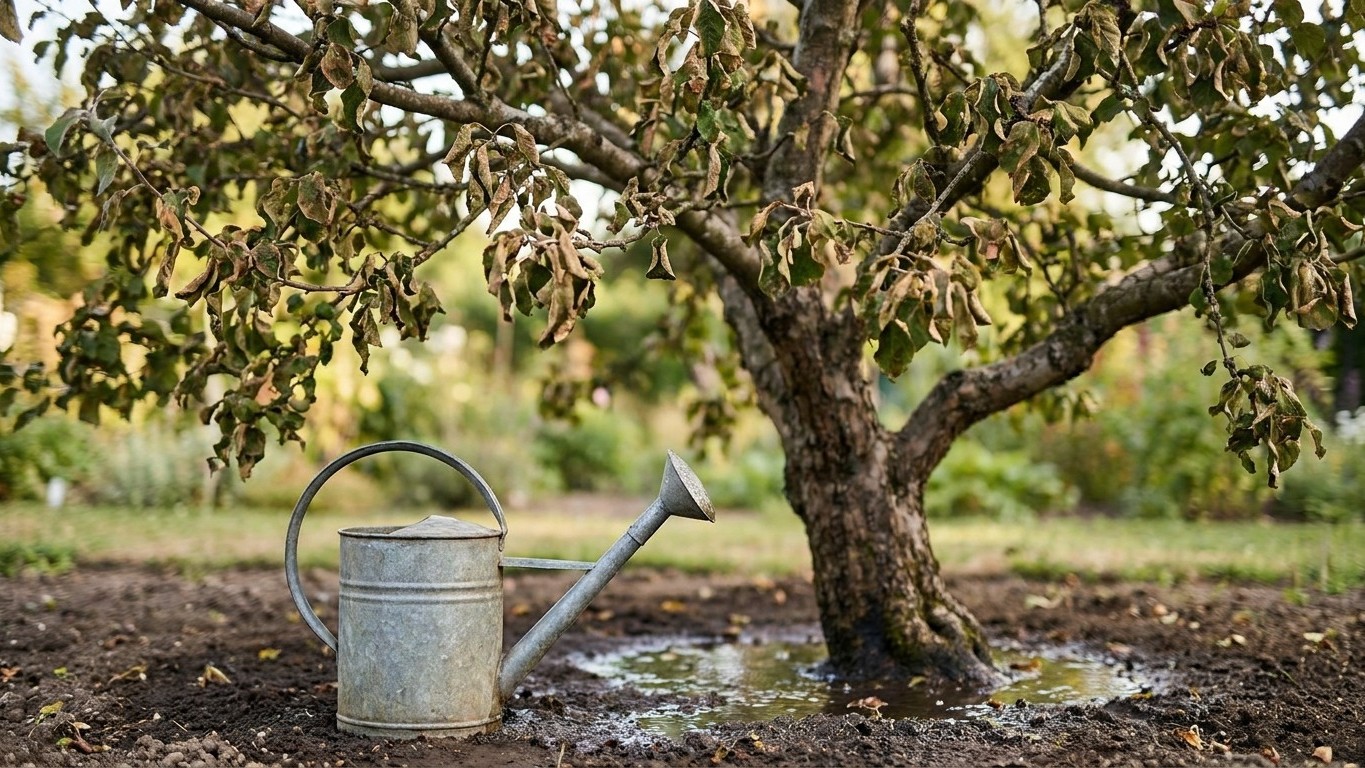
Every evening for weeks, a full watering can went straight against the base of an apple tree trunk. The soil there looked perfectly moist, the bark stayed dark and damp, and yet the leaves kept curling inward like tiny fists refusing to open. The answer showed up with a shovel: digging near the edge of the branches, where the canopy stops and the sky opens up, revealed soil so dry it crumbled like sand. All that water had been landing in the wrong spot for weeks.
Key takeaways
- A full watering can poured nightly at the trunk produced visibly moist soil—yet the tree’s leaves kept curling inward like fists
- One shovel dig at the canopy’s edge exposed bone-dry soil where it mattered most, while the trunk zone stayed waterlogged
- Apple trees don’t absorb water where most gardeners pour it; the real drinking roots hide where rain would fall off the leaves
The trunk is the least useful place to water
Apple trees don’t drink through their bark. Water reaches the tree through fine root hairs, and those hairs aren’t clustered around the trunk the way most people assume. The tree’s feeder roots that absorb water and nutrients are concentrated in this outer zone beneath the canopy’s edge, while the area near the trunk has fewer absorbing roots. That outer zone has a name gardeners rarely use in casual conversation: the drip line, the exact spot where rain would fall off the edge of the leaves if it were pouring outside.
On a young tree, this matters less. In a young tree, the root system is still small, so the absorbing roots may be closer to the trunk. But as the tree grows, the roots spread outward. A five-year-old apple tree with a canopy spreading six feet wide has roots that have already moved on from the trunk zone entirely. Pouring water there night after night is a bit like knocking on a door nobody uses anymore, while the actual entrance sits twenty feet down the hall.
What the dry soil at the drip line actually revealed
The curling leaves weren’t a mystery once the shovel came out. Insufficient watering is by far one of the most common causes of leaf curling in apple trees. When trees experience water stress, their leaves may curl as a defense mechanism to reduce moisture loss. The tree wasn’t short on water in general, it was short on water where it could actually use it. Meanwhile, the trunk zone had been getting soaked repeatedly, which brings its own risk. Extension specialists warn that root problems can go both ways at once: not enough water in one place, too much in another, and the tree can’t tell you which is which just by looking at the leaves.
There’s a second detail worth checking before blaming watering alone. Apple leaf curl can also come from aphids or a small midge insect that lays eggs in the folds of young leaves, and it climbs up from the soil where it overwinters and lays eggs in the folds of young apple leaves. The larvae that hatch feed on the juice of the leaves causing them to curl. A quick look at the underside of a few curled leaves settles the question fast. No insects, no sticky residue, no clusters of tiny bodies? Then water distribution is almost certainly the culprit, especially if the curling showed up during a stretch of hot, dry weeks.
Watering the right way, without wasting a drop
Fixing this doesn’t require new equipment, just a change in aim. The general guidance from arborists is straightforward: the root zone can spread three times as far as the edge of the canopy (also known as the dripline), so don’t water just at the base of the tree. If you are in doubt, a safe bet is to water the area between the dripline and trunk. For a mature apple tree, that could mean moving the watering can, hose, or bucket several feet away from where instinct says to place it.
Depth matters as much as location. A quick splash on the surface evaporates before it reaches anything useful. Extension research from Arizona recommends going deep rather than often: encourage a deep, drought-resistant root zone by watering deeply, infrequently and at the drip line where many fine roots can absorb more water. For most home orchards, that translates to watering less frequently but more generously, letting the moisture sink 18 to 36 inches down rather than staying trapped in the top inch of soil.
Mulch helps lock that moisture in place once it’s there, but placement counts here too. Piling wood chips or compost against the trunk traps moisture against the bark, inviting rot and pests. The safer approach: use mulch over the critical root zone. 2-3 inches of mulch under the canopy of the tree helps to reduce moisture loss & the drying effects of wind. Avoid placing the mulch in contact with the trunk. A donut shape, not a volcano, with a few clear inches of bare soil right against the bark.
A habit worth breaking gently
Old watering habits die hard, mostly because they feel productive. Standing at the base of a tree, can in hand, water disappearing into visibly damp soil, looks and feels like care. But a tree’s real needs sit further out than instinct suggests, quietly waiting at the edge of its own shadow. Moving the watering point outward each year as the canopy grows isn’t just a fix for curling leaves, it’s a habit that pushes roots to stretch wider and deeper, making the whole tree steadier against the next dry spell.
One more detail rarely mentioned: as an apple tree matures, extension guidance notes that its root system can spread far beyond what the branches suggest, sometimes reaching two to four times the width of the canopy itself. That means even watering at the drip line eventually undersells a mature tree’s real thirst, and the smart move is to expand the circle a little further out each season rather than treating the drip line as a fixed target.
Sources : couchtohomestead.com | worldofgardenplants.com