Your neighbor’s gaze lands on your balcony every time you step outside for coffee. Sound familiar? For millions of urban apartment dwellers across America, the balcony is both a sanctuary and a fishbowl at the same time. The good news: a well-designed living privacy screen made of balcony privacy plants in pots can transform that exposed slab of concrete into a genuinely sheltered retreat, without drilling a single hole, violating your lease, or making the space feel smaller.
This guide covers everything from plant selection to container choices, support structures, layout strategy, and seasonal upkeep. Think of it as your blueprint for building a green wall that actually works.
Why a Living Privacy Screen Beats Any Artificial Alternative
Balconies and terraces can often feel exposed and open, with passersby able to look directly into your home. Planting that screens your outside space enhances your balcony by adding a sense of privacy and seclusion.
But green screening does more than block sightlines.
It adds color, texture, and life to urban spaces. Dense foliage absorbs sound, creating a quieter environment. Plants filter dust and pollutants while producing oxygen. Green spaces promote relaxation, reduce stress, and enhance mood.
Compare that to a roll of synthetic privacy mesh or a bamboo reed panel. Both fade, crack, or look shabby within two to three seasons. A living screen, by contrast, gets denser and more beautiful year after year, provided you choose the right plants and give them what they need. The investment pays dividends in aesthetics, air quality, and actual psychological comfort. That last point isn’t marketing speak: researchers have long documented the stress-reducing effect of visible greenery, especially in dense urban environments.
There is one real trade-off worth acknowledging upfront: living privacy screens require care.
Real plants need regular watering and care. Pots can take up valuable floor space on tiny balconies.
That’s why plant choice and layout strategy matter so much, the goal is maximum screening with minimum footprint and manageable maintenance.
How to Choose the Right Balcony Privacy Plants in Pots
The Core Criteria: Exposure, Height, and Wind Tolerance
When choosing plants for privacy, consider height, growth habit, foliage density, maintenance needs, and container suitability.
Start with the most honest question: what does your balcony actually offer? Sun hours, wind intensity, and available floor depth will determine which plants survive, and which simply struggle until they die.
Plants with large leaves become tattered if constantly exposed to wind. Lush or soft foliage also gets burnt or dried out. A plant with a single stem or trunk could also be easily damaged. Multi-branched, small-leafed shrubs are the best choices on a windy balcony.
If your balcony is on a high floor facing the prevailing wind, that shortlist narrows considerably, but it doesn’t disappear. See our dedicated resources on windy balcony container gardening tips and windy balcony container gardening tips for specific strategies around wind protection.
A subtler factor: the hardiness zone effect of containers.
On an exposed balcony in a pot, your hardiness zone may be a point or more lower/harsher than simple location might suggest.
A plant rated to zone 6 may behave more like it’s in zone 5 when its roots are entirely exposed to freezing air inside a pot. Always choose a variety rated at least one zone colder than your location if the plant will overwinter outdoors.
Plant Types: Evergreens, Climbers, Grasses, and Bamboo
While bamboo offers rapid privacy answers, evergreen shrubs provide the most reliable year-round screening for container gardens. These hardy plants maintain their foliage through all seasons, ensuring consistent privacy coverage when you need it most.
Climbing plants such as ivy, jasmine, and vines provide vertical coverage for maximizing limited balcony space. Ornamental grasses like Calamagrostis offer movement, privacy, and low-maintenance options for urban settings. Compact plants like potted arborvitae and Japanese holly are ideal for small balcony spaces with limited room.
Grasses are becoming increasingly popular for containers. They provide a great deal of movement to the container garden, and can easily hide a difficult view in a way that doesn’t seem blocky or forced. They can be effective blockers of street noise while adding a pleasant rustling sound of their own to the balcony or patio.
That’s a dimension most people don’t consider: acoustic screening. A dense clump of ornamental grass muffles the neighbor’s conversation almost as well as it blocks their eyes.
The Best Plants for Balcony Privacy Screens in Pots
For Sunny, South- or West-Facing Balconies
Bamboo (clumping varieties) is the perennial favorite for good reason.
If you want to provide garden screening for privacy, bamboo is an excellent choice for growing on balcony gardens. Using lush planting in large troughs or a row of large pots provides privacy from the neighbors, screens out ugly views, and provides a windbreak.
The critical detail: always choose clumping varieties, never running ones.
Varieties such as Bambusa multiplex or Fargesia spp. are well-suited for container gardening, boasting compact growth habits and lush foliage ideal for creating dense privacy screens.
Fargesia varieties are particularly useful in cooler climates, while Bambusa multiplex ‘Golden Goddess’ excels in warm, sunny spots.
Bamboo is easy to take care of, water regularly in the summer, prune the tops of the canes to maintain their height, and occasionally thin out congested areas.
Star Jasmine (Trachelospermum jasminoides) is a climber that earns its place on any sunny balcony.
Star Jasmine offers a fragrant privacy solution for balcony gardeners seeking year-round screening. This versatile, evergreen climbing plant thrives in various light conditions, from full sun to partial shade.
Train your Jasmine on balcony railings or trellises to create a lush barrier. Its vigorous growth will quickly form a dense green curtain that offers visual seclusion and a pleasant aroma.
Arborvitae ‘Emerald Green’ is the sleeper pick — underused, highly effective.
Potted arborvitae offers an excellent alternative for those seeking year-round privacy. These slim evergreens can grow 12-15 feet tall while maintaining a narrow 4-5 foot width, making them ideal for compact spaces. As potted plants, arborvitae creates effective visual barriers with dense, year-round foliage.
A pair of these flanking a balcony door creates an instant architectural statement, and costs far less than a cedar screen.
Laurel (Laurus nobilis) brings both privacy and practicality.
This evergreen can be grown as a large shrub or small tree, and can be pruned into attractive topiary shapes for a more sculptural feel. You can also use the leaves to flavor recipes.
Useful and ornamental. Few plants can claim both.
Ornamental grasses — particularly Calamagrostis ‘Karl Foerster’ or pampas grass — add movement and sound to any privacy setup.
Ornamental grasses are easy to care for while also providing attractive screening, helping to create a private and protected space.
For Shaded or North-Facing Balconies
A north-facing or heavily shaded balcony isn’t a plant graveyard. It’s a niche.
Japanese holly, Ilex crenata, is shade-tolerant, with dark-green foliage that is evergreen, ensuring year-round interest and privacy on your balcony. These shrubs respond well to shaping, meaning that domes or pyramids can be attempted depending on your topiary skills.
Ivy (Hedera helix) remains the definitive shade climber.
Ivy is a go-to if you’re looking for a climber that adds a year-round green backdrop for a shady space. All varieties of ivy are great climbing plants for shade, where they will grow prolifically and only require minimal upkeep.
Plant it in a trough at the base of a trellis, and within a season or two you’ll have a genuinely dense curtain of green.
Clematis handles shade better than many realize.
Clematis are great climbers for shady gardens as there is a choice of varieties for every situation. Some clematis even grow in heavily shaded areas. Most grow well in sun or partial shade, but flowering can be less prolific in a very shady spot.
For maximum impact, choose a Viticella clematis, they’re tough, fast-growing, and come in a dazzling range of colors.
Climbing hydrangea is a great option if you live in USDA Zones 4-9. It is shade tolerant and can be grown in partially shaded spots.
It’s slower to establish than jasmine or ivy, but the payoff, enormous white flower heads against dense dark foliage, is spectacular. For broader heat and container care advice on shaded spots, check out our guide to protect balcony plants from heat in containers.
Supports, Containers, and Safe Fixation
Choosing the Right Pots
The main thing to remember is that plants must be planted in large, sturdy containers that won’t tip over or blow away. Privacy plants need to be lush and bushy to be effective, which means they can blow over. To grow and keep healthy and leafy they need plenty of space to form a strong root system and enough potting mix around their roots to hold water and avoid constant drying out.
As a general guide, select round pots that are at least 40-60cm (roughly 16-24 inches) across or rectangular planters that are 1-2m long for privacy plantings. For best growth plant just one plant per round container, or several plants can grow well in a long rectangular planter.
For deep-rooted specimens like bamboo,
plants with deep roots like bamboo and palms need deep pots (18-24 inches).
Bamboo is a special case for container material.
Metal, concrete, or thick wood pots are your only real options. Bamboo roots can crack through plastic pots.
Add a layer of gravel or a few small rocks at the bottom of any pot for stability, make sure to weight the bottom of your large pots with a brick or other material, so it doesn’t blow over.
On a very tight balcony,
wheeled containers offer mobility for repositioning, practical for reconfiguring your layout seasonally or for following the sun. Just make sure the wheels lock securely. A 60-pound pot rolling in a gust is not a minor inconvenience.
Trellises, Lattice Panels, and Railing Fixation
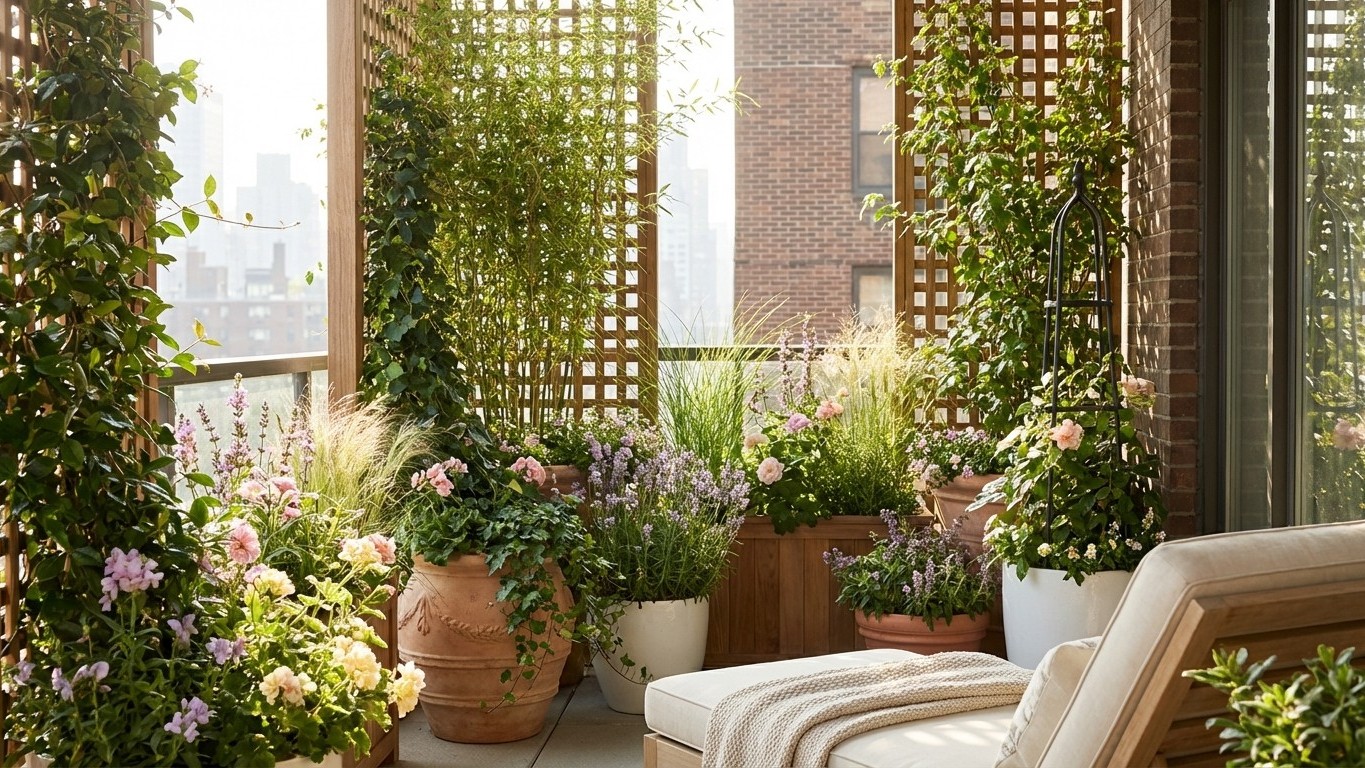
Trellises are available in myriad materials, shapes, and sizes, and can be used to effectively extend the height of your railings. If it’s all-out privacy you’re after, a trellis is best paired with a selection of climbing plants.
A trellis placed in a pot at the base of the railing, with a jasmine or clematis trained up it, creates a self-contained privacy unit that requires no drilling.
Install lattice screens or vertical trellises in your pots to support climbing plants such as jasmine, clematis, or ivy, adding vertical privacy without taking up floor space. Trellises can also provide support for tall, slender plants in windy conditions.
For renters especially, fixation strategy matters enormously.
Apartment balconies commonly feature wrought iron railings, making it easy to secure a privacy screen with zip ties. Its easy installation requires no drilling or structural modifications, allowing it to bypass restrictions from landlords and HOAs. It can be effortlessly secured to the railing, creating a privacy barrier.
For any freestanding frame or trellis panel,
ensure that your trellis is structurally sound and provides adequate support. If necessary, reinforce the trellis or attach it securely to a wall or railing. Choose materials and hardware that can withstand the weight and growth of the plants over time.
Using plant shelves to display a variety of plants is an effective and space-efficient way to create a privacy barrier on your balcony. These shelves can accommodate multiple pots, allowing you to showcase a diverse collection of plants while blocking the view. Opt for a multi-tiered shelf to maximize vertical space and arrange plants with different heights and textures for a lush, layered look.
Layout Strategy: Maximizing Coverage on a Small Balcony
Six pots lined up flat against the railing rarely creates effective privacy. The better approach involves layers and levels.
Place taller plants at the back and shorter plants in front to create a layered effect. This maximizes privacy. Also, adds depth and interest to your balcony garden.
Think of it like stage lighting: foreground, midground, background. Each layer contributes to the total effect.
Layer different plant types to create depth and texture in your privacy screen. Place tall bamboo or ficus trees as your backdrop screening, then position flowering or ornamental plants in front for aesthetic appeal. Angle containers slightly toward the viewing area to maximize the screening effect of each plant’s natural growth pattern.
On a narrow balcony (think four feet deep or less), the vertical dimension becomes everything.
Think in “bands” from back to front. Against the railing, place your tallest narrow plants, bamboo, dracaenas, trellised vines. In front of those, use medium-height fillers in regular pots, and at the very front, a few low spillers in small planters to soften edges. The whole thing can still take up only about 12-18 inches of depth but read like a lush green wall.
Place taller plants at the back or along balcony edges, with medium-height and trailing plants in front or along railings. Fill balcony corners and along railings with tall or trailing plants for optimal coverage.
Corners are especially valuable, a single large bamboo pot in each corner immediately creates a sense of enclosure. For a comprehensive approach to small-space container gardening, our container gardening small space balcony urban guide covers the full methodology.
Year-Round Care: Watering, Feeding, and Problem-Solving
Watering and Fertilizing Routines
Container plants on balconies dry out faster than anything in the ground — sometimes dramatically so in summer.
Consistent watering is the most important factor, as pots dry out quickly. Fertilize during the growing season to promote lush, dense foliage ideal for screening.
Keep soil evenly moist but avoid waterlogging. Check moisture by inserting a finger 1-2 inches into soil; water only if dry. Use mulch to retain moisture and regulate temperature.
A 2-inch layer of bark mulch on top of the potting mix makes a measurable difference in how often you need to water, and it keeps roots cooler through the heat of summer.
Feed plants every 4-6 weeks with balanced, slow-release fertilizer; palms and bamboo benefit from high-nitrogen fertilizer.
High nitrogen drives leafy growth, exactly what you want for a dense screen. Switch to a lower-nitrogen formula in late summer to harden growth before winter.
Managing Wind, Heat, and Pests
Urban balconies create their own microclimates — sometimes brutal ones. Wind tunnel effects between buildings, reflected heat from glass facades, and the absence of natural rainfall all put container plants under sustained stress.
To maintain the density and appearance of your privacy screen, routine pruning and thinning are necessary. Remove any dead or yellowing foliage to promote airflow and prevent disease. Thin out crowded areas by selectively trimming excess growth, allowing light to penetrate and ensuring uniform coverage across the screen.
For bamboo in particular,
water regularly in the summer, prune the tops of the canes to maintain their height, and occasionally thin out congested areas.
Bamboo that is never thinned becomes a clump of bare canes, the opposite of the lush screen you’re after.
Pest pressure on balconies tends to concentrate on spider mites (hot, dry conditions) and aphids (lush new growth). A strong spray of water from a hose removes most infestations before they escalate. For persistent problems, neem oil solution applied in the early morning is both effective and safe around balcony furniture. Check your HOA or co-op rules before using any chemical spray, as some buildings restrict pesticide use on common-area balconies. The broader context of urban balcony rules and constraints is worth understanding, our article on windy balcony container gardening tips addresses this in full.
FAQ: Your Practical Questions Answered
How many pots do you actually need?
When creating a private space with container plants, consider the view you wish to block at eye level — whether that is standing or seated. If you’re surrounding a seating area or table, look for plants that reach eye level while sitting. If you are working to obscure an unsightly view, you can use taller plants to block and redirect your gaze.
As a practical benchmark, three to five large containers (12-inch minimum diameter) of varying heights, combined with a trellis or two, typically provide adequate screening for a standard apartment balcony of 60-80 square feet. Less than that and you’ll have gaps. More than that and the space starts to feel crowded.
Can I secure a trellis without damaging the railing? Yes.
If you’re renting, stick to methods that don’t cause damage. Heavy-duty zip ties are often your best friend. Freestanding designs (like a lattice panel in a simple weighted base) also work well. Avoid drilling unless you have explicit permission.
A lattice panel inserted into a deep, heavy trough of soil is essentially self-supporting, and entirely damage-free.
How do I keep the screen looking good year-round? The answer is simple but easy to skip: regular light pruning.
Trim and prune your plants to keep them at ideal heights for screening and maintaining a tidy look. Regular feeding and watering keeps foliage healthy and dense, ensuring optimum privacy.
Combine evergreen structure plants (bamboo, arborvitae, boxwood) with seasonal flowering climbers. That way the backbone of your screen is always present, even when the flowering vines are dormant.
What about winter for tender plants?
If the perennials will overwinter in place, choose those whose hardiness is rated at least a zone colder than your zone. In cold climates, some great plants that grow from tropical bulbs, like Canna Lilies or Elephant Ears, can be overwintered easily in a dormant state for next year.
For bamboo pots specifically, wrapping the outside of the container with burlap or bubble wrap protects the roots from freezing, the foliage will tolerate cold better than the root ball exposed inside a thin pot.
A living privacy screen isn’t a one-time installation, it’s a garden that happens to be doing double duty as a wall. The most satisfying balcony setups are the ones that evolve: a jasmine that takes three summers to fully cover its trellis, a bamboo that thickens each spring, a Japanese holly pruned into a sphere that becomes a visual anchor for the whole arrangement. The question isn’t just how to block a neighbor’s view. It’s what kind of outdoor space you want to inhabit every morning.