
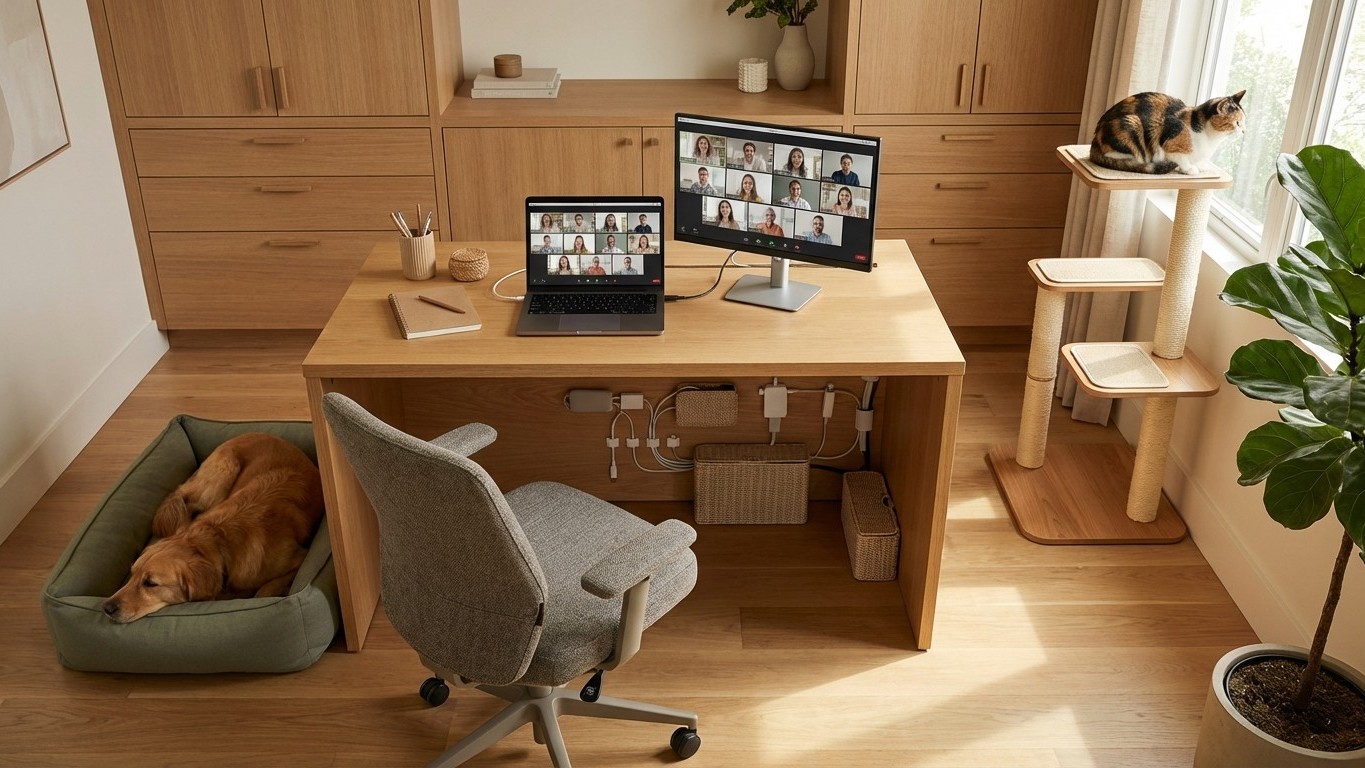
Picture this: you’re three minutes into a video call with a client when your dog charges through the door, or your cat decides your keyboard is the ideal nap spot, right on the mute button. Sound familiar? For the roughly one in three American remote workers who share their home office with a cat, a dog, or both, this isn’t an occasional comedy. It’s Tuesday morning. Building a genuinely functional home office pet friendly setup means thinking beyond a cozy pet bed tucked in the corner. It means cables secured against determined chewers, a chair that survives contact with claws, storage that keeps paperclips out of curious mouths, and daily routines that actually earn you two uninterrupted hours at a stretch.
Why a Pet-Friendly Home Office Is Worth Getting Right
The real dangers hiding in your setup
Pets are pretty much guaranteed to get tangled up in a disorganized web of cables. The threat is real: electrocution and strangulation are genuine risks when cables aren’t contained.
That’s not catastrophizing — that’s physics. A retriever mix weighing 60 pounds hitting a taut power cord at full gallop is a different situation than a toddler pulling at a lamp wire. Dogs generate force. Cats generate obsession.
Pets love chewing on things, so they may end up munching wires — which can result in damaged cables or even an electric shock.
Add to that the reality that
cat fur can clog up PC fans, resulting in expensive repairs and even loss of essential data, so keeping your PC elevated in an area where your cat’s fur is less likely to reach it is worth planning for.
The upside of a well-designed shared space
There’s genuine value to working alongside your animals — reduced stress, lower blood pressure, and a built-in reminder to actually take breaks.
When cats have appropriate outlets for climbing, scratching, and resting, workdays flow more smoothly. Fewer interruptions and a happier feline companion result from thoughtful furniture choices.
The same logic applies to dogs. The goal isn’t to banish your pets from your workspace, it’s to design a setup where everyone gets what they need. This is also the approach taken more broadly across pet friendly home design cat dog furniture, where the whole house benefits from the same intentional thinking you’ll apply to your office.
Cable Management: The First Priority in Any Pet-Friendly Setup
Why cables are magnetic to cats and dogs
Dangling cords are a magnet for curious paws.
For cats, it’s prey-drive — a swaying cable triggers the same neural pathway as a mouse tail. For dogs, it often comes down to texture and boredom: chewy, slightly warm, endlessly interesting.
Cats are attracted to dangling cables and may chew them, risking injury or equipment damage.
The solution isn’t willpower on your pet’s part. It’s removing the temptation entirely.
Practical solutions: from cable sleeves to desk positioning
Keep your setup sleek by using cable sleeves, under-desk trays, and cord boxes that hide wires. Switching to wireless keyboards and mice declutters your desk. Also, removes tempting cables.
For dogs specifically,
you should place cable sleeves wherever your pet can access the cords — these are hard shells that go over a cord and can’t easily be chewed.
Desk placement matters too.
Placing a home office desk against a wall reduces access to wires, and a corner desk creates a controlled space where cables stay inside the inner angle.
For cable runs that have to travel along the floor,
use cable organizers to consolidate cords and consider cord covers or conduits that can be attached to baseboards or under the desk. For additional safety, apply bitter apple spray to cords — a safe but unpleasant-tasting deterrent for most cats.
Standing desks require extra attention:
a height-adjustable frame must guide cords along the lifting column, with clips and trays keeping cables moving safely. An electric standing desk should have a mounted power unit under the desk surface rather than on the floor.
Choosing the Right Office Chair When You Have Pets
The material question: what actually holds up
Choosing the right material is the single most important decision for a pet-friendly office chair. The ideal material must balance durability, cleanability, and comfort. A common mistake is prioritizing soft, plush fabrics for initial comfort, which often become magnets for pet hair and are difficult to clean.
The truth is more nuanced than “leather good, fabric bad.”
Microfiber tends to be the best all-around performer for households with both cats and dogs.
Microfiber is scratch-resistant because it is a very tightly woven material with no tiny holes that cat’s claws can hook onto. The high density of the texture makes it durable even if a cat attempts to scratch it, and it’s a cat-hair resistant material since hair won’t get stuck into the texture.
For heavy shedders,
smooth, wipeable surfaces like PU leather work better for shedders, while tight-woven microfibers suit scratchers.
Mesh backrests breathe well but carry a risk:
mesh provides excellent ventilation but can be susceptible to snags and tears from sharp claws.
A frequent misconception is worth addressing directly:
genuine leather is often assumed to be the ultimate pet-proof material, but while high-quality leather is durable, its smooth, uniform finish makes every scratch visible. A high-grade, textured PU leather or a tightly woven synthetic microfiber often performs better, as these materials are adept at hiding minor abrasions and are significantly easier to clean.
Beyond the upholstery: floor casters and maintenance
The wheels matter more than most people think.
Consider the casters — if you have hardwood or tile floors, opt for hard-floor casters made of a softer material to prevent scratching and ensure smoother, quieter rolling.
Quieter also means less startling for a napping dog nearby. As for maintenance,
use a lint roller or a vacuum with an upholstery attachment at least once a week to remove accumulated pet hair, which prevents it from getting embedded in the fabric or mechanical parts.
Pair that habit with
regular nail trims for your dog or cat, keeping their nails trimmed is one of the most effective ways to prevent accidental punctures and scratches.
For a broader look at how upholstery choices connect to the rest of your living space, the guide on pet friendly living room design with cats and dogs covers fabric selection for sofas and area rugs using the same durability framework.
Smart Storage: Protecting Your Stuff (and Your Pet)
What goes in a drawer stays safe
Cats can be notorious for knocking over objects and playing with items that catch their eye, pens, paper clips, and other small office supplies, which can be dangerous if swallowed.
The answer is closed storage, full stop.
Keep all small items and important documents in drawers and cabinets that your cat cannot open. Use magnetic locks if necessary. Consider using scanning and digital filing solutions to minimize the amount of paper and other enticing materials within reach.
The same applies to office chemicals:
keep all office supplies such as paperclips, staples, pens, toner cartridges, ink, and glue tucked away in a drawer, well away from curious paws and noses.
DIY and design-forward approaches
Hidden wiring, closed storage, durable materials, and clear floor paths protect animals and devices equally.
A wall-mounted shelving system is one of the best investments you can make: documents and accessories go above nose-height, and you reclaim floor space that your pet can actually use.
Adopting a minimalist approach to your office design, removing clutter and anything breakable that could be knocked off by a paw or wagging tail, makes the whole room easier to manage.
For plants:
avoid peace lilies, ivy, dieffenbachia, pothos, jade, aloe vera, and ZZ plants — all of these are toxic to cats and dogs.
Instead, reach for
pet-friendly plants like spider plants, areca palms, and Boston ferns, which are safe and easy to care for.
Anti-Interruption Routines: The Behavioral Side of Pet-Proofing
Read your pet’s clock, not yours
Most interruptions follow a predictable pattern. Dogs tend to peak in energy about 20 minutes after a meal, and again around the time they expect a walk. Cats go through play bursts triggered by sounds, light shifts, or simply the sight of you moving.
Developing a schedule for feeding and playtime is one of the steps recommended by trainers to help pets that have anxiety. Meeting your pet’s basic needs in predictable ways means they’re more likely to relax while you’re occupied.
Front-load the energy expenditure:
for dogs, regular exercise should include their usual walk and possibly also a game such as tug-of-war or fetch. For cats, it may mean an interactive activity such as hide-and-seek or time with wand toys.
A tired dog during a 10am call is worth thirty minutes of pre-work fetch.
Designing the dedicated pet zone
Designating a pet area in your home office is a great idea if you have enough space. Consider closing this area off with pet barriers. This way, your furry friend can have a place to relax and have fun without getting in the way of your work — and smart toys in this area keep the fun going.
For cats specifically,
if your kitty loves being up high, invest in a tall cat tree or wall-mounted cat shelf to keep in your office, they can find a resting place that’s not your lap while still being comforted by your presence.
The ritual matters as much as the furniture.
Establish a daily ritual: before starting work, pet them, place them in their designated spot, and return to your tasks. Consistently redirect them back whenever they wander onto your laptop — over time, they’ll associate their spot with bonding time and naps.
For dogs,
keeping routines regular helps both pets feel secure, and stimulating both pets through mental and physical activity reduces unwanted behaviors.
A food puzzle filled at 9am can buy you ninety minutes of focused work.
Use a snuffle mat for offering treats or dry food, or stuff a puzzle toy with plain yogurt, peanut butter, or their meal for a fun and delicious challenge that will keep your dog busy and mentally stimulated.
The ASPCA recommends this approach specifically for keeping pets engaged without requiring your attention. It’s not bribery, it’s enrichment design.
Ergonomics, Décor, and the Finishing Details
Materials and surfaces that survive daily wear
The desk itself warrants attention beyond cable management.
A solid wood desk with a water-resistant finish handles daily wear better than thin boards. Solid wood legs add weight and stability when a cat jumps onto the desk surface, and a walnut or hardwood desk is easier to clean and traps less fur.
For the floor,
your office’s flooring should also be pet-friendly — choose a flooring type that won’t scratch, stain, and is easy to clean. Hardwood, tiles, and vinyl are ideal choices.
If you want a rug underfoot (helpful for rolling chair noise), choose low-pile options with tight weaves. Deep-pile rugs trap fur at a rate that will genuinely test your relationship with your vacuum.
The whole-home perspective
The office is rarely isolated from the rest of the house. A dog who knows there’s a well-designed leash station at the front door transitions more calmly between outdoor time and your work hours, which directly reduces mid-morning energy explosions in your office. The article on pet friendly entryway design dog leash station explores exactly how to build that transition zone. For a room-by-room view of how all these principles connect, pet friendly living room design with cats and dogs maps the same logic across every space in your home.
Keep your desk surface clear of objects at the edge.
Anything that’s on your desk is at risk of being ingested, knocked off, broken, or otherwise harmed. It’s up to you to ensure your office is risk-free — remove objects that can be hazardous, like paperweights, ink pots, glue, and even earbuds.
A desk with a built-in cable channel, closed drawers, and a dedicated drawer for tech accessories isn’t just tidy, it’s structurally safer for a home that includes animals.
FAQ: Your Pet-Friendly Home Office Questions, Answered
How do I stop my cat or dog from playing with desk cables? The most reliable method combines physical containment with deterrence. Use cable sleeves, cord boxes, and under-desk trays to eliminate dangling cords. Route cables along walls using adhesive clips or conduit channels. For dogs, hard plastic cable sleeves are the most durable option. For cats, bitter apple spray on accessible cords adds a chemical deterrent. Switching to wireless peripherals eliminates a large portion of the problem at source.
What office chair fabric works best with cats and dogs? Microfiber and PU leather are the strongest general-purpose choices. Microfiber resists claw-hooking because of its tight weave, repels pet hair, and handles spills at the surface layer. PU leather wipes clean in seconds but shows scratches more readily than textured microfiber. Avoid deep-pile fabrics, velvet (despite its scratch resistance, it clings to fur), chenille, and open-mesh bases if you have a clawing cat.
How do I keep my pet from interrupting work at critical moments? Pre-work exercise is your single most effective tool. A well-walked dog or a cat who’s had a morning play session is dramatically less disruptive than one who saved all their energy for your 10am meeting. Build a designated spot close to you, stocked with a puzzle toy or a warm self-heating mat. For video calls, close the door and leave a chew or stuffed Kong on the other side.
Which storage solutions protect accessories from pets? Closed-front drawers and cabinets with simple magnetic or lever latches. Dogs can learn to open push-to-open mechanisms; magnetic closures require thumbs. Wall-mounted shelving for documents and important supplies. Scan paper documents to reduce the volume of chewable material at desk level.
The home office is often the last room pet owners think to redesign, and the first one where cohabitation actually breaks down. Getting the cable management, chair material, storage discipline, and morning routine right doesn’t just protect your equipment. It changes the texture of your working day. Which part of your current setup is already working for your animals, and which is silently working against you?