
The Asian hornet (Vespa velutina) has been spreading across Europe since a single mated queen arrived in France in a container of pottery from China in 2004. Two decades later, the invasion is still accelerating, and scientists just handed us an unexpected piece of the puzzle. The answer involves a bird, a much-maligned tree, and a complete rethink of what “invasive” even means.
Key takeaways
- A bird exists that’s perfectly equipped to hunt and destroy Asian hornet nests—but hardly anyone knows it
- The solution might be hiding in a tree type that experts have been aggressively clearing for decades
- One surprising scientific finding could completely change how we manage forests and fight this invasion
A predator with no rivals
With no natural predators and a voracious appetite, a single Asian hornet nest can consume over 11 kilograms of insects in one season, including bees, wasps, spiders, and other pollinators. That 11 kilograms might not sound alarming until you consider the scale: in France, Asian hornet colonies are believed to cause 20 to 50% of honeybee deaths. Entire apiaries gutted. Beekeepers walking away from the profession. For fruit growers and beekeepers, the hornet’s presence can be catastrophic, disrupting pollination and decimating colonies.
The Asian hornet’s status as a specialist predator of the European honey bee (Apis mellifera) has caused the most anxiety. Pollinators, including honey bees, contribute an estimated €22 billion each year to European agriculture and pollinate over 80% of the continent’s crops and wild plants. Research suggests that the estimated economic impact of the loss of bee colonies in France could amount to €30.8 million per year, and the annual cost of attempting to contain Asian hornets could reach €11.9 million in France, €9.0 million in Italy, and €8.6 million in the UK. These are not abstract numbers. They represent failing harvests, collapsing ecosystems, and a pollination chain that underpins much of the food on your table.
Against this backdrop, scientists have been searching desperately for a biological solution. Traps, pheromone lures, transmitters attached to individual hornets to locate nests, the traditional method for locating hornet nests is often a labour-intensive process, with teams of inspectors spending days tracking feeding hornets from bait stations, marking them with colored pens, timing their return visits, and estimating flight paths. None of these approaches qualifies as an ecological fix. What the equation was missing was a natural predator. And it turns out there is one.
The bird that eats hornets for breakfast
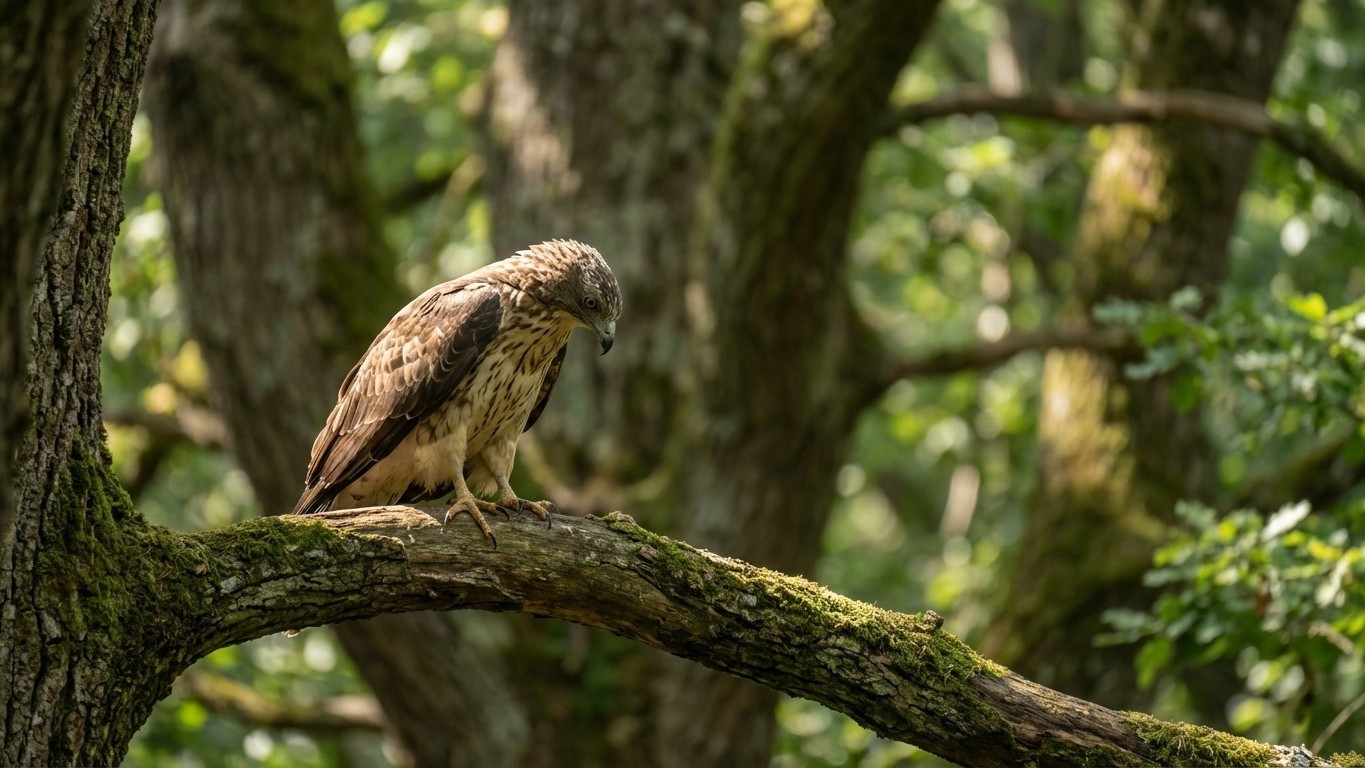
The European honey buzzard (Pernis apivorus) is a specialist feeder, living mainly on the larvae and nests of wasps and hornets. It is the only known predator of the invasive Asian hornet. That status as “the only one” carries enormous weight in the context of an invasion with no natural brake. The bird is equipped with long toes and claws adapted to raking and digging, and scale-like feathering on its head, thought to be a defense against the stings of its prey. Honey buzzards are also thought to have a chemical deterrent in their feathers that protects them from wasp attacks. Evolution, built this raptor to do exactly this job.
The first scientific confirmation of honey buzzards actively predating on Asian hornet nests came in 2019 from Spain. Researchers reported the first case of predation on the nests of Asian hornet Vespa velutina by the European honey buzzard Pernis apivorus. Additionally, this raptor could be considered as a potential biocontrol agent, because it is possibly the only European bird species capable of destroying active Asian hornet nests during the period of maximum generation of individual insects. Since then, the research has only deepened.
A landmark study published in Pest Management Science in January 2025 quantified what honey buzzards actually do to hornet populations around their nests. The average distance from raptor nests to attacked hornet nests was about 1,235 meters, with 89.3% of attacked nests destroyed. Researchers found a significant decline in hornet worker abundance within 1,000 meters of a raptor nest, and this impact intensified as the breeding season progressed. The authors concluded that these raptors should be considered allies in the fight against hornet populations and included in integrated pest management programs as a native controller of the pest.
Stop pulling out that tree
Here is where the story gets genuinely counterintuitive. The European honey buzzard needs mature forest to breed, large trees, structural complexity, multiple canopy layers. In southwestern Europe, that habitat is increasingly provided by one tree considered invasive and routinely cleared: the eucalyptus (Eucalyptus globulus).
A second major study, also published in Pest Management Science in 2025, examined honey buzzard breeding preferences across eucalyptus plantations in southwestern Europe. Vegetation and topography were the most influential factors affecting habitat preferences, especially around nests. Honey buzzards preferred large nest trees within forest patches exhibiting high structural complexity and maturity. The punchline? Eucalyptus plantations can offer suitable breeding habitats for honey buzzards if managed appropriately, and this finding is crucial for guiding forest management decisions aimed at enhancing high-quality breeding habitats for honey buzzards and encouraging their regulatory services against yellow-legged hornets.
So eucalyptus, widely dismissed as a water-hungry ecological nuisance, aggressively cleared in many regions — may, if managed well, harbor the very bird capable of suppressing the Asian hornet’s spread. Two invasive species, one of which accidentally shelters the answer to the other. The study also revealed a positive relationship between the structural complexity of forest plantations and their capacity to deliver regulating ecosystem services, with the likelihood of occurrence and the density of breeding pairs of honey buzzards increasing with greater structural complexity of eucalyptus forest plantations.
The limits of a natural ally
None of this means the honey buzzard will single-handedly stop the Asian hornet. The researchers are careful about that. The predatory effect of the honey buzzard affects the reproductive performance of Asian hornet colonies, decreasing the density of workers over distance and time, but the effect is local, operating within roughly a kilometer of the raptor’s nest. Scale matters. According to researcher Eric Darrouzet of the University of Tours, “the hornet’s playground is now too large in Europe” and the prospects for complete eradication are virtually nil.
The honey buzzard itself is under pressure. Illegal hunting and persecution along migration routes in parts of southern Europe, the Mediterranean, and the Middle East remain a major source of anthropogenic mortality, while loss of mature woodland reduces nesting opportunities. The bird is a long-distance migrant, spending only the summer months in Europe for breeding before heading to tropical Africa for winter. That means its window of predatory impact is seasonal, while the hornets stay active year-round.
Still, the strategic implication is real. Protecting honey buzzard populations, preserving mature forest patches, and rethinking blanket policies against eucalyptus clearance in areas where this raptor breeds could, area by area, reduce hornet pressure on pollinator populations. Studies show that honey buzzards mainly consumed vespids (82% of their prey), with common wasps and Asian hornets being almost the only two vespid species consumed, the invasive hornet was the second most consumed prey. This bird is already eating the enemy. The question is whether we manage the landscape in ways that let it keep doing so — or clear the forests that make it possible.
Sources : scijournals.onlinelibrary.wiley.com | scijournals.onlinelibrary.wiley.com