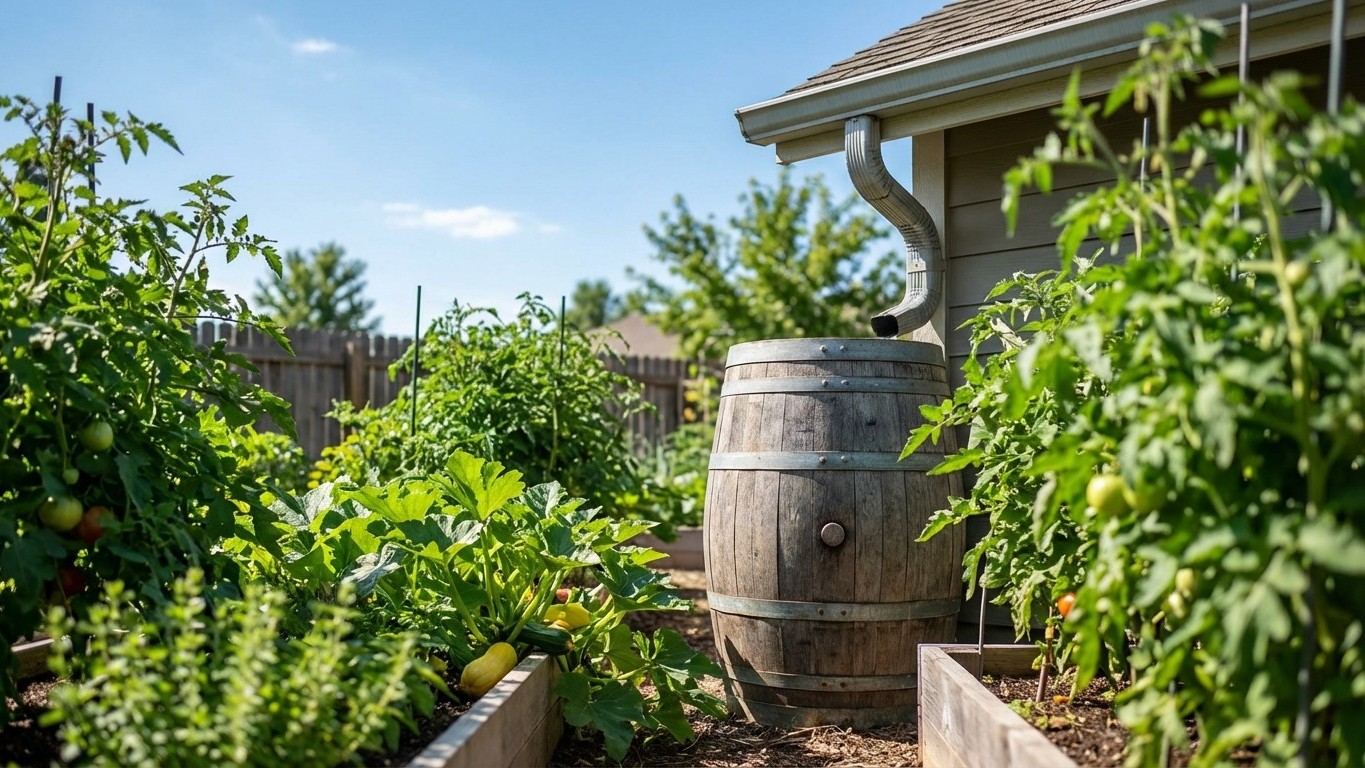
You could call it gardening without guilt. Picture a sun-drenched July afternoon in Phoenix, thermometer creeping past 100 degrees, lawns crisp and brittle, sprinkler systems gasping. Yet, tucked behind a modest fence, my vegetable patch pulses green, grape tomatoes swelling in clusters, kale leaves jostling for room. Nothing extravagant, just stubbornly alive. The twist? I haven’t paid a dime to water it in over five years.
This garden’s secret doesn’t feel futuristic or complicated. It’s deceptively old-school: rainwater harvesting. The notion may conjure images of rain barrels and clunky DIY rigging. For me, it started with a single barrel tucked under a sagging downspout, an experiment more than a mission. At the time, a summer’s water bill had arrived, echoing the price of a weekend getaway. Something had to give.
Key takeaways
- What if your garden never needed tap water again?
- Discover the ancient Secret That Transformed urban gardening.
- Learn the surprising impact of collecting rain on your plants and wallet.
What Rainwater Did That Tap Water Never Could
The shift was immediate, not just on my monthly expenses but in the texture of the soil itself. Rainwater carries a softness, even a smell, that city water can’t match. No chlorine tinge, no hardness. Plants seemed to respond as if finally breathing freely. That season’s tomatoes tasted almost wild, the way you imagine they did before supermarkets grew them for shelf life instead of flavor. Coincidence? Maybe. But I’ve grown addicted to the ritual: scanning the sky, listening for the first drops, angling barrels for maximum catch. There’s pleasure in the dependence, a kind of gardening weather forecast written in puddles and pooling gutters.
The math still makes me sit back. A single inch of rain on an average roof can yield over 600 gallons, enough to fill half a dozen barrels or more. For context, that’s more water than most families use in a week for showers and dishes combined. Even in Texas, where downpours hit and tumble away, the numbers add up startlingly fast. Once you look at that glistening overflow after a storm, the idea of letting it all stream uselessly to the curb feels borderline irresponsible.
Setting Up: More Practical Than Perfect
There’s a temptation toward perfection in home improvement, the lure of hyper-engineered solutions. Forget that. My second barrel came from a bakery, a battered blue drum that once ferried vanilla extract. With a spigot cut near the base, it became the star of my garden hose. I hid it behind a bush, barely visible from the street. Later, I added two more, daisy-chained with old garden hoses and a few spare cinderblocks. Rainwater doesn’t care for symmetry; it cares for gravity.
The magic ingredient? Patience. First summer after switching, I ran out mid-July, barrels bone-dry during a two-week rainless stretch. Instead of retreating to tap water, I doubled down, adding an overflow channel for capturing late-night thunderstorms. I learned the rhythm of my microclimate, adjusting what I grew to match rainfall as much as sunlight. No tropical ferns, but Mediterranean herbs and sunflowers thrive in sync with what nature provides.
More Than Saving Money : A Shift in Perspective
Cost-cutting is an obvious motive, but soon it blends into something subtler. Water from the tap feels infinite, turn the handle, fill the can, repeat. Rainwater changes that math. Each gallon tracked in a barrel counts for something. When you see the Harvest dwindle in a dry month, you’re forced to prioritize, to become selective about what deserves moisture. My cucumbers share, but the tolerant sage waits it out. The garden becomes as much about restraint as abundance.
This sense of stewardship seeps quickly into other corners of life. I found myself reusing graywater for ornamental beds, switching from overhead sprinklers to drip irrigation, researching drought-resistant berry varieties. My household’s landscape gradually morphed into a patchwork of edibles and low-water natives, not out of environmental piety, but out of frugality that grew satisfying. Hard to overstate how much it matters when 40 out of 50 U.S. states expect water shortages in the next decade. The backyard becomes a test plot for how Neighbors might, eventually, have to adapt en masse.
The Ripple Effect : Lifestyle, Not Just Utility
Rainwater barrels quietly prompt conversations with everyone who visits. Kids ask whether you’re making moonshine. Friends marvel at how the lettuce resists wilting in a heatwave. Even the mail carrier, pausing and glancing at my odd array of blue drums, inquires if tomatoes taste better with “real water.” There’s a neighborly impulse in this kind of visible eccentricity. Each summer, I lend buckets to new converts down the block and trade tips on repurposing barrels from bakeries, breweries, and car washes.
Critics will note, rightly, that rain barrels alone won’t feed the world. Stormwater systems in dense urban grids may complicate things, and large gardens require more storage than a suburban roof can provide. But changing one household’s usage maps onto a larger trend: what we do individually shapes neighborhood culture, even city policies. If rainwater harvesting once sounded fringe, it’s mainstream now in Austin, Portland, parts of Oakland, any city where storm drains overflow while lawns dry up.
So where does it go from here? Technology inches forward, making underground cisterns sleeker, filtration smarter, smart systems ubiquitous. Maybe we’ll soon see apps that predict how long a barrel will last given next week’s forecast, or neighborhood sharing economies for surplus water during the wet season. Or maybe, the most resilient settings will still hinge on the same basics: a barrel, a spigot, and a sense of seasonality. If gardening teaches anything, it’s that sustainability often lies in rediscovering simple things, waiting for rain, counting the drops, and letting the garden teach you the difference between enough and excess.