
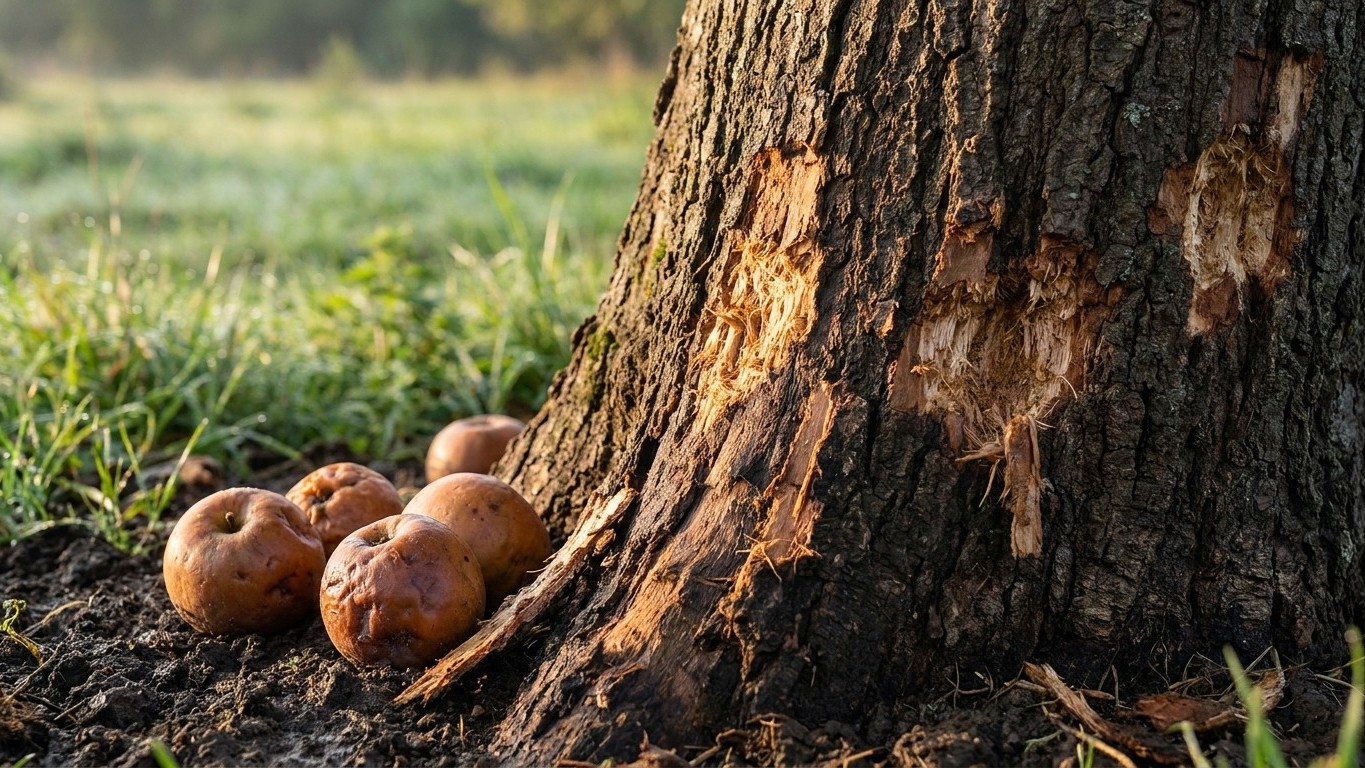
Skipping the September pickup felt like a win at the time. No bending, no bruised knuckles hauling a five-gallon bucket, no sticky hands from split plums. By the time the first frost hit, though, the ground under both trees looked less like a lawn and more like a crime scene, and the bark at the base of every trunk told me exactly why.
What I found: shredded strips of bark chewed away in ragged patches, a few inches up from the soil line, running almost all the way around one of the plum trunks. That’s not weather damage. That’s teeth.
Key takeaways
- What looked like a time-saving decision in September became a visible disaster by first frost
- Rotting fruit is a rodent magnet that leads directly to bark damage and tree girdling
- Fallen fruit you ignore becomes a breeding nursery for next year’s orchard pests
Rotting fruit is a dinner bell for rodents
Windfall fruit doesn’t just sit there quietly decomposing. It ferments, softens, and turns into an easy calorie source right when small mammals are stockpiling for winter. Mice and voles read that as an invitation, and once they’ve moved in under the canopy, the trunk itself becomes the next course. Michigan State University Extension notes that nearby corn or soybean fields can provide a fall food source for mice who will then move into the orchard and feed on trunks and roots, and a home orchard with a carpet of rotting apples works the same way, just on a smaller scale.
Voles are the sneakier culprit. Pennsylvania State University Extension explains that damage from pine voles is harder to detect because it occurs underground as they consume small roots, girdle large roots, and eat bark from the base of trees, and by the time orchardists note weak, unhealthy trees, the damage is already extensive. Meadow voles leave a more obvious calling card. According to Penn State, the most easily identified sign of meadow vole presence is a system of surface runways in the grass, created by their feeding activities and kept free of vegetation, generally about 1.5 inches wide. I found two of those runways leading straight from the fruit pile to the trunk. Coincidence, it was not.
Unmowed grass makes the situation worse, because it gives rodents cover right up to the bark. Utah State University Extension is blunt about it: leaving grasses un-mowed around trees creates rodent habitat, and in the winter, if populations are high and other food sources are scarce, rodents will eat the bark from fruit trees, which will girdle and kill the trees. Pile windfall fruit on top of that tall grass and you’ve built a rodent buffet with a bed included.
The insects didn’t wait for frost either
Bark damage was the visible headline, but the real story started months earlier, back when those plums and apples first hit the ground. Plum curculio, one of the most common pests of backyard stone and pome fruit, lays eggs in developing fruit that eventually drops. University of Maine Cooperative Extension describes the cycle plainly: the eggs hatch into larvae and feed inside the fruit and seed cavity, causing infested fruit to drop in early summer, and plum curculio larvae move from fallen fruit into soil, where they pupate and emerge as adults from late July into September. Every windfall I left rotting was essentially a nursery, delivering next year’s curculios straight into the soil under the tree.
Apple maggot works on a similar principle, and so does codling moth in orchards where it’s established. By ignoring the drops all August, I wasn’t saving myself work. I was running a breeding program.
Mummies, mold, and next spring’s problem
Fruit that doesn’t get eaten by wildlife or insects eventually shrivels into what growers call a “mummy,” and mummies are trouble long after they stop looking like food. Mississippi State University Extension warns that mummified fruit is a favored location for many diseases to overwinter, and these dried, unappetizing mock fruits might be hanging from the tree, lying on the ground, or, worse, partially buried in the soil near the tree. Left in contact with damp soil, those mummies can go a step further. The extension service notes that infected fruit mummies that have been buried or partially buried in the soil may produce small, brown, cup-shaped mushrooms that produce a different kind of spore that infects the trees. Their advice is straightforward: retrieving and destroying all mummies will be very beneficial.
Ohio State University’s guide to home fruit plantings makes the same point about brown rot specifically. The brown rot fungus overwinters on old mummified fruit left hanging on the tree or on the ground, so after harvest or in the spring before the buds open, collect and destroy all mummified fruits beneath the trees and any that remain hanging in the trees. I’d unknowingly set up an infection reservoir that would greet my trees again come bloom time, right on schedule.
What actually goes on the fall checklist now
The fix isn’t complicated, it’s just consistent. Fallen fruit needs to come off the ground on a rolling basis through August and September, not in one dramatic cleanup after frost. Mowing the area around each trunk short removes the cover that lets rodents approach bark without being exposed. A physical guard, plastic or wire mesh wrapped loosely around the lower trunk through winter, blocks gnawing even if a few voles are still working the property line.
None of that fruit needs to go to waste, either. Windfalls that are still firm can be cut for cooking within a day or two of dropping; anything soft, split, or clearly wormy should go into a hot compost pile (Alameda County’s UC Cooperative Extension notes that to kill pathogens compost piles must be at least 131°F or higher) or straight into the trash, never left to slowly rot where the tree can see it. My trunks have healed some since I started tree guards last winter, but the scars are still there, a permanent reminder that a few minutes of daily fruit patrol beats a season of damage control every single time.
Sources : ucanr.edu | extension.umaine.edu