
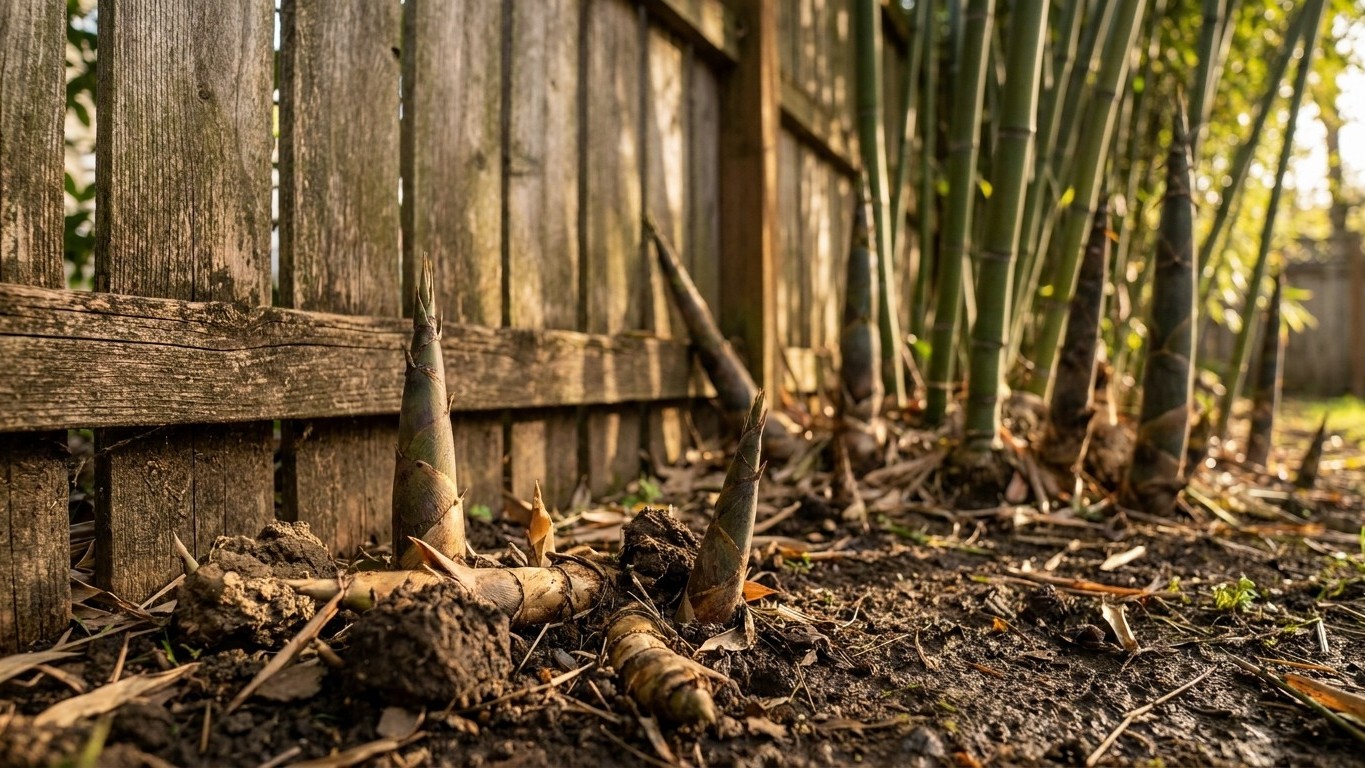
Three summers. That’s roughly how long a stand of Phyllostachys bamboo needs before its underground rhizomes stop behaving and start colonizing whatever soil they find, fence or no fence. Many species require 3 years of growth before they begin to spread, and in some situations it’s easiest to wait and see if there is going to be a problem before implementing containment measures. By year three, that privacy screen you planted has usually decided the fence line was never really a boundary, it was just a suggestion.
What’s popping up on the neighbor’s side isn’t a new plant. It’s the same organism, extending itself through a rhizome network that never stopped moving once it left the nursery pot.
Key takeaways
- Running bamboo doesn’t stop at property lines—rhizomes can spread 15-20 feet in just a few years, traveling toward moisture and irrigation systems
- Courts have ordered bamboo removal, awarded damages, and issued injunctions; some states now ban the species outright due to invasive spread
- A 30-inch root barrier alone won’t work—mulch layers and seasonal monitoring are essential, or your ‘should have known’ negligence becomes a lawsuit
Why Phyllostachys Ignores Property Lines
The botanical explanation is almost mechanical in its simplicity. Running bamboos produce long, thin rhizomes that travel horizontally through the soil in all directions, and each rhizome can travel several feet in a single growing season before sending up a new culm, making the resulting growth pattern aggressive, wide-spreading, and capable of covering a large area quickly. Phyllostachys isn’t the exception here, it’s the textbook case. Most of the ornamental bamboo species commonly planted in the United States, including Phyllostachys, Pleioblastus, and Pseudosasa, are runners.
Under the right conditions, the numbers get almost absurd for a plant most people bought to hide a chain-link fence. In warm climates with ample water and loose soil, a bamboo planting that is not contained can spread 15 to 20 feet from its original location within a few years, and the rhizomes actively seek moisture and can travel significant distances to reach irrigation, drip lines, or neighbors’ watering systems. That last detail explains a lot of “mystery” bamboo shoots that show up nowhere near where anyone expected them, usually right next to a sprinkler head or a soaker hose.
Depth matters too, though maybe not the way people assume. The bamboo root system is largely shallow by nature, with the majority of fibrous feeder roots concentrated in the top 12 to 18 inches of soil, but rhizomes can extend down to 2 to 3 feet in depth depending on soil conditions and bamboo species. The real threat was never vertical. It’s lateral, patient, and invisible until a culm breaks the surface somewhere it has no business being.
The Legal Line You Just Crossed
Here’s where a landscaping choice quietly becomes a legal exposure. When running bamboo crosses a property line and damages a neighbor’s land, the bamboo owner can face legal liability under the doctrine of private nuisance, an unreasonable interference with someone else’s use and enjoyment of their property. Courts don’t treat this as a hypothetical. Courts have ordered neighbors to remove encroaching bamboo, awarded money damages for the cost of removal and repairs, and in some cases issued injunctions ordering the spread to stop.
Trespass claims work a little differently than most people expect, since nobody has to set foot on anyone’s land for the theory to apply. If bamboo roots, rhizomes, or shoots crossed onto your property, that can support a trespass claim because the law does not require the person themselves to physically step onto your land if they caused the intrusion of an object there. Liability generally hinges on two questions. Liability usually turns on two questions: did the owner know (or should they have known) the bamboo was spreading, and did they fail to take reasonable steps to contain it?
A few states have stopped waiting for lawsuits to sort this out. Connecticut passed legislation specifically targeting the genus responsible for most of these disputes. Public Act No. 13-82, An Act Regulating the Planting and Sale of Running Bamboo, was passed by the Connecticut Legislature in 2013 to regulate certain bamboo species that spread by long, running, underground rhizomes, since when established without appropriate buffers or barriers, these species have the potential to encroach onto neighboring properties, where they may become difficult to remove. New York went further on Long Island. Running bamboo was now a prohibited plant in New York State due to its highly invasive characteristics and the extreme difficulty to eradicate bamboo that had spread. A Shelter Island case even involved neighbors suing over bamboo that had been planted years before the ban took effect, which tells you how long these underground disputes can simmer before anyone notices the damage above ground.
The good news, if there is any, is that self-help exists without needing a courtroom. Property owners generally retain the right to cut back whatever crosses onto their side, right at the line, no permission required.
Containing It Before It Contains You
None of this means bamboo has to go. It means the barrier has to be taken seriously, not treated as an afterthought. A high-density polyethylene root barrier installed at the right depth and angle actually works, stopping lateral rhizome spread dead when installed 24 to 30 inches deep with the top edge slightly angled outward. Nurseries that specialize in the genus back that up. We typically recommend using the 30″ x 0.060″ barrier for most plants in the Phyllostachys genus.
The trick that catches most first-time growers off guard is the mulch layer, because a barrier alone doesn’t stop rhizomes, it just redirects them upward where you can see and deal with them. The use of bark mulch or other loose, organic substances spread 2 to 5 inches deep over the top of your planting area within the barrier encourages the rhizomes to spread just inches below the surface, which turns an invisible underground problem into a visible, manageable one. That’s the whole strategy in a sentence: force the plant to show its hand before it reaches the neighbor’s tomatoes.
Barriers aren’t a plant-it-and-forget-it fix, either. The outer edge should be checked by cutting into the soil with a sharp spade two to three times per year in the summer through fall during the bamboo’s active spreading phase, removing any rhizome attempting to spread out. Skip that annual ritual for a couple of seasons, and the barrier you installed with such care becomes exactly the kind of “should have known” evidence a neighbor’s lawyer would love to cite.
If the bamboo has already crossed the line, the fix isn’t glamorous but it works: dig a trench along the property boundary, sever every rhizome you find, and install a barrier retroactively rather than hoping the plant reconsiders its ambitions. Skipping that step doesn’t save time, it just moves the reckoning to next August, when the shoots come back taller and the conversation with the neighbor gets harder to have.
Sources : answers.justia.com | sgrlaw.com