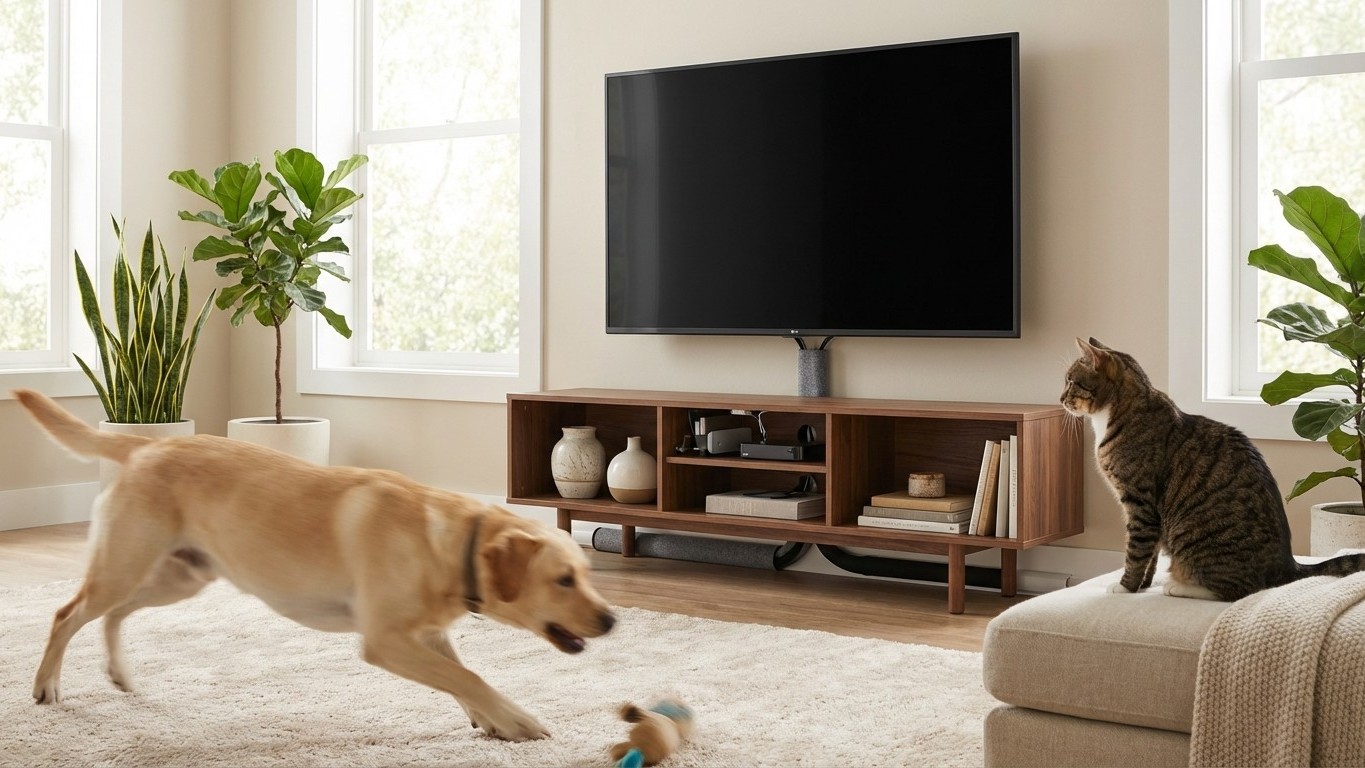
Your living room looks beautiful. The TV stand is a design statement, cables tucked away, a decorative object balanced just so on the top shelf. Then your Labrador cuts a corner during evening zoomies, and suddenly that carefully curated setup is a two-inch wobble away from catastrophe. Or your cat, the one who watches bird videos with you every morning, decides an HDMI cable is actually the most interesting thing in the house. Sound familiar?
An estimated 71% of U.S. households now share life with at least one pet
, yet most furniture on the market is still designed as if animals don’t exist. The TV stand and media console are especially vulnerable: they concentrate cables, electronics, and tempting nooks all in one spot, right at paw level. Getting this piece of furniture right is less about aesthetics and more about engineering a peaceful coexistence. Here’s how to do it without sacrificing your living room’s soul.
Why Cables Are the First Problem to Solve
Electrocution from chewing on live electrical cords is the single most common type of electrical injury in dogs and cats.
That’s not a scare tactic — it’s a clinical reality backed by veterinary emergency services. The TV corner, with its cluster of power cords, HDMI cables, and streaming device chargers, is essentially ground zero for this risk.
The cords that go to the TV, and all related devices, are very tempting for a cat to chew on, regardless of its age.
The injuries go beyond a simple shock.
Two categories of injuries result from electrical cord injuries. The first is a local injury, typically a thermal burn, occurring at the site of contact with the electrical current — in animals that bite the cord, these burns are found in the mouth, lips, gums, and tongue.
Systemic injuries are due to the electrical current coursing through the animal’s body and can manifest as vomiting, muscle spasms, seizures, respiratory distress, irregular heart rate, or cardiac arrest.
The bill for emergency treatment is no small matter either:
on average, the cost to treat an animal for electrical shock runs between $500 and $3,000.
Why do pets do it?
When pets get anxious, they look for ways to cope with stress — from moving into a new home to separation anxiety. If cords are easily accessible, they can become the target of stress relief.
Boredom and inactivity are equally common triggers: if your pet isn’t getting enough exercise, chewing on electrical cords can become a way to use pent-up energy.
Understanding the “why” helps you address the behavior at the source, but protecting the cords themselves is always the first line of defense.
Pet Friendly TV Stand Cable Management: Building the Right Setup
The smartest approach starts with the furniture itself.
A good pet friendly TV stand hides temptation. Built-in cable channels, rear cutouts, and grommets bundle cords so there’s less to chew.
This is a fundamentally different design philosophy than the typical open-back media console that lets wires dangle freely behind the unit. When shopping, look for these integrated features specifically, they’re increasingly common as manufacturers respond to the reality of pet-owning households.
Built-in cable channels, rear cutouts, and grommets bundle cords so there’s less to chew or swat. Ventilation holes or slatted doors keep consoles cool without leaving cabinets ajar.
That last point matters more than it seems: pet owners often leave cabinet doors slightly open for heat ventilation, which immediately creates an access point for curious paws. A stand with ventilated door panels solves both problems at once.
Accessory Solutions When the Stand Isn’t Enough
Even with excellent built-in management, some cables will still be exposed during transitions. Several product categories address this directly.
Pet cord protectors have evolved from afterthought plastic tubes to high-tech armor, and the current lineup is tougher, smarter, and less of an eyesore than ever.
Woven PET (polyethylene terephthalate) braid sleeves can bundle several cables together and resist significant chewing force, while split-loom tubing allows quick installation without disconnecting anything.
Quarter-round cable hiders provide cable paths at floor level, while cable organizer boxes contain socket extensions and cable clutter.
Wall-level raceways are another option —
self-adhesive half-round raceways can blend above baseboards or attractively cover cables dropping vertically from a wall-mounted TV.
The goal is to make every cable inaccessible, not just the obvious ones. Cats, in particular, will find the one wire you forgot.
For a complementary layer of deterrence,
coating power cords with vinegar or chili paste can repel most pets — the smell of vinegar alone is enough to keep many animals away.
Commercial bitter-apple sprays work on a similar principle. These should be viewed as a backup, not a primary strategy: the furniture and physical barriers should do the heavy lifting.
Doors, Drawers, and Keeping Curious Paws Out
Closed cabinets and drawers are your best friends when you live with curious paws. Doors keep consoles, remotes, cables, and electronic equipment out of reach.
But not all doors are equal when you have a determined cat or a dog whose enthusiasm outruns its coordination. The type of closure mechanism makes a real difference in daily life.
Push-to-open (touch-latch) systems are one of the cleanest solutions for pet households. There’s no handle to paw at, no lever to hook a claw around. The door opens only under direct, sustained pressure in the right spot — something a cat investigating with one paw rarely replicates accidentally.
Recessed pulls or smooth handles that won’t snag collars are preferable, and soft-close hinges, magnetic latches, and felt pads under décor prevent sudden bangs that might spook nervous animals.
Sliding doors present a more complex picture. They eliminate the risk of a swinging door hitting a pet, and they can’t be pulled open the same way as hinged doors — but a determined cat can sometimes work a sliding panel sideways if the mechanism lacks resistance.
Securing cabinets with childproof locks or deterrents remains one of the most reliable management strategies.
Cabinet-specific magnetic latches, installed on the inside, require a magnetic key to open and are completely invisible from the outside, ideal if you want to preserve the clean lines of a modern media console.
For cats already in the habit of opening cabinet doors, the approach combines physical barriers with behavioral redirection.
Providing your feline pet with approved high places for jumping is a way to keep them off furniture surfaces and out of cabinets, a cat tree or jumping condo positioned near the TV area gives them a legitimate high vantage point that satisfies their instinct.
Stability: The Safety Issue Nobody Talks About Enough
Pets, especially cats, have a knack for finding their way into the most unexpected places. Cats may jump onto TV stands or shelves, causing the TV to become unstable or knocked over. Large dogs can also bump into furniture when playing or running around indoors.
A tipping TV stand is not just an expensive repair, it’s a genuine physical danger to any pet (or person) in the room when it goes.
Look for wide, low, or plinth bases rather than tall, narrow legs.
A lower center of gravity changes everything.
The best material for high-traffic homes is usually solid or engineered wood paired with metal, because you get stability, weight, and impact resistance without babying the surface.
Hollow-core or particle-board-only constructions shift under repeated impact, and a mid-sized dog can deliver considerable force on a good day.
Adding anti-tip hardware or wall anchors is especially important if you have climbing cats or active dogs.
Most well-designed media consoles now include an anti-tip strap in the box — use it. It takes five minutes and eliminates an entire category of risk.
Make sure the stand is deep enough that your TV isn’t perched near the edge — wall-mounting the TV above a stable, fully assembled stand gives you an extra safety layer and a cleaner look.
Wall-mounting the screen separately from the console is genuinely the gold standard for households with large or energetic dogs: the screen becomes completely immune to a tail-wagging collision.
Materials, Finishes, and the Practicalities of Living with Pets
The surface of your TV stand or buffet is going to be tested. Claws, damp noses, the occasional muddy paw that somehow cleared the usual barriers — all of it lands on the furniture.
Pet-focused home design is now a mainstream trend, with experts calling out durable, easy-clean materials as key to modern interiors. Mid-tone woods, warm taupes, textured beiges, and matte finishes hide fur and fingerprints better than jet-black gloss or pure white.
From a scratch-resistance perspective, laminate and thermofoil surfaces over a solid core outperform painted MDF when it comes to resisting claw marks. True solid wood has the advantage of being repairable — a light scratch can often be buffed out with the right oil or wax. Glass-front doors look elegant but invite nose-smudging and can crack if struck, making them better suited to households where the animals are older and calmer.
For high-traffic homes, the most durable TV stand materials are solid or engineered wood combined with metal. A sturdy wood frame with powder-coated steel legs provides weight, stability, and impact resistance.
On the cleaning side, keep it simple.
Quick weekly wipe-downs of handles and shelf fronts work best, using a slightly damp microfiber cloth and a gentle, finish-safe cleaner on laminate, sealed wood, or metal. Avoid harsh abrasives, scouring pads, or ammonia-based sprays, which can dull finishes over time.
Fur accumulates most in the ventilation gaps and along the base, a small handheld vacuum with a crevice tool is perfect for grabbing fur around baseboards, vents, or the plinth.
Design That Works for Both of You
There’s an assumption baked into most pet-proofing conversations that safety and style are in opposition. They’re not. The media console category has genuinely evolved: today’s most pet-considerate designs, with their solid bases, push-to-open hardware, integrated cable management, and low profiles, also happen to align with the clean, modern aesthetic that dominates interior design trends.
In multi-pet homes, some owners pair a long, low TV stand with a side pet zone, a cat tree on one side, a dog bed on the other, so everyone has a clear, calm spot.
This approach acknowledges what the pet is actually seeking (proximity, warmth, a view of the household action) and provides a sanctioned version of it. A cat that has an attractive perch next to the TV is far less likely to climb onto the stand itself. The same logic applies to the sofa zone, if you’re thinking about your entire living room ecosystem, a look at pet friendly home design cat dog furniture will give you the broader picture of how to make the whole space work.
For those who want to go further than a standard retail purchase, the DIY route opens real possibilities. Cable management boxes can be built into existing media consoles with basic woodworking, and custom magnetic latch systems can be retrofitted into older buffets. The investment is modest; the payoff, in peace of mind and preserved electronics, is not.
Installation, Habits, and the Long Game
How you position the stand matters as much as what you choose.
Choose a stand that keeps the TV center slightly above eye level when seated, then either wall-mount the TV or place it deep on the surface. This reduces the chance of a paw knocking the screen.
Position the stand so that the cable exit points face the wall, any gap between the back of the unit and the wall should be too narrow for a cat to squeeze into and investigate.
Give your cat a better option right beside the “forbidden” area — a tall scratching post or cat tree near the TV almost always helps. Reward them when they use it, and use a safe deterrent spray on the stand’s corners if needed.
This positive-reinforcement approach works with dogs as well: redirect the attention before correcting the behavior. Punishment alone rarely solves curiosity-driven behavior, it just creates anxiety.
The broader pet friendly furniture for cats and dogs conversation extends well beyond the TV stand, fabric choices, structural resilience, and easy maintenance are themes that apply to every piece in the room. If you’re also rethinking your seating, the criteria for a cat and dog friendly sofa share significant overlap with what you’d want from a media console: durability, cleanability, and no sharp edges that could harm an animal moving at full speed.
Frequently Asked Questions
How do I secure cables behind a TV stand when I have a dog or cat? Start with the furniture itself, choose a stand with built-in rear cable channels or grommets. For any cables that still exit the back, use woven PET braided sleeves or split-loom tubing to bundle and armor them. Wall-level cable raceways can route everything from the stand to the outlet along the baseboard, removing floor-level exposure entirely. If you want the best couch fabric equivalent for your floor setup, think of cable protection the same way: layered, durable, and resistant to sustained attention.
How do I stop my cat from opening cabinet doors on the TV stand?
Secure cabinets with childproof locks or deterrents.
Magnetic latches installed inside the door require a specific tool to open and are completely invisible. Push-to-open mechanisms eliminate the handle entirely, removing the paw-hook point of failure. If the cat is already in the habit, combine the physical lock with behavioral deterrents, citrus-scented spray on the cabinet fronts, and a cat tree nearby as a sanctioned alternative.
What materials resist cat scratching on a TV stand?
A truly pet-friendly TV stand resists damage, protects your tech, and keeps pets safe. That means scratch-resistant surfaces and sturdy construction.
Laminates with a matte finish and hardwood veneers over solid cores are the most practical. High-gloss surfaces show scratches more visibly and are harder to repair. Powder-coated metal legs resist scratching entirely and add structural stability. For a deeper look at material selection across all upholstered furniture, the guide on best couch fabric for pets cat dog covers the full performance comparison.
Is wall-mounting the TV better than placing it on a stand in a pet household?
By mounting the TV securely on the wall, it is completely out of reach from pets’ playful antics, reducing the risk of accidental damage or injury.
That said, you still need a media console for electronics, wall-mounting the screen alone doesn’t solve the cable or storage problem. The best approach combines a low, anchored stand with a wall-mounted screen, removing the top-heaviness that makes tip-overs possible.
The TV stand question is ultimately a microcosm of the larger project: building a home that actually functions for every member of the household, including the four-legged ones. Get the cables contained, the doors secured, and the stand properly anchored, and the living room stops being a daily negotiation between what looks good and what keeps everyone safe. What’s left is the more interesting question of how the rest of the room can meet the same standard.