
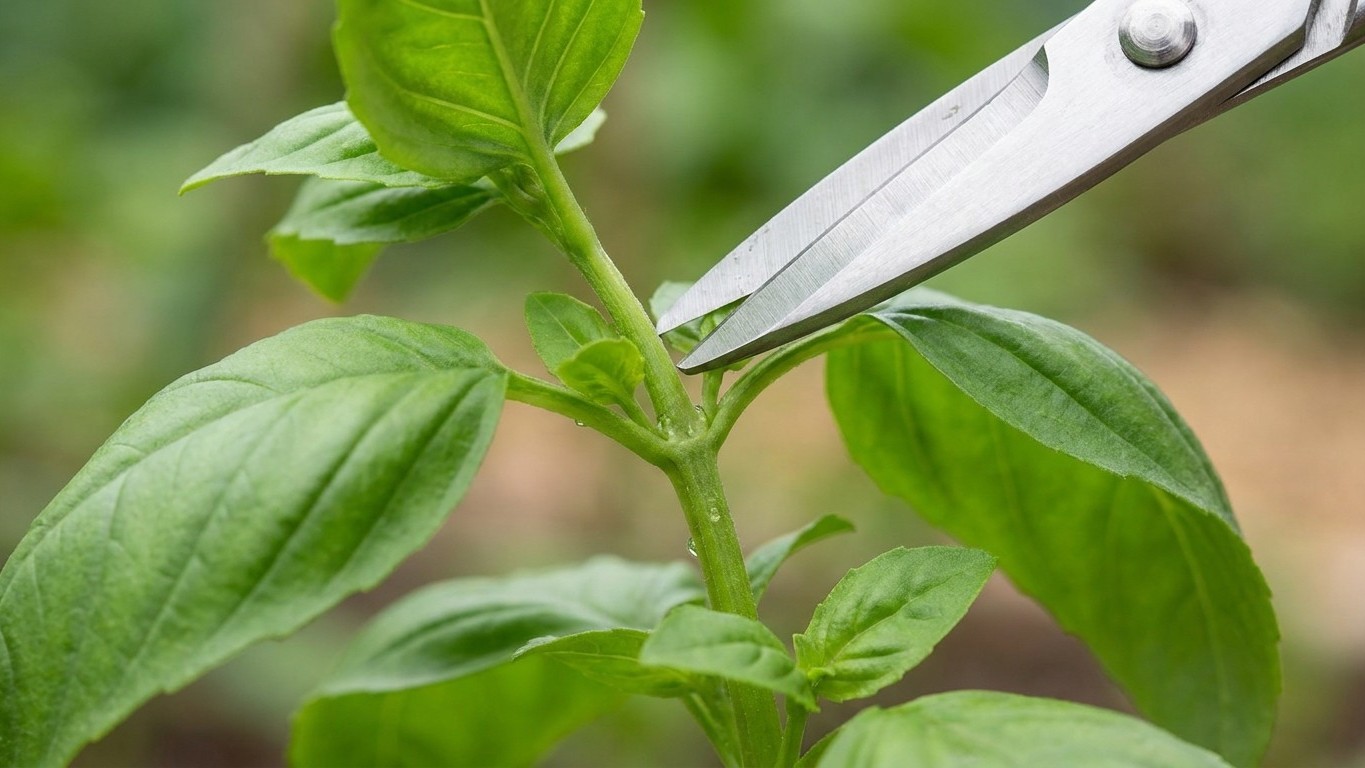
Burnt basil leaves show up fast during a heat wave, and picking them off one at a time feels like a never-ending chore. The fix isn’t more patience with tweezers or scissors on individual leaves. It’s a single cut, made in the right spot, that lets the whole plant rebuild itself instead of losing leaves to sunscald week after week.
The scorched leaves themselves are not the real problem. They’re a symptom. Basil leaves turning yellow, brown, and crispy along the edges are a sign of sunburn, where the rays scorch the foliage. That damage tends to concentrate on the tender, newest growth at the top of stems, exactly the part most exposed to direct midday rays. Pull off individual scorched leaves and you’re just chasing symptoms while the stem underneath keeps pushing out more foliage in the same vulnerable position, under the same brutal light.
Key takeaways
- A single botanical detail on the stem determines whether your basil bounces back or keeps deteriorating
- The recovery timeline isn’t theoretical—it’s measured in days, not weeks, if you cut in the right spot
- Why removing scorched leaves individually actually makes the problem worse, not better
Why the cut location matters more than the cut itself
Snipping anywhere on a basil stem doesn’t produce the same result. There’s a specific point, the leaf node, where two leaves emerge in opposite directions along the stem. Look at the stem and find the point where two leaves branch off in opposite directions. That point is a leaf node. Everything about basil’s recovery speed hinges on cutting close to, but not into, that junction.
The technique is almost embarrassingly simple once you see it done. Cut ¼ inch above that node using sharp, clean scissors for young thin stems, or hand pruners for the thicker central stem of a mature plant. Leaving that small buffer of stem tissue matters: it is important to make each cut about 1/4 inch above a node, since leaving this small amount of stem helps keep the plant healthy and encourages proper regrowth. Cut too close and you risk damaging the dormant buds that are about to do all the work.
What happens biologically explains why this location is non-negotiable. Every actively growing shoot tip on a basil plant produces a hormone called auxin. That hormone travels downward and keeps the lower buds dormant, essentially telling the plant “don’t branch here, I’ve got this.” Remove the tip, and that chemical signal disappears. Every stem you remove correctly triggers two new branches from the node below the cut, and those two become four, then eight, then sixteen. A plant that was struggling with sunburned, single-direction growth suddenly has an incentive to branch out sideways instead of straight up into the harshest light.
The week-long turnaround, explained
The timeline isn’t an exaggeration or a lucky one-off. Cut above a leaf node and within a week, two new shoots are already pushing out. Other growers report the same window: within 5–7 days, you’ll see two new shoots emerging from the node where you cut. Compare that to a plant left to fend for itself, dropping burnt leaves one by one while the same exposed tip keeps producing more foliage in the same danger zone, and the difference in recovery speed is obvious.
Warm, humid conditions can push that recovery even faster. New leafy growth returns within two weeks in warm conditions when the cut is made cleanly at the right healthy node, even on a plant that’s already showing significant stress. The plant isn’t just replacing what was lost, it’s building a sturdier structure than the one that got scorched in the first place, because those new stems tend to angle outward rather than straight up.
There’s a ceiling to how aggressive you can be with a single pruning session, though. Never remove more than one-third of the plant’s total foliage at a time. That guideline pops up across nearly every source on basil care for a reason: strip too much tissue and the plant no longer has enough leaf surface to photosynthesize its way back to health quickly. A scorched plant is already running on a deficit. Piling a heavy-handed prune on top of sun damage can tip it from “stressed” into “struggling to recover at all.”
Preventing the next round of burnt leaves
Cutting correctly fixes what’s already damaged, but the sun that caused it isn’t going away. In the case of too much afternoon sun, move plants to a spot with bright shade or dappled light during the hottest part of the afternoon. Basil genuinely loves sun, just not the unfiltered, hours-long blast of a July or August afternoon. Six hours of morning and early-afternoon light is plenty; what fries the leaves is usually that punishing 1 to 4 p.m. window when intensity peaks.
Watering habits play a bigger role in leaf scorch than most people realize. The most common cause of sunburn is water sitting on the leaves and attracting harsh light like a magnifying glass, which is yet another reason why it’s so important to only water basil from the base and avoid overhead irrigation. A quick overhead sprinkle in the morning before heading to work can, ironically, set up the exact conditions for the crispy brown patches you’re trying to avoid. Watering at the soil line, ideally in early morning, sidesteps that risk entirely.
Newly transplanted or recently repotted basil deserves extra caution before it ever sits in full sun for a whole day. To avoid leaf scorch on basil, adjust seedlings to sunlight gradually, giving plants progressively more time in the sun until they can handle it all day long. Skip that adjustment period and even a healthy, well-watered plant can end up with the same crispy edges that started this whole cutting ritual. One well-placed snip above a node solves the leaves you’ve already lost. A little shade cloth and base watering keeps you from needing to make that cut again next week.
Sources : mygardyn.com | bloomingexpert.com