
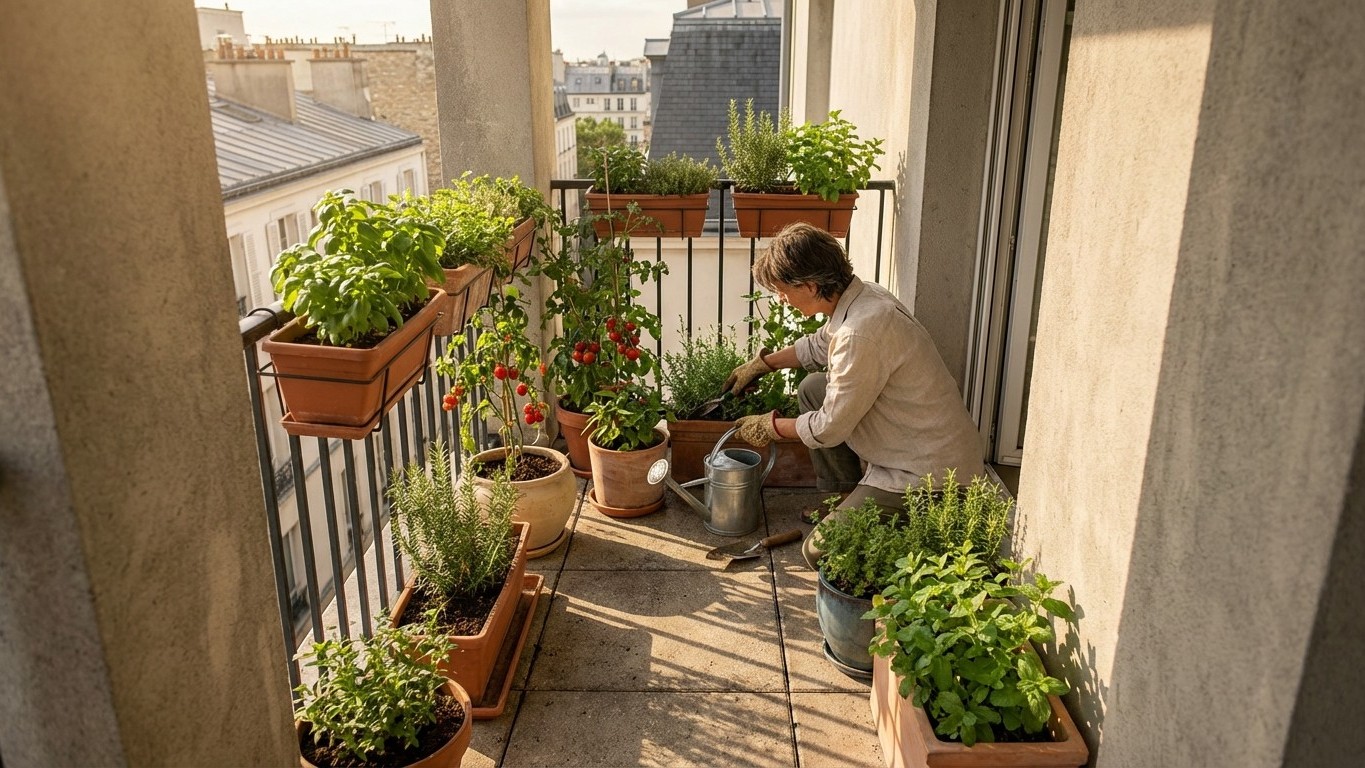
A pot of basil on a sunny balcony. Strings of cherry tomatoes. A herb corner squeezed between two concrete walls. Urban balcony gardening is one of the most satisfying small-space hobbies going — and one of the most misunderstood from a legal standpoint. Ask most apartment dwellers in France whether they can freely water their plants or stack up heavy planters along the railing, and you’ll get a shrug. The reality is more layered:
life in a co-ownership building means respecting your neighbors, and it isn’t always possible to do everything you’d like.
Understanding the rules isn’t about limiting your garden, it’s about protecting it, and protecting yourself.
Understanding balcony regulations in apartment buildings
Before you buy a single bag of compost, one document deserves your full attention: the règlement de copropriété.
The rules of co-ownership determine whether balconies or terraces are common areas or private portions — generally, they are treated as common areas with private use, meaning their use is reserved for the relevant co-owner.
That distinction matters more than it sounds. You enjoy the space exclusively, but you don’t own it outright, which means the collective rules of the building apply.
The co-ownership rules govern the installation of furniture, awnings, and vegetation. Any modification visible from outside generally requires authorization from the general assembly of co-owners.
A balcony garden with tall climbing roses or a wall of vertical planters might look beautiful to you and constitute a structural or aesthetic violation in the eyes of the syndic.
If the rules don’t specify anything on the matter, it is strongly recommended to check local regulations, since a prefectural or municipal decree may also impose obligations, and may even expressly prohibit pot placement on apartment balconies for safety reasons.
Tenant or owner: who is responsible for what?
Most often, the co-owner is responsible for routine maintenance and floor coverings of the balcony or terrace. Structural repairs, on the other hand, fall to all co-owners collectively.
For tenants renting the apartment, the situation is simpler in principle but equally binding: they must comply with both the lease and the building’s co-ownership rules.
If water infiltration is caused by overly intense watering of balcony flowers, the resident will be held responsible and will have to cover any damage caused to the co-ownership.
No gray area there.
The good news:
unless specific contrary provisions exist in your co-ownership rules, gardening is permitted on your balcony.
The framework is there to prevent harm, not to ban plants. For more on navigating the broader challenges of urban balcony gardening, from wind to heat to pests — windy balcony container gardening tips gives you the full picture.
Watering your plants without flooding your neighbor
Here’s the question almost every apartment gardener eventually faces: can you water freely without risking a complaint from below? The short answer is yes — with conditions.
What is prohibited is intentional nuisance linked to watering plants on an upper balcony, or any other voluntary action.
The key word is “voluntary.” Rain runoff is one thing; a jet of water deliberately sent over the edge is another matter entirely.
You are not required to put up with water runoff from the watering or cleaning of the balcony above yours.
If the water originates from watering or large-scale washing of the upper balcony, you do not have to endure those nuisances.
The legal framework here draws a clear line between natural precipitation (which falls under Article 640 of the Civil Code) and deliberate water runoff from gardening or cleaning activities. The latter is actionable.
Practical watering methods that keep everyone happy
The solution isn’t complicated — it just requires thought before you reach for the hose.
For watering your plants, prefer a watering can rather than a hose to avoid sending water onto your neighbors’ spaces, and use a saucer under each pot to prevent leaks.
Saucers seem trivial, but
flower pots, even on balconies, must rest on watertight bases capable of retaining excess water.
That’s not a suggestion, it appears in many standard co-ownership rules as a direct requirement.
Planters and pots equipped with saucers or water-recovery systems are to be preferred.
Self-watering containers with integrated reservoirs take this one step further: they water from below, eliminating surface runoff entirely. Drip irrigation connected to a small tank is another option — especially practical for anyone spending time away.
A drip or micro-irrigation system is the most economical and the least demanding day-to-day.
For more tips on managing heat and moisture on exposed balconies, see our guide on how to protect balcony plants from heat in containers.
Water drainage rules and what happens when they’re ignored
While the Civil Code addresses water from rooftops (Article 681) and naturally flowing water from one property to another (Article 640), nothing specifically addresses runoff from one balcony to another. The DTUs 20.12 and 43.1 define waterproofing and drainage rules for balconies, terraces, and flat roofs.
In practice, this legal gap places the burden on common sense and co-ownership rules rather than a specific national statute.
Washing a balcony is not prohibited by law, but most co-ownership rules frame or prohibit large-scale water washing to prevent infiltration, nuisances for neighbors, and facade deterioration. Consulting your building’s rules before hosing down your balcony is therefore essential.
Getting that wrong once, particularly in older buildings with aging waterproofing, can mean a water damage claim against you.
What you can be held responsible for
The potential consequences go beyond a neighbor’s complaint.
In the event of a pot falling from a balcony onto a neighbor’s space or onto the street, and especially in the case of an incident, the resident’s liability will be engaged — whether from a child ingesting a toxic flower or leaf, or a pot falling on a passerby’s head.
Civil liability, not just co-ownership sanctions, is on the table.
In the event of accidents, the civil liability of residents can be engaged by the Prefecture.
That’s a level of exposure most gardeners don’t expect from a misplaced terracotta pot. The takeaway is simple:
you cannot legally place anything beyond the railing. Your pots and planters must absolutely be installed on the interior side of the guardrail.
Weight, loads, and keeping your balcony structurally safe
Weight is the silent variable in balcony gardening — and the one most likely to create serious structural problems if ignored.
The load capacity of balconies is generally limited to 350 kg/m² on average, particularly for recent buildings.
That sounds generous until you start calculating: a large terracotta planter filled with standard potting soil, well-watered, can reach 80 to 100 kg on its own.
Placing heavy planters toward the outer edge of a balcony carries significant risk. A load is considered very heavy from around 150 kg — which doesn’t necessarily correspond to a very large container.
Pay particular attention to the weight of potted plants, since wet soil adds to the weight of the container.
A pot that weighed 30 kg dry can easily double once saturated after a heavy rain.
Smart choices to reduce load without sacrificing your garden
The solution isn’t to give up on a rich, varied balcony garden — it’s to choose materials wisely.
The same planter in plastic, filled with clay pebbles for hydroculture, weighs only 60 to 80 kg
versus nearly 300 kg in terracotta with standard soil. Lightweight substrates, perlite, vermiculite, coconut fiber, cut the weight of your growing medium by 30 to 50% while keeping drainage and aeration excellent.
Position matters as much as weight.
The feet of containers concentrate the load on a small surface area, which compounds the risk.
Place large, heavy containers against the building facade (where structural support is greatest), and reserve the railing area for smaller, lighter pots.
When in doubt, consult your syndic or a professional architect or landscape designer.
A one-hour consultation is infinitely cheaper than a structural incident. For a complete introduction to successful container gardening in small urban spaces, our guide on container gardening small space balcony urban covers everything from pot selection to vertical setups.
Neighbor relations and the unwritten rules of shared buildings
The legal framework is one thing. Living with your neighbors day after day is another.
Exterior spaces must not harm the general appearance of the building or generate nuisances for neighbors. Co-owners must avoid accumulating bulky objects, hanging laundry visible from the street, or disturbing neighbors with noise.
Plants create specific friction points that aren’t always obvious.
Balcony plants must remain contained without invading neighbors or extending onto the building facade — ivy, for example, can proliferate to the point of covering an entire facade, and in doing so, significantly weakens it.
Toxic plants are strongly discouraged, especially if your neighbors have children or pets.
And
dead leaves and spent flowers must fall neither onto neighbors’ spaces nor onto the street below.
Cigarette stubs deserve a specific mention.
Smoking on a balcony is permitted unless your co-ownership rules specify otherwise. As with any authorized use, you must still respect your neighbors by avoiding smoking during their outdoor meals. And absolutely do not turn your balcony, or theirs, into an ashtray.
Flicking a cigarette onto a neighbor’s plants or furniture is a nuisance that can prompt formal complaints. On windy balconies, the risks compound, see our practical advice on windy balcony container gardening tips for managing exposure safely.
What the law actually says: co-ownership rules, codes, and local restrictions
Three layers of regulation apply simultaneously to any balcony garden in France: national law (Civil Code, health code), local rules (PLU, municipal decrees, prefectural orders), and the building’s own co-ownership rules.
Article 99-2 of the Departmental Health Regulation sets general cleanliness and sanitation requirements: objects, plants, and laundry on balconies must not create unsanitary conditions and cannot constitute a danger or nuisance for passersby or neighboring building occupants.
The Local Urban Plan (PLU) of your municipality may recommend separating domestic wastewater and rainwater, and may prohibit discharging rainwater into public spaces. If this is not mentioned in the PLU, the sanitation service regulations may make it mandatory.
These are not obscure technicalities, in dense urban areas, municipalities take stormwater management seriously.
Reading your co-ownership rules like a pro
Every building has its own rules — read them carefully and verify the rights of all parties, both co-owners and tenants. Most rules contain a paragraph detailing security rules and facade appearance.
Look specifically for clauses on: vegetation height, planter placement (interior or exterior of guardrail), water drainage requirements, and any restrictions on specific plant types.
Before installing pots on a balcony, consult the co-ownership rules. If they prohibit it for aesthetic reasons, the syndic has the right to require the co-owner or tenant to remove the pots.
Municipalities and architectural constraints
Numerous regulations differ between cities and municipalities concerning the exterior appearance of buildings.
In listed neighborhoods or near classified monuments, restrictions can be particularly strict, a pergola, a large trellis, or even certain types of planters visible from the street may require prior authorization. Check with your municipality’s urban planning department (service d’urbanisme) before any significant installation.
Common situations and how to handle them
What to do when a neighbor complains about water or falling soil
The first move is always direct, calm communication.
During a neighborhood conflict, communication is paramount. Approach the neighbor responsible for the nuisance, remaining courteous and avoiding a reproachful tone. Don’t wait until you’re at your limit. Explain the problem clearly and calmly, backing it up with specific examples.
Most balcony-related conflicts resolve at this stage.
If that fails,
since October 1, 2023, Article 750-1 of the Code of Civil Procedure makes prior conciliation mandatory before any judicial proceeding in certain categories of disputes, including neighborhood conflicts. This obligation aims to encourage amicable resolution before resorting to justice.
Skipping this step means any subsequent court action will be declared inadmissible.
The intervention of a conciliateur de justice is always free of charge.
Can you install water-reservoir containers on a balcony?
Self-watering pots and containers with built-in water reservoirs are a different matter from large rainwater collectors. The former are simply pots — no authorization needed. For genuine rainwater collection systems, the rules are stricter.
The right to collect rainwater applies whether you live in a house or an apartment. If you live in a co-ownership building, you must first request authorization at a general assembly.
To install a rainwater collector on an apartment balcony, refer to the co-ownership rules to find out the maximum authorized size.
Weight is the primary constraint: a 100-liter tank full of water weighs 100 kg. Add pots, soil, and the collector’s own weight, and you may be approaching structural limits faster than expected.
Every balcony has a maximum capacity it cannot exceed without risking structural damage.
Legal options when an agreement can’t be reached
If nuisances persist despite correspondence, you can turn to a conciliateur de justice (free) or a mediator (paid), or initiate a participatory procedure with legal assistance. This step is mandatory before any appeal to a tribunal. Before the court, you may claim damages.
For disputes involving sums under 4,000 euros, the juge de proximité is the relevant court; beyond that, the tribunal judiciaire takes over.
The path from a dripping plant to a court case is long, and avoidable. A well-maintained balcony garden, with saucers under every pot, planters firmly fixed inside the guardrail, and a weight total that stays within structural limits, generates no legitimate complaint. The gardeners who get into trouble are rarely the careful ones. They’re the ones who assumed the rules didn’t apply to them — or simply never looked.
Urban gardening is increasingly encouraged by cities grappling with heat islands and biodiversity loss.
More and more co-ownerships are encouraging residents to plant on balconies. City centers are becoming greener as a way to absorb CO₂.
The regulatory framework, when understood properly, isn’t an obstacle to that movement, it’s the structure that makes it sustainable. The question worth asking isn’t whether you’re allowed to garden on your balcony. It’s whether your setup will still be standing, and neighbor-approved, five growing seasons from now.