
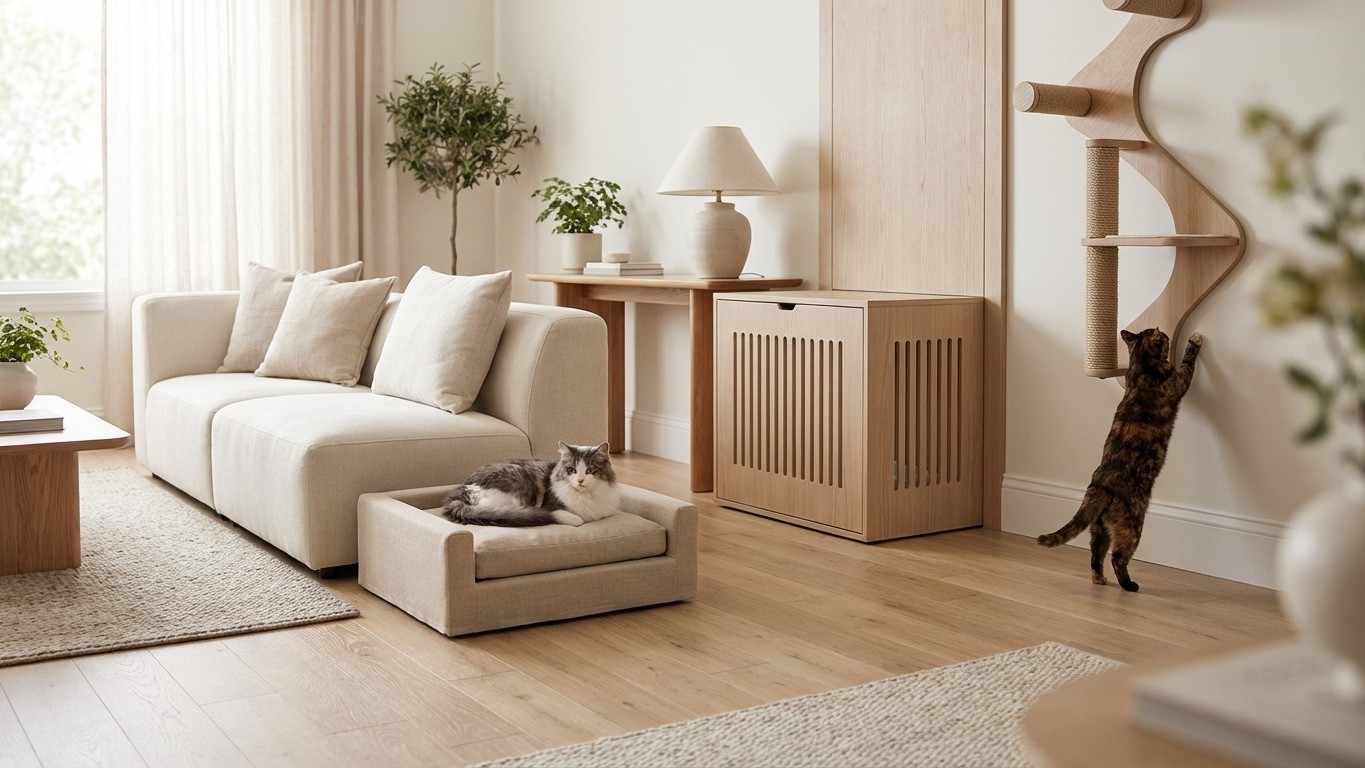
Think about the last time a guest walked into your home and the first thing they spotted was a plastic litter box shoved behind the couch, or a giant carpet-covered cat tree eating up half a corner.
With 66% of U.S. households now owning a pet, and Gen Z driving a 43.5% increase in pet-owning households from 2023 to 2024, the demand for stylish yet practical pet-friendly interiors has never been higher.
The gap between what your home looks like and what your animals actually need has become one of the most common frustrations in modern interior design, and also one of the most solvable.
The real shift happening right now isn’t just aesthetic.
Nearly half of pet owners prioritize pets in their decision-making when upgrading their home (48%), with considerations including pet-friendly products and materials, as well as incorporating space for an animal’s bed or feeding station.
We’ve crossed into a new era: one where your cat’s bathroom and your dog’s nap spot deserve as much design attention as your kitchen backsplash. This article is your blueprint for making that happen, whether you’ve got a drill and an afternoon free, or you’re ready to call in a carpenter.
Why Integrated Pet Furniture Changes Everything
The Real Challenges: Odors, Scratches, and Visual Noise
Let’s be honest about what’s at stake.
Seventy-three percent of pet owners report having to replace a household item in the last two years because of their pets. Carpets or rugs (35%) are the most frequently replaced items due to pet damage, followed by furniture (17%) and bedding (15%).
That’s not just money lost. It’s also a design problem that repeats itself, year after year, if you never address the root cause.
Scratching surfaces that blend nowhere near your decor, litter boxes parked in the middle of a hallway, dog beds that migrate from room to room like furniture tumbleweeds, these aren’t minor inconveniences. They accumulate. And they signal to anyone who enters that your home has been partially surrendered to its animal inhabitants. The good news: it doesn’t have to be that way, especially when you can invest in stylish cat scratching post furniture that complements your interior design.
Functional Integration vs. Temporary Patches
A throw blanket over a dog bed isn’t a design choice. A basket tucked in a corner concealing a litter box might buy you a week before the odor escapes – this is why proper hidden litter box cabinet design with adequate ventilation and odor control is essential. Similarly, investing in built in dog bed furniture eliminates the furniture tumbleweeds, while modern cat wall furniture shelves and climbing solutions transform vertical space into functional territory that cats love while creating dedicated spaces that work with your decor. For inspiration on aesthetically pleasing solutions, explore these cat litter box furniture ideashat are both beautiful and easy to maintain.
Creating pet-inclusive environments benefits both animals and humans psychologically. Pets feel more secure in spaces designed with their needs in mind, leading to better behavior and reduced anxiety. Meanwhile, owners experience less stress when their homes can handle pet-related challenges gracefully.
True integration means building or choosing furniture that performs a human function (bench, bookshelf, TV stand, nightstand) while simultaneously serving your pet’s biological and behavioral needs. The space doesn’t look like a compromise. The pet uses it reliably. And maintenance becomes a five-minute routine instead of a weekend project. That three-way win is what separates smart pet-friendly design from simply coping.
For a broader look at the materials and strategies that make this possible room by room, our guide on pet friendly home design cat dog furniture covers the full spectrum, from flooring choices to sofa fabrics that can actually survive daily cat naps.
Hiding the Litter Box: Solutions That Actually Work
The Best Furniture Forms for Cat Litter Integration
The bench-with-hidden-compartment has become the gold standard for a reason.
The litter box bench is a multi-functional masterpiece, combining storage with seating — made from wood, it features a concealed litter box underneath, with a side opening for the cat’s convenience. For cat owners seeking a blend of style and function, a mid-century modern-inspired litter box cabinet is an excellent choice.
Position one in a mudroom entry, a hallway, or near a bathroom, and guests will never suspect a thing.
Buffets and credenzas offer another elegant path.
Hidden cat litter box furniture like a cat cabinet or credenza helps reduce odors and provides practical storage space, completely concealing the litter box when viewed from the front.
In a Scandinavian-styled living room, a low slatted sideboard with a discreet circular entrance on one side looks like furniture, because it is. The litter tray lives inside; the bowl of fruit lives on top. Problem solved.
Window seat cabinets deserve special mention.
A window bench seat can actually be a cabinet that houses kitty litter, extra scoops, and a litter box — with cabinet doors that remain closed while a secret cat entrance on the side allows access.
This approach creates the impression of a classic built-in while tucking away what would otherwise be an eyesore. Two birds, one beautifully crafted stone.
Want a deep dive into which enclosure dimensions and ventilation setups actually perform? Our dedicated article on cat litter box furniture ideas breaks down a curated selection of the most aesthetically refined options on the market.
DIY vs. Ready-Made: Honest Comparison
Dressers, nightstands, or cabinets can be repurposed by removing drawers, adding a cat-sized entrance, and painting or staining to match your home. This approach is sustainable and cost-effective, and you can customize the look to suit any room.
With a jigsaw, some sandpaper, and a weekend, a $30 thrift-store cabinet becomes a bespoke furniture piece that fits your exact space. The catch: you need to think through dimensions carefully before cutting anything.
IKEA furniture is a top choice for DIY litter box enclosure projects. Besta units, Hol tables, and storage benches are frequently converted into stylish litter box enclosures.
These platforms offer a head start, the carcass is already there, and the finish looks intentional. Add a hole saw, a dowel perch, and a coat of matte white paint, and you have something that would cost four times as much ready-made.
That said, off-the-shelf solutions have moved up dramatically in quality.
In 2026, these pieces are no longer afterthoughts slapped together with cheap MDF; they’re genuine design statements sporting soft-close hinges, integrated odor science, and IoT sensors that ping your phone when it’s scoop time.
For households without the time or tools for DIY, the premium is often justified.
Ventilation, Access, and the Details You Can’t Skip
Here’s where most hidden litter box builds go wrong.
Enclosed boxes can help contain odors but may also trap humidity and ammonia — good airflow is essential. Partially enclosed designs featuring ventilation holes are often preferred.
At minimum, drill a row of small holes along the top or back panel. A small carbon filter clipped inside the enclosure takes it further. For ambitious DIYers, a whisper-quiet USB exhaust fan ducted through the back panel is the move.
Entry placement matters too, and it depends on your cat’s personality.
Front entries suit tight bathroom alcoves but tend to track more litter. Side entries tuck neatly under console tables yet require adjacent clearance. Top-entry bench seats provide the best scatter control and dog-proofing, but older or heavier cats may struggle.
Observe your cat’s habits before committing to a design, some cats won’t tolerate a flap door; others feel exposed using a top entry.
Daily scooping is ideal; complete litter changes every one to two weeks can help mitigate odors and bacteria growth. In homes with multiple cats, you may need to replace litter more often.
And remember: no amount of beautiful furniture compensates for a neglected litter tray. The box still needs to be cleaned, integration just makes the whole experience less visually punishing. For a detailed guide on proportions and airflow engineering, see our article on hidden litter box cabinet design.
Integrated Sleep Spaces for Cats and Dogs
Bed Nooks: Stairs, Benches, and Forgotten Corners
Under the stairs is one of the most popular and spacious options for built-in pet beds. You can design a full-fledged pet room here — complete with lighting, padding, or even decoration.
HGTV designers have demonstrated this beautifully:
making great use of the otherwise wasted space under the stairs, the family dog gets its own hideaway, den-like retreats that are great for helping dogs calm down during loud events such as thunderstorms, fireworks, or parties.
The kitchen island is an underused canvas.
Built-in cabinetry gets a brilliant upgrade with a hidden dog nook tucked beneath the kitchen counter, perfectly proportioned and stylish, with a checked pillow adding a hint of pattern and oak grain cabinetry tying it seamlessly into the rest of the kitchen. Ideal for larger dogs who want to stay close during dinner prep without getting underfoot.
For homes with limited space, multifunctional furniture is an ideal solution. A coffee table with a built-in pet bed or an entryway bench that also stores toys and accessories works beautifully — as does a desk with space underneath for a pet bed, letting your dog rest nearby while you work.
The logic is the same everywhere: use the volume of furniture that already exists rather than adding new footprint to the room.
If you prefer the dog bed to feel architecturally intentional rather than improvised, the full treatment of options including banquette integrations, TV unit niches, and bookshelf dens is covered in our guide to built in dog bed furniture.
Cushions, Textiles, and Multi-Function Pieces That Pull Double Duty
Built-in dog beds with removable cushions simplify the cleaning routine — they can often be machine-washed. Regular washing of the bedding helps minimize pet odors in the living space.
This is non-negotiable if you’re integrating pet beds into upholstered banquettes or bench seating. Removable, washable covers transform a maintenance burden into a five-minute chore.
For cats, the calculus shifts. Cats don’t always sleep where you think they will.
Window seats and benches are favorites for cats, who can use a padded bench or wide sill as both a lounging area and an observation post.
Rather than investing in a built-in bed a cat may ignore, start with a well-placed cushion on an existing window bench. Let the cat vote. Then build accordingly.
The lounge is a shared space for relaxation, and pets are often happiest settling nearby while the household winds down. Integrating pet furniture helps avoid loose beds disrupting the flow of the space. Media units, sideboards, or corner furniture can include a dedicated pet sleeping area, keeping the lounge feeling calm and uncluttered while supporting your pet’s comfort.
Scratching Posts That Belong in the Room
Materials, Form, and Where to Put Them
Cats have various reasons for scratching — they use it to maintain nails, mark territory, stretch muscles, and relieve stress. Therefore, it is important to have a scratching post that meets all these needs.
Ignoring this isn’t an option unless you want your linen sofa to serve as a scratch pad. The question is how to provide the right outlet without sacrificing the room’s visual coherence.
Sisal rope is the go-to option because it’s durable, safe, and cats love the texture. Avoid synthetic ropes, which may fray and cause harm over time. Stick to neutral tones, add decorative trims, and integrate the post into existing furniture or corners.
A sisal-wrapped column beside the sofa looks intentional. A carpet-covered monolith in the middle of the room does not. Placement and finish are everything.
Choose a design that is functional. Also, matches your home décor, and place the cat scratching post in a visible spot — ideally where your cat spends a lot of time. Placing it near a window works well for cats who scratch occasionally.
For cats that target specific pieces of furniture, place the scratcher directly adjacent to the threatened item, then gradually move it once the habit is redirected.
A good height for a scratching post is around 24 to 36 inches — this gives the cat enough room to stretch fully and keeps them engaged for the long haul.
Anything shorter defeats the purpose. Cats scratch to stretch as much as to sharpen; a short post is like offering someone a yoga mat the size of a welcome mat.
DIY Scratching: Design That Disappears Into the Decor
The most invisible approach: wrap what’s already there.
Turn something your cat already loves into something stylish and intentional — just wrap the leg of a side table, stool, or plant stand in thick sisal rope. Add a dab of wood glue every few turns to secure it. It saves your table leg while giving your cat an irresistible place to scratch.
Guests may not even notice. Your cat absolutely will.
For maximalist or eclectic interiors, novelty is actually an asset.
Build a tall faux Roman-style column using PVC pipe or a cardboard concrete tube, wrap it in sisal, and top it with a faux marble or stone disc. It blends right into maximalist or classic interiors while serving a totally modern function.
The object becomes a design statement rather than a concession to pet logistics.
Another elegant wall-based option:
hang a flat sisal mat from a wall hook, cabinet, or shelf. Add wooden beads or macramé fringe for a decorative touch that makes it look more like wall art than pet furniture. Your cat gets their scratch fix, and you get compliments from guests who think it’s just cool boho decor.
If you also want to give your cat vertical territory, wall shelves, climbing bridges, elevated pathways, the full architecture of a cat-friendly wall is explored in our guide to cat wall furniture shelves and climbing.
DIY and Custom Builds: A Practical Framework
Common Mistakes and What to Do Instead
The most expensive mistake in pet furniture DIY: building before observing. Spend a week watching where your cat sleeps, where your dog retreats, and what surfaces get scratched.
Before making any major furniture or decor purchases, spend a week observing your pet’s behavior patterns, noting where they like to sleep, scratch, play, and rest. This “pet mapping” exercise will guide your design decisions and help you invest in solutions that actually work for your specific pet’s habits.
The second most common mistake: prioritizing aesthetics over cat logic.
One designer concealed a litter tray within a faux cabinet so effectively that their cat refused to use it for two long days — which taught a vital lesson about the importance of ventilation and understanding feline habits.
A gorgeous piece that your cat won’t enter is a very expensive side table. Always test the configuration before finalizing the build, and introduce changes gradually.
The third: ignoring litter scatter.
Pull-out litter drawers are exceptionally popular in compact apartments due to their ability to slide into existing furniture, instantly concealing messes. They are effective for odor control and swift cleanup, but ensure the drawer features robust slides and ventilation holes to prevent trapping humidity.
Adding an entry tunnel or a mat inside the enclosure traps scatter before it reaches your floor. A small design detail that makes a significant daily difference.
Safety and Maintenance Checklist
Before declaring any integrated pet furniture complete, run through these non-negotiables:
- Ventilation: at least four to six holes (1-inch diameter) on the top or back panel of any litter enclosure.
- Stability:
ensure the top of any scratching post is at least 4 inches smaller than the base, this prevents it from toppling over when your cat is climbing on it. - Cleanability: all surfaces that contact litter or bedding should be lined with waterproof material or have removable, washable inserts.
- Toxicity check: confirm that paints, glues, and finishes used are pet-safe once cured, water-based formulations are generally the safest bet.
- Access for humans:
add a hinged door for easy cleaning access and consider lining the interior with waterproof material for durability.
Style Inspiration: Scandinvian, Minimalist, and Classic Homes
In Scandinavian interiors, white walls, oak tones, clean lines, the integration almost happens naturally. A pale wood litter cabinet with slatted ventilation sides reads as a credenza. A sisal-wrapped birch post beside the sofa looks like a sculptural accent. The restraint of the style covers a lot of functional ground without visual noise.
Minimalist homes are slightly less forgiving; every object must earn its place.
A stylish ottoman or sleek bookshelf, with portions covered in sisal or another scratching material, can be the solution — guests might not even realize it’s there, but the cat certainly will.
Built-in niches with no visible doors, seamlessly painted to match walls, house litter areas and pet beds without announcing themselves.
In a traditional or classic home, the opportunity is richer.
A hidden litter box cabinet infused with vintage charm, made with delicate spindle legs and outfitted with fabric curtains — provides a stylish hideaway that feels at home in any period interior.
Custom millwork can integrate a dog kennel into a mudroom with the same moldings as the surrounding cabinetry; guests will assume it’s a decorative cabinet until the tail starts wagging from inside.
As pet ownership rates continue to increase, we’re seeing an impact on home renovation decisions — homeowners are designing spaces that prioritize the needs of all family members, including pets, from pet-friendly materials to incorporating built-in feeding stations and cozy nooks.
That trend isn’t slowing down. If anything, the vocabulary of pet-friendly design has expanded to the point where a visitor can no longer assume a piece of furniture is purely for human use. That ambiguity, that doubling of purpose, is exactly the goal.
FAQ: Practical Questions About Pet Furniture Integration
How can I hide a litter box in my living room furniture?
The most reliable approach is a sideboard or TV console with a side-entry cutout.
The wood finish looks great and blends seamlessly with real furniture, and it completely hides the litter box while still being easy for the cat to use.
Keep the dimensions generous, a minimum of 18 inches wide by 18 inches deep for the litter compartment — and drill ventilation holes along the back panel. If you’re in a multi-pet household,
a double-door cabinet with a partition board in the middle allows each cat to have its own toilet and privacy.
What are the best stylish cat scratching post ideas?
The most design-forward options are those that disappear into the furniture you already own. Wrapping the leg of a side table or entryway bench in sisal rope takes 20 minutes and costs almost nothing. For something more intentional,
a simple vertical scratching post using a wooden dowel or sturdy table leg wrapped in natural sisal rope, mounted on a chic square wooden base, produces an elegant, understated piece that looks like modern art.
For cats that prefer horizontal surfaces,
covering boards with carpet remnants offers affordable alternatives to commercial products.
How do I integrate pet beds into built-in furniture without losing space?
The trick is targeting negative space — volume that already exists but isn’t being used.
The unused space under a sofa or bed can easily become a pet hideaway with a cushion or blanket — add a pull-out drawer for easier access and cleaning. Under a coffee table, use an open bottom shelf or custom-cut entry to create a central, low-profile nook, perfect for social pets who like being near the action.
No additional footprint required.
The design landscape for pet owners has shifted from tolerance to intention. The old model asked: “Where can we put this?” The new model asks: “How can this serve everyone?” That’s a more interesting design problem, and, as it turns out, a much more beautiful one to solve.