
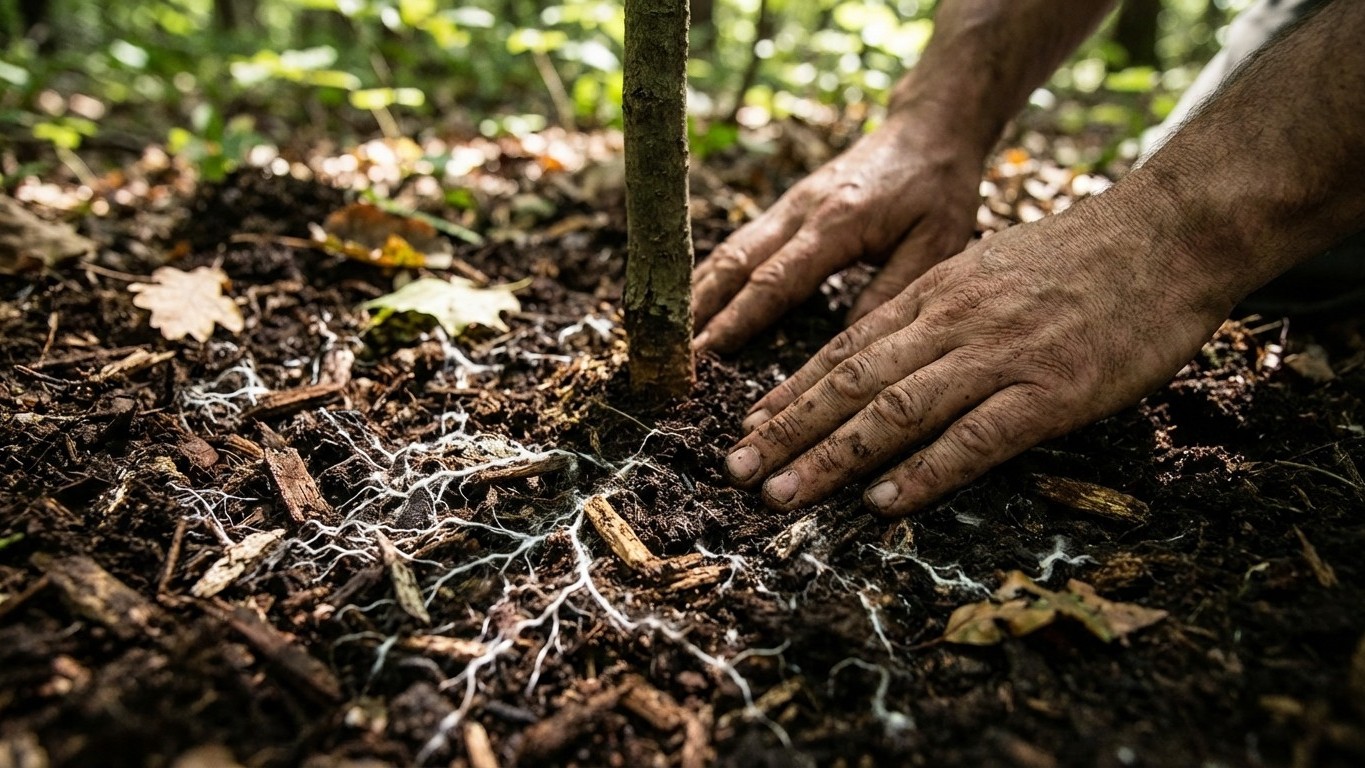
Walk into any old-growth forest and crouch down. Push aside the fallen leaves and you’ll find something extraordinary: dark, crumbly, sweet-smelling earth that practically begs you to dig your hands into it. Nobody fertilized it. Nobody aerated it. Nobody added a single bag of amendment from a garden center. The forest did it all itself, through one simple, Ancient mechanism, the slow decomposition of wood.
The gardeners who figured this out generations ago had a name for it, though they rarely wrote it down. They just did it: pile the chipped branches under the fruit trees, let the woodpeckers and beetles and fungi do their work, and come back the following season to soil that felt alive. Today, this practice has a formal name : Bois Raméal Fragmenté, or BRF, developed by researchers at Laval University in Quebec during the 1970s and 80s. But the principle predates the science by centuries.
Key takeaways
- Fungi feeding on wood chips slowly release nutrients that synthetic fertilizer can’t match
- The trick only works with branches under three inches thick—the thin, living wood matters
- Your soil can transform in just three years, but patience is the real ingredient
What’s Actually Happening Under the Mulch
The magic isn’t in the wood chips themselves. It’s in what they feed. When you spread a layer of crushed young branches across bare soil, you’re essentially rolling out a buffet table for fungi, specifically the white-rot and brown-rot basidiomycetes that form the living backbone of healthy forest ecosystems. These organisms break down lignin and cellulose, the tough structural compounds in wood, and in doing so they release a cascade of nutrients: nitrogen, phosphorus, potassium, trace minerals. Not in a sudden synthetic spike, but slowly, steadily, across months and years.
There’s a critical detail that most people miss. The trick only works well with branches under about three inches in diameter, the young, green, ramified wood that still contains significant amounts of sap, proteins, and living cells. Thick trunk wood or old dry logs decompose through a different process and don’t produce the same soil-building effect. Old-timers pruned their orchards in late winter and ran the cuttings straight through a chipper or chopped them by hand. Nothing wasted. Nothing bought.
One study from the 1990s showed that properly applied BRF mulch increased soil organic matter by 200% within three years on depleted farmland. That’s not the equivalent of a good compost application, it’s closer to rewinding the soil clock by decades.
How to Actually Do It (Without Overcomplicating Things)
The application is almost offensively simple. Chip or coarsely crush fresh branches from deciduous trees, fruit trees, willows, poplars, hazelnuts, and maples all work beautifully. Spread the chips three to four inches deep directly on the soil surface around your plants, keeping the material a few inches away from the base of stems and trunks to prevent rot. Do not dig it in. Do not mix it. The forest floor doesn’t till itself, and that’s the point.
Leave the chips to sit through the season. The surface layer will look messy for a few weeks, then begin to knit together as fungal threads (mycelium) spread through the material. You’ll know the process is working when you start to see white, cottony patches appearing in the lower layers. That’s not mold in the harmful sense, that’s your soil coming back to life.
One thing worth getting right from the start: avoid chips from conifers like pine or cedar when possible. Their resins slow decomposition and can temporarily acidify your soil. Stick to broadleaf species for the first application, especially if your soil is already depleted.
The Nitrogen Scare (And Why It Shouldn’t Stop You)
Ask any experienced gardener about wood chips and they’ll bring up nitrogen lock-up, the idea that decomposing wood chips steal nitrogen from the soil, starving your plants. This fear is legitimate but mostly misunderstood. The nitrogen competition happens primarily when wood material is mixed into the soil. Applied on the surface, as a mulch, the decomposition occurs at the wood-air interface, not at the root zone. Your plants are largely insulated from the effect.
That said, if you’re working with very young, nitrogen-hungry plants, freshly transplanted seedlings, for instance, a thin top-dressing of compost between the chips and the base of the plant creates a buffer. Old kitchen gardeners often did exactly this without knowing the chemistry behind it. They just noticed that things grew better when they added a handful of well-rotted manure at planting time, then tucked the branches around it. Empirical knowledge, centuries before soil science had vocabulary for it.
Some growers report a temporary yellowing of lower leaves during the first few weeks after applying fresh chips. It passes. The trade-off, by mid-season, is noticeably better moisture retention, fewer weeds (the fungal mat suppresses germination), and soil that, by the following spring, has measurably improved texture and color.
Patience as a Garden Practice
The deepest thing the old-timers understood wasn’t a technique. It was a timeline. Chemical fertilizer works in days. The forest floor works in years. Both deliver results, but only one builds something that lasts, soil structure, microbial diversity, water-holding capacity, resilience against drought and disease. A bag of granular fertilizer feeds your plants; a layer of crushed branches feeds your soil’s ability to feed your plants forever.
The first year, you’ll mostly notice what’s absent: fewer slugs (the dry chip surface deters them), fewer weeds, less watering. By the second year, you’ll notice what’s present: earthworms in quantities that feel almost theatrical, dark crumbly aggregates in the upper soil horizon, plants that seem to push back against pests with less intervention from you.
There’s something worth sitting with here. Our grandparents’ gardens often outproduced modern ones with a fraction of the inputs. Not because they worked harder, but because they worked with processes that were already running. The forest has been building soil for 400 million years. Copying its homework doesn’t seem like a bad idea.