
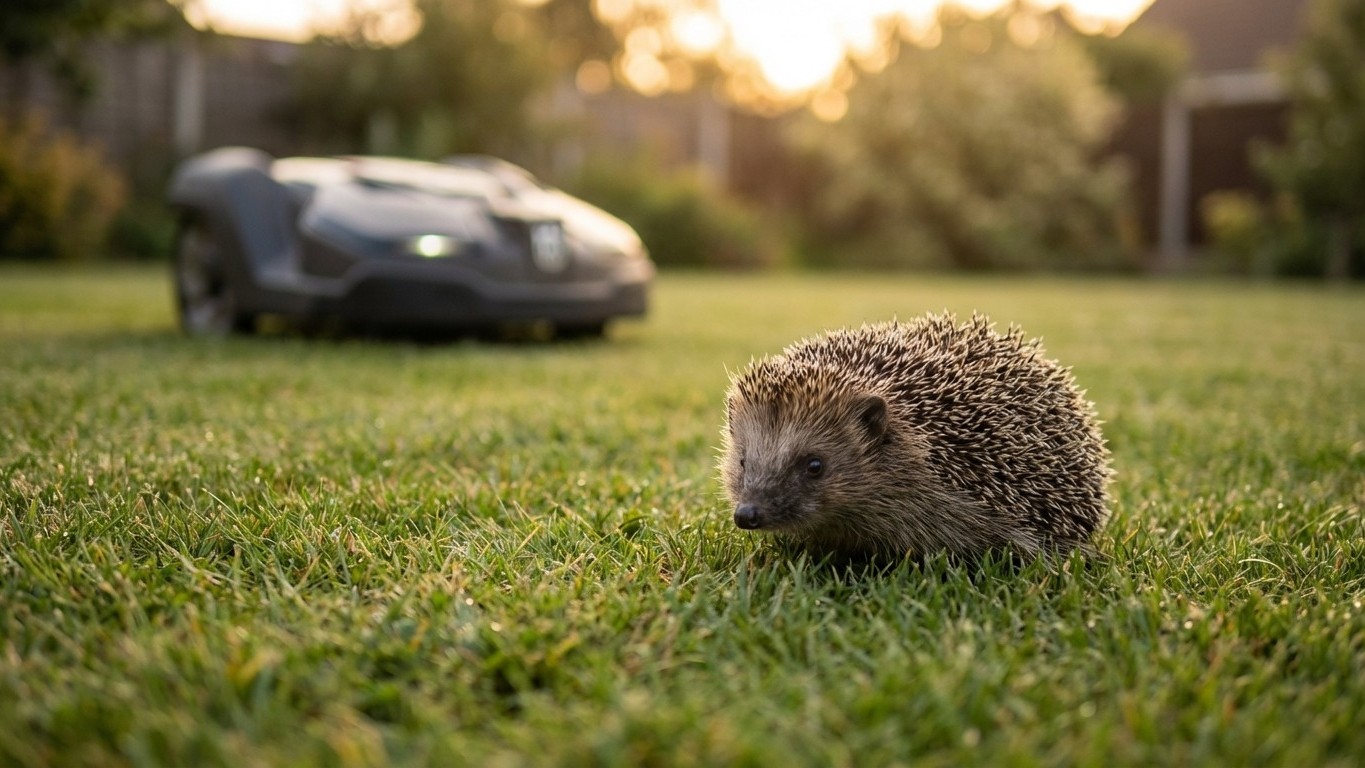
Wildlife rescuers have a simple, urgent request this spring: before you send your robot mower out tonight, check its operating schedule. Hedgehogs, ground-nesting birds, rabbits, and frogs are being injured and killed in backyards across the country at a rate that shelters describe as a quiet crisis. The machines are efficient, quiet, and almost invisible in the dark, and that combination is proving deadly for animals that have learned to treat suburban lawns as sanctuary.
Key takeaways
- Millions of robot mowers are running on nocturnal schedules—exactly when vulnerable wildlife is most active
- The injury patterns are severe and preventable, but most owners have never revisited their mower’s initial settings
- One scheduling change, verified by wildlife experts across two continents, nearly eliminates the danger without sacrificing your lawn
A Problem Hiding in Plain Sight
Robot mowers have become genuinely popular. Estimates suggest that over 5 million units are now operating in North American and European yards, and that number climbs every year. Most of them run on schedules set once and rarely revisited, often defaulting to nighttime hours, when the grass is cool and the machine won’t disturb anyone. The logic is sound from a lawn-care perspective. From a wildlife perspective, it couldn’t be worse.
Nocturnal animals use those exact quiet hours to forage, nest, and move through low vegetation. Hedgehogs, in particular, travel up to two miles a night across lawns and gardens. They’re slow, they curl into balls when startled (rather than fleeing), and their spines offer zero protection against spinning blades. Wildlife hospitals in the UK have been sounding the alarm since at least 2022, with some reporting that robot mower injuries account for a significant portion of their hedgehog admissions during warmer months. In the U.S., where ground-nesting birds like killdeer regularly place eggs directly in open grass, the risk extends well into spring and summer.
The injury patterns are brutal and specific. Rescuers describe animals with severed limbs, deep lacerations across the torso, and skull injuries from repeated blade contact. These aren’t accidents in the casual sense, they’re predictable outcomes of a machine designed to roam autonomously through exactly the habitat these animals occupy.
The One Setting That Changes Everything
Here’s where shelters are focusing their energy: the scheduling function. Nearly every robot mower on the market allows owners to program operating windows, specific days, start times, and stop times. Many users set this once during installation and never return to it. Shelters and wildlife organizations are asking you to do one thing: shift those hours to late morning through early afternoon, roughly 9 a.m. to 3 p.m.
That window is not arbitrary. Most nocturnal animals have retreated to cover by sunrise. Ground-nesting birds are most active and alert during morning hours and are far more likely to flush from danger rather than sit still. Frogs and toads, which move into lawns after dark and during rain, are back near water features and dense cover by mid-morning. Running your mower in the middle of the day doesn’t just reduce risk, it nearly eliminates the window during which these animals are most vulnerable.
Some manufacturers have begun acknowledging the issue. Certain newer models include lift sensors and object detection that are marketed partly on safety grounds, though their reliability with small, low-profile animals remains inconsistent. A sensor that stops the blades when the machine is tilted won’t protect a hedgehog that gets clipped by the mower’s perimeter before the tilt registers. Scheduling is the one intervention that actually works, and it costs nothing.
What Else You Can Do Without Giving Up a Manicured Lawn
Changing the schedule is the highest-impact adjustment, but a few other habits compound the benefit. Walking your yard before starting any mowing session, robotic or otherwise, takes about three minutes and can locate a ground nest, a sleeping rabbit, or a toad tucked under a grass clump. Killdeer will tell you themselves: they perform a conspicuous broken-wing display to lead you away from a nest, so if a bird is acting dramatically injured near your feet, stop moving and look down.
Keeping a small section of the yard in a longer, rougher state matters more than many homeowners realize. Wildlife corridors don’t have to be elaborate. A strip of unmowed grass along a fence line, a modest brush pile in a corner, or a border of native ground cover gives animals a refuge that the mower can’t reach. Many municipalities have loosened regulations around “natural lawn” sections precisely because the ecological data is so consistent on this point.
If your mower has a perimeter wire, check that it doesn’t completely seal off any existing wildlife access points. Animals that commute through your yard on a regular path will continue trying to use it regardless of the wire’s presence, and a machine patrolling just inside that boundary is exactly where they’ll encounter it.
One practical step that costs nothing: join a neighborhood app or local Facebook group and share your updated schedule. When one yard shifts its mowing window, neighboring properties benefit too, since animals don’t respect property lines. This kind of informal coordination has worked in suburban neighborhoods in the UK, where wildlife-friendly mowing pledges have spread block by block through community groups.
The Bigger Picture
Suburban yards collectively cover more acreage than all U.S. national parks combined, a statistic that tends to stop people mid-sentence when they hear it. The choices made in those spaces, multiplied by millions of households, add up to something that genuinely matters for biodiversity. Robot mowers aren’t the villain here. Convenience isn’t the enemy. The gap is just information: most people who injure a hedgehog with their mower had no idea the risk existed.
Wildlife shelters aren’t asking anyone to sacrifice a well-kept lawn. They’re asking for a two-minute schedule adjustment. The real question worth sitting with is what else in our automated, set-it-and-forget-it home routines is running on defaults that were never designed with the living world in mind.