
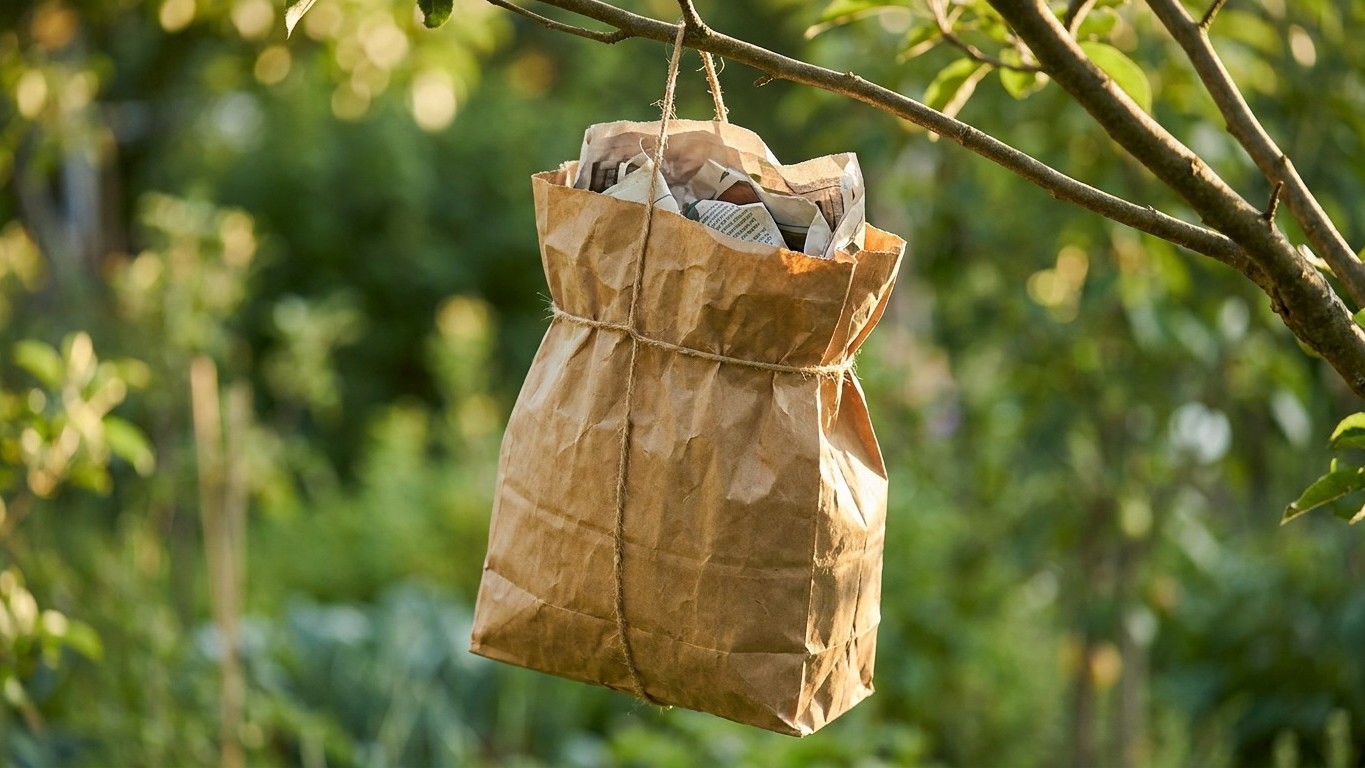
Every spring, the same story plays out across American backyards: the first warm weekend on the deck, someone spots a hornet, and the annual stress begins. This year, with a new invasive species already detected in Georgia and South Carolina, that anxiety has a sharper edge. The good news? A brown paper bag, some crumpled newspaper, and a piece of string might be enough to send those scouts packing, if you know exactly what you’re doing.
Key takeaways
- An invasive Asian hornet species from Asia has been detected in Georgia and South Carolina and poses a serious threat to honeybees and crops
- A paper bag filled with newspaper and hung from a branch can trick scout hornets into avoiding your yard—but timing is everything
- The trick only works in early spring before queens start building nests, and it’s most effective when combined with other prevention strategies
A New Threat Has Landed in the U.S.
In August 2023, the Georgia Department of Agriculture confirmed the presence of a yellow-legged hornet near Savannah, Georgia. This was the first time a live specimen of this species had been detected in the United States, followed by the first report from South Carolina in November 2023, and the discovery of nests in 2024. The species in question is Vespa velutina, also known as the Asian hornet, not to be confused with the so-called “murder hornet” (Vespa mandarinia), which was declared eradicated from North America by the Washington State Department of Agriculture in December 2024.
With origins in Afghanistan, eastern China and Indonesia, the yellow-legged hornet has expanded during the last two decades into South Korea, Japan and Europe. When it invades new territory, it preys on honeybees, bumblebees and other vulnerable insects, and a single yellow-legged hornet can kill up to dozens of honeybees in a single day. For context, French beekeepers have reported 30 to 80 percent of honeybee colonies exterminated in some locales, costing the French economy an estimated $33 million annually. That’s the scale of what early detection, and early prevention, is really about.
The yellow-legged hornet is a social wasp species that constructs nests above ground made from paper-like materials. These nests can be found hanging in trees and on structures such as barns, garages and sheds, and they can grow large enough to contain up to 6,000 workers. The lifecycle matters here: nests are built on an annual cycle, and each spring, a single queen starts a nest from scratch. The nests grow rapidly during the warmer months. That queen, scouting for a location in early spring, is the target of the paper bag trick.
How the Paper Bag Trick Actually Works
The idea behind the paper bag deterrent is that if you hang a slightly inflated paper bag, wasps and hornets will mistake it for a rival nest and avoid the area. The logic is rooted in territorial instinct. Social wasps are territorial and don’t want to interact with other colonies. When a scout wasp searches for a place to make a colony, she usually avoids building her nest in the near vicinity of an existing hornet’s nest.
Making one takes about two minutes. Take a brown paper bag and stuff it with some newspapers or more paper bags, tie the top off with string or tape it closed, crinkle the bag so it resembles a wasp nest, then hang it in an area you wish to keep free. Placement matters: hang it in areas where wasps tend to build nests, such as near doorways, windows, outdoor dining areas, and under decks, and position it where it’s clearly visible.
Timing is everything. Queens emerge from overwintering sites in late winter and early spring and begin scouting for nest locations. Hanging your decoys from late February to mid-April, before queens start building, gives you the best chance of deterring nest establishment. If you wait until summer, established colonies will simply ignore it. The analogy is almost real estate: you’re putting up a “Taken” sign before the buyers arrive, not after they’ve already moved in.
The Real Limits, and Why That Matters
Here’s where the honest conversation starts. Bald-faced hornets and European hornets are also unlikely to be deterred by paper wasp nest decoys. Hornets build their own distinct types of nests and operate differently than paper wasps, they may or may not avoid areas with other hornet nests, but a decoy designed to mimic paper wasps is not likely to fool them.
Evidence that wasps will build nests right next to each other, active or inactive, suggests that in at least some cases, wasps don’t care about neighbors at all. And there’s a twist specific to the paper bag version: it’s possible hanging a paper bag next to a wasp nest could actually encourage the pests to stay put, because wasps use paper to build their nests and may find it a welcome help in crafting their new home. Some experts suggest using a plastic bag inflated into a similar shape as an alternative, specifically to avoid this issue.
Fake wasp nests are a legitimate, chemical-free tool for deterring paper wasps from building new nests on your property, but they work best under specific conditions. Deploy them early in spring before queens begin nesting, place them in likely nesting locations, and combine them with other prevention strategies for the most effective results. The paper bag trick is one layer of defense, not a force field.
Building a Smarter Defense for Your Yard
The paper bag alone won’t protect you from a determined colony of yellow-legged hornets moving up from the Southeast. Think of it as part of a system. Effective wasp control comes down to removing what attracts them and blocking their access. Wasps aren’t randomly flying around, they’re on a mission for food and water, and if your yard provides a snack station, they’ll keep coming back. Practical steps include cleaning up outdoor eating areas after every meal, covering sugary drinks and desserts, and sealing garbage bins tightly while rinsing recyclables.
The golden rule of wasp control is to prevent nesting or catch nests early, ideally in spring, when colonies are small and queens are still setting up shop. A paper bag hung from a branch today costs nothing and takes less time than brewing a cup of coffee. Even if the science on its effectiveness remains mixed, the risk of trying it is essentially zero. The yellow-legged hornet, by contrast, is the first insect to make the European Union’s blacklist of invasive species — it was the first insect to land on the EU’s blacklist of invasive species, which tells you something about how seriously professionals take its potential spread. One paper bag hanging outside won’t stop an invasion. But a vigilant homeowner who reports sightings, acts early in spring, and removes food attractants? That’s actually useful. If allowed to establish in the United States, these invasive pests could threaten populations of domestic and feral honeybees and other native pollinators, and their presence could also disrupt the pollination of many crops. Your backyard is part of that bigger picture — paper bag and all.
Sources : nature.com | ebay.com