
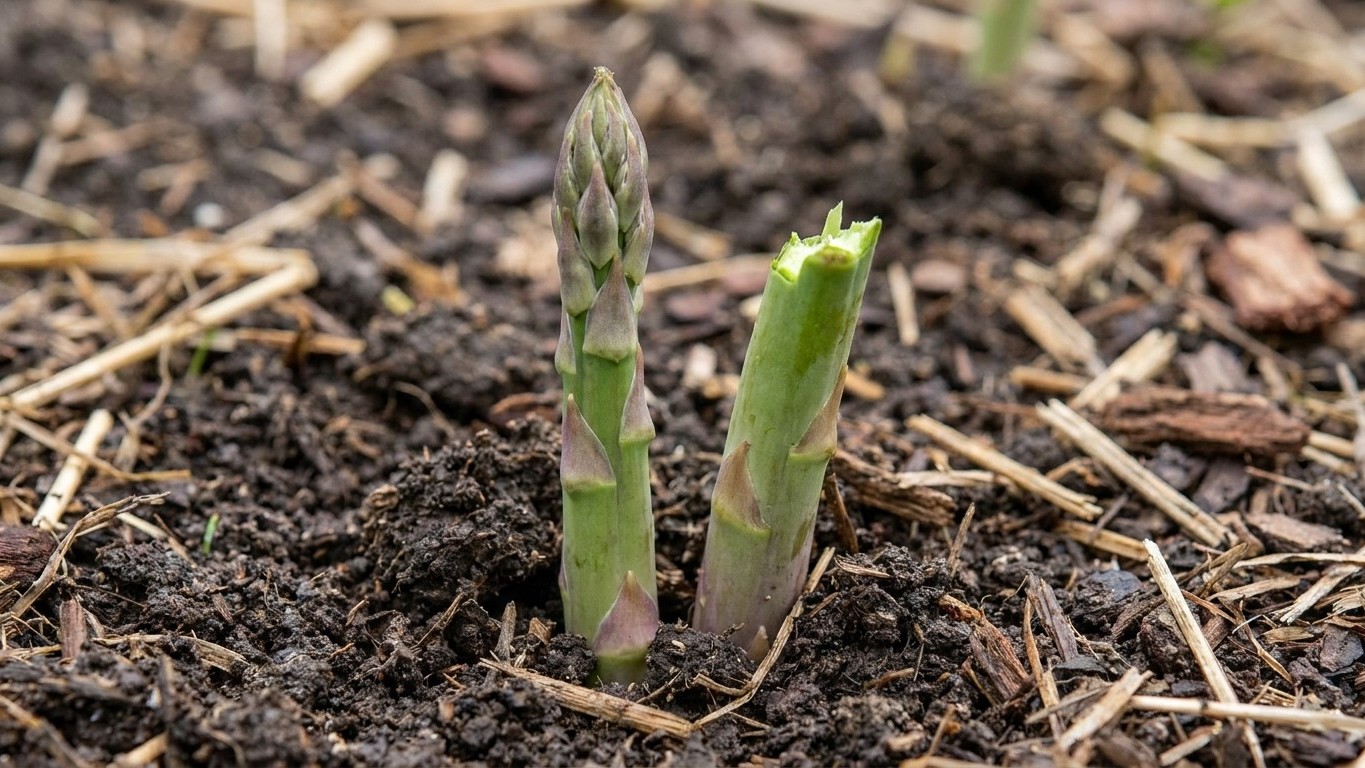
Asparagus crowns can live for 25 years or more. That statistic alone should make any gardener stop and think before grabbing their knife. For a long time, the standard advice circulating in home gardening circles was to cut the spears down low, just below the soil surface, to get the cleanest, most tender harvest possible. Logical on the surface. Wrong in practice.
A retired commercial grower in Pennsylvania, someone who had been managing asparagus beds since the 1980s, changed the way I look at this entirely. He knelt down next to my raised bed, pointed at a brown, slightly sunken spot on the crown of one of my older plants, and said something that has stayed with me: “You’ve been giving it wounds it can’t close.”
Key takeaways
- A simple cutting mistake can silently destroy asparagus crowns over several seasons without obvious symptoms
- Wounds made below soil line trap moisture and bacteria, preventing the plant from healing like above-ground cuts do
- The technique commercial growers have switched to takes just a small adjustment but adds years to your bed’s lifespan
Why the Cut Location Actually Matters
Asparagus spears emerge from a crown, a dense cluster of rhizomes and storage roots sitting just a few inches underground. When you slice through the base of a spear below the soil line, you’re cutting into tissue that is chronically wet, oxygen-deprived, and full of soil bacteria. The plant’s ability to callus over a wound drops sharply the deeper you go. Above ground, dry air and sunlight help seal cuts quickly. Below the surface, that process slows to nearly nothing.
The grower explained it through an analogy I hadn’t considered: think of it like cutting through the heel of your foot versus the tip of your finger. The heel is weight-bearing, poorly circulated, and slow to heal. Same principle applies here. The underground cut creates a persistent entry point for Fusarium and other soil-borne pathogens that are, frankly, ubiquitous in any garden bed that has seen rain and organic matter. Over several seasons, these small wounds accumulate. The crown doesn’t die outright, it just slowly loses vigor, producing thinner spears each spring, until one year it barely produces at all.
The Snap Method Is Not Just a Beginner’s Shortcut
Here’s where the advice I had dismissed for years turned out to be the right call: snapping asparagus spears by hand, rather than cutting them, isn’t just about convenience. The spear naturally breaks at the point where tender meets fibrous, typically 2 to 4 inches above the soil surface. That break point keeps all the exposed tissue above ground, in the dry zone where healing is possible.
Commercial operations that still use knives have largely adapted their technique. Experienced harvesters cut at an angle, keeping the cut well above the crown, sacrificing a small amount of spear length to preserve the plant’s long-term health. Some growers in Washington State’s Yakima Valley, one of the largest asparagus-producing regions in the country, have moved toward mechanical harvesters precisely calibrated to cut at the correct height rather than flush with the ground.
The grower who corrected me uses a sharp, thin-bladed knife but cuts no lower than the natural bend point of the spear, the spot where you’d instinctively want to snap it. He’s harvested from the same bed for 18 consecutive seasons without replanting. His yields have stayed consistent. Mine, by contrast, had been quietly declining for four years before I understood why.
What the Damage Actually Looks Like
Once you know what to look for, the signs are hard to ignore. Pull back the soil mulch around your crowns mid-season, after harvest is complete. Healthy crowns are firm, almost woody, with no discoloration at the growing points. Damaged crowns show brown or rust-colored patches, sometimes with a slightly hollow or spongy feel. In advanced cases, you’ll see actual rot at the base of last season’s cut sites.
This kind of damage is often misattributed to asparagus beetle pressure or a late frost. Both of those can cause real problems, but they affect the fern growth rather than the crown itself. Crown deterioration that starts at precise cut locations has one likely explanation. The other diagnostic clue is timing: if your bed was productive for three or four years and then started thinning out without any obvious environmental change, repeated improper cutting is a strong candidate.
Fusarium crown rot, the most common pathogen involved, doesn’t always kill plants quickly. Penn State Extension’s disease guide describes it as a slow decline that growers sometimes mistake for soil exhaustion or simple aging. The crowns keep producing, just less and less, until the gardener assumes it’s time to replant and starts the whole cycle over, often with the same technique that caused the problem in the first place.
Fixing the Habit Before It Costs You a Bed
Switching technique mid-way through a bed’s life does help. Crowns that haven’t yet crossed into active rot can stabilize and partially recover if given clean, above-ground cuts going forward. The grower’s recommendation was to also dress the bed with a thin layer of agricultural lime after harvest each year, not to adjust pH significantly, but to create a drier, slightly alkaline surface environment that discourages fungal establishment at ground level.
Timing the harvest end date matters too. Stopping harvest when spears start coming up noticeably thin (under pencil-width for established beds) lets the plant redirect energy into the fern, which rebuilds the carbohydrate reserves in the crown for next year. Pushing harvest too long compounds whatever stress the cutting wounds have already introduced.
The deeper irony in all of this: asparagus is one of the few vegetables where patience in one season directly buys you more abundance the next. A bed that gets the right cut in April will tell you plainly in May whether it’s on the right track. The spears come up fatter, more numerous, and they keep coming longer into the season. That’s the feedback loop the old grower pointed to. Not a wound you can see, but a yield you can count.