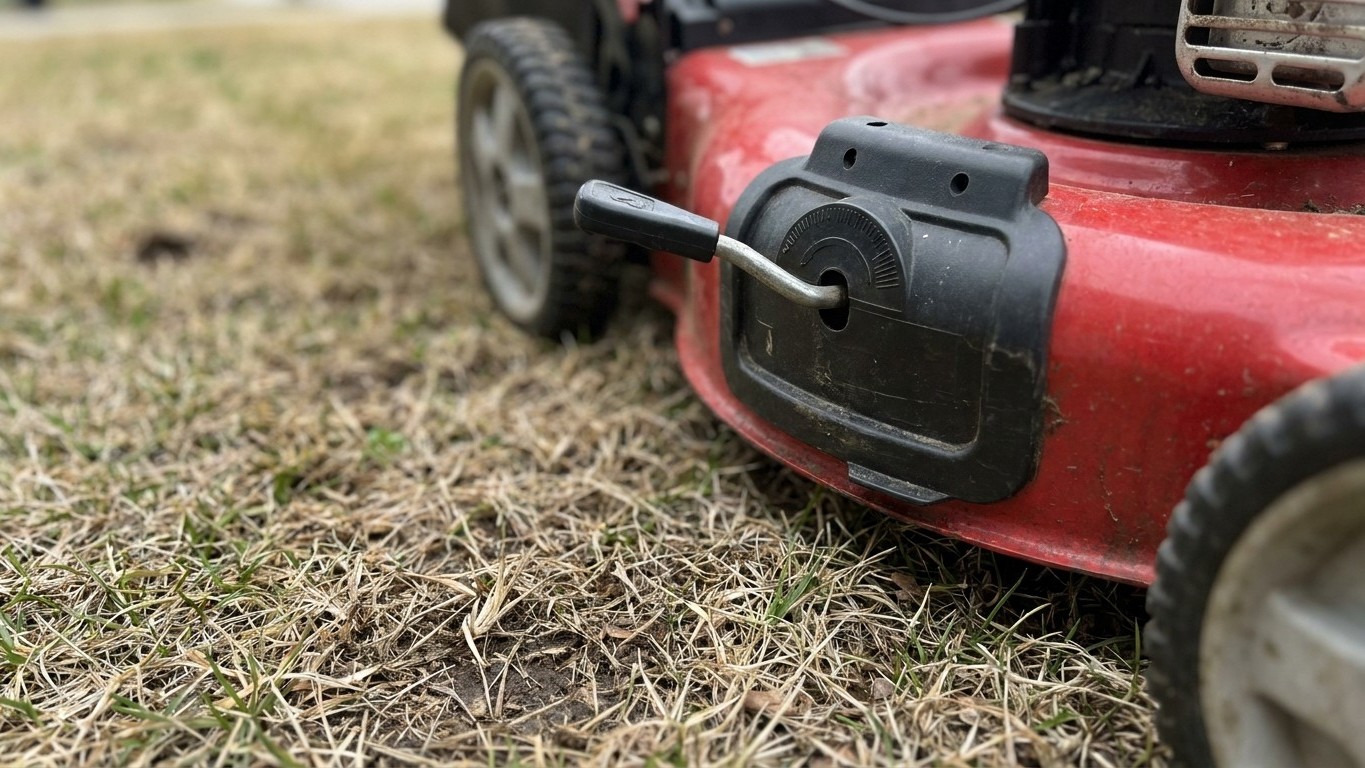
Every Saturday in May, same routine: fire up the mower, set it where you always have, and push it across the yard until things look neat. The lawn seemed fine, a little brown here and there, thin in spots by July, but nothing you couldn’t blame on summer heat or dry spells. The culprit, it turned out, was a single dial on the mower deck that had been quietly strangling the grass for years.
Key takeaways
- One forgotten mower setting has been silently scalping your grass every time you mow
- Cutting too short in May masks damage that doesn’t show until your lawn is already dying by July
- A 30-second adjustment to mower height can reduce weeds and disease by up to 80%
The setting nobody checks, and the damage it does silently
Most homeowners set their mower height once and never touch it again. That’s the problem. Cutting your grass too short, scalping, stresses your turf and can result in poor growth, bare spots, or visible damage. The damage doesn’t show up as a sudden catastrophe. It builds slowly over weeks, disguised as heat stress or drought. By the time the lawn looks genuinely rough, you’ve been scalping it every single Saturday for months.
Lawn scalping is cutting the grass so short that the green leaf cover has been eliminated and the stems are left exposed, you’ll recognize it by the brown, patchy sections that appear on your lawn. Those stems are pale and straw-colored. They don’t photosynthesize. When all of the leaf cover is stripped away, the grass can no longer absorb the energy it needs from the sun to fuel photosynthesis, the process by which it grows and thrives. A lawn getting mowed this way isn’t just looking bad. It’s starving.
What made a groundskeeper’s observation so jarring was how obvious the fix turned out to be. The mower deck was set at its second-lowest notch, a common factory default, and a position that regularly cutting grass at the mower’s lowest setting is one of the clearest signs you may be scalping. Moving it up two notches changed the trajectory of the entire lawn within a few weeks.
Why May is the worst month to cut too low
Spring feels forgiving. The grass is green, growth is fast, and a freshly mowed yard looks sharp on a Saturday morning. May is the month when a lot of decisions don’t show up as problems until July, when fixing them is twice as hard and the damage is already done. The cool, wet weather masks the stress being applied to the root system with every pass of the mower.
Removing more than one-third of the grass blades can cause root growth to cease while the leaves and shoots are regrowing, and this can be especially destructive if practiced continuously over successive mowings. Roots may not have a chance to fully develop, leaving plants more susceptible to environmental and management stresses. Week after week, the same aggressive cut. The roots never recover between mowings. By midsummer, the lawn has the structural integrity of a welcome mat.
Kentucky bluegrass, tall fescue, and perennial ryegrass, the most common lawn grasses across a wide swath of the country — all perform best when kept between three and four inches tall. That’s not a number chosen for aesthetics. It’s the height at which the plant can shade its own soil, retain moisture, and actually win the competition against weeds. Mowing to the proper height can reduce weeds and diseases by 50% to 80% in tall fescue. That statistic deserves a moment.
The one-third rule: simple, rarely followed
The rule every turfgrass specialist cites is brutally simple: never cut more than one-third of the grass blade off at a time, as doing so can stress your lawn and result in yellowing or scalping damage. So if the lawn is sitting at four and a half inches, which it absolutely will in a fast-growing May, mowing it down to three inches is the move. Not to two. Not to one and a half because it looks “cleaner.”
Mowing more frequently at the right height is far better than waiting and then hacking it down all at once. This is the part that trips people up. The Saturday ritual feels efficient. Show up once a week, cut everything short so you can skip a week if life gets busy. But the lawn keeps score. Cutting too much too quickly stresses the grass and makes it more likely to burn out in the sun, especially important during hotter months when grass is already under pressure.
Then there’s the blade itself, which compounds everything. Dull blades tear grass rather than cutting cleanly, leaving ragged tips that turn brown and invite disease. Torn grass loses more moisture through its damaged leaf tips, causing the lawn to dry out faster, especially in hot weather. The one-two punch of cutting too short with a dull blade is how a healthy lawn turns into a patchwork of brown by the Fourth of July. Sharpening mower blades at the beginning of the mowing season and then again every four to six weeks is the kind of maintenance most people skip entirely.
How to recover, and what to do next Saturday
A scalped lawn looks worse than it is. In most cases, grass can grow back after scalping, sometimes faster than you’d expect, as long as you don’t make the classic recovery mistakes. The classic mistake? Mowing again too soon, and too short, trying to even things out. Once a patch has been scalped, it needs recovery time, not another close shave.
The two things most important when nursing a scalped lawn back to health are watering and fertilizing. Water daily very thoroughly, but keep the water pressure low so you don’t do further damage to the vulnerable stems. If the scalping was uniform across the yard, that’s a mower height problem. Uniform scalping suggests you’ve set the mower too low, but if it’s only in certain areas, you’re probably mowing unevenly, perhaps because the underlying land is uneven.
Going forward, the adjustment is mechanical and takes thirty seconds. For a typical residential Midwest lawn, maintain a height of 3 inches or higher. Taller grass shades out weed seeds and keeps soil cooler. Taller grass means longer roots and greater ability to withstand drought and reach nutrients. Raising the mower deck is one of the best things you can do when heat arrives, taller grass provides more shade to the soil, keeping roots cooler and slowing down evaporation.
One detail worth knowing: grass type changes the math slightly. Most warm-season grasses should be at least 1 inch high, while most cool-season grasses should be at least 2.5 inches high. Zoysia and Bermuda, for instance, have tighter tolerances than fescue or bluegrass, but even they suffer when pushed to their lowest limits week after week during active growing season. The mower deck setting isn’t a set-it-and-forget-it detail. Treating it like one is, quite literally, what burns a lawn alive.
Sources : all-trustedlawncare.com | moneytalksnews.com