
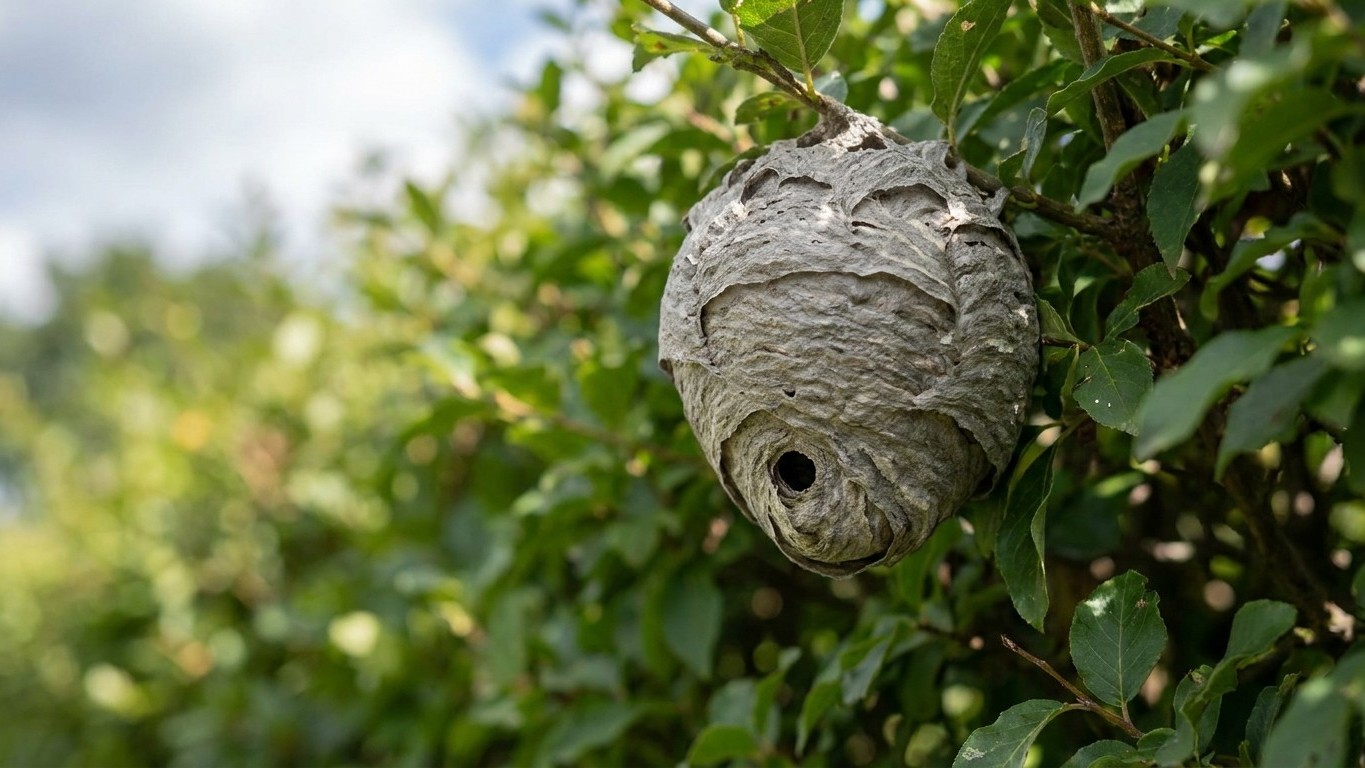
A golf-ball-sized wasp nest in early June seems almost harmless. Cute, even, that papery gray orb tucked into the hedge like a forgotten ornament. Most people make the same call: leave it, watch it, deal with it later. That instinct is understandable. It is also, as thousands of homeowners discover every summer, a serious miscalculation.
By August, that same nest can be the size of a basketball. Sometimes larger. The colony inside has grown from a few dozen workers to anywhere between 5,000 and 15,000 individual wasps, roughly the population of a small American town packed into a structure built entirely from chewed wood pulp. Attempting removal at that stage without professional equipment is not brave. It’s a trip to the ER.
Key takeaways
- A single queen wasp can build a colony that doubles in size every 2-3 weeks during summer
- The nest’s exponential growth between June and August creates a biological timeline most homeowners don’t anticipate
- Late-summer colonies become increasingly aggressive as workers run out of time to reproduce and defend their nest
Why June is when the clock starts ticking
Wasp colonies follow a biological schedule that is almost militarily precise. A single fertilized queen overwinters in a sheltered spot, under bark, inside a shed wall, sometimes in the gap behind your shutters — and emerges in early spring to build alone. Those first few weeks, she constructs the initial comb cells, lays eggs, and raises the first cohort of workers entirely by herself. A nest in late May or early June represents that first generation: maybe 50 to 200 workers, a structure still small enough to fit in your palm.
The exponential shift happens fast. Once that first wave of workers matures, their sole job is to expand the nest and feed the queen’s next batch of larvae. The colony essentially switches from startup mode to full production. Worker populations can double every two to three weeks through July. A nest that measured four inches across on June 15 can hit 18 to 24 inches by mid-August. The geometry of that growth is what catches people off guard, they’re not watching centimeters accumulate, they’re watching a biological machine accelerate.
What “too big to handle” actually means
The danger isn’t purely about size. A mature late-summer colony is also a colony under stress. Worker wasps live only three to four weeks, and by August the nest is producing fewer new workers and more reproductive queens and males. The workers become increasingly aggressive, foraging more desperately for sugars and proteins, which is why August is when wasps crash your barbecue and hover over soda cans. They’re not just annoying. They’re defending a massive, active colony with nothing left to lose.
Disturbing a nest of that scale triggers a coordinated alarm response. Guard wasps release pheromones that recruit defenders within seconds. Unlike bees, wasps can sting repeatedly, no barb to lose, no biological cost per sting. A single person who accidentally disturbs a mature hedge nest can receive dozens of stings before reaching safety. For anyone with a venom allergy, even a handful of stings can be life-threatening. The CDC estimates that stinging insects send roughly half a million Americans to emergency rooms each year, with late summer representing the peak of that caseload.
There’s another layer to this that often goes unnoticed: wasps built inside a hedge are harder to locate precisely than those in an open eave or attic. The foliage masks the entry point. You might brush against the hedge several times before realizing the nest entrance is six inches from your hand.
The window for safe DIY action, and when it closes
If you do spot a nest in early June, the window for low-risk self-treatment is real but narrow. Colonies under roughly 200 workers, typically pre-July, can often be managed with a commercial aerosol wasp freeze spray applied at dusk or dawn, when workers are inside and cold-slowed. The key is distance: most effective products work at 15 to 20 feet. Seal the point of access, retreat immediately, and do not investigate until 48 hours have passed.
That window closes firmly by mid-July. At that point, the calculus shifts completely. A licensed pest control technician has access to insecticidal dusts that can be injected into the nest structure, protective suits rated for full colony contact, and the training to identify secondary entry points. The cost of professional removal, typically between $150 and $400 depending on location and nest size — is considerably less than an urgent care visit, which averages around $250 before any epinephrine administration or follow-up care.
One practical detail that surprises most homeowners: wasp nests are not reused. Once a colony dies out in late fall (only the new queens survive to overwinter), the structure is abandoned permanently. Removing the papery nest in November or December is entirely safe and takes about 30 seconds. The problem is that an abandoned nest, left in place, can attract other species the following spring, including hornets, who sometimes adopt existing structures as a starting scaffold.
Reading your hedge before summer gets away from you
Hedges are prime nesting territory precisely because they offer what wasps need: structural support, shade, and limited human contact. Boxwood, privet, and arborvitae are especially common sites. A quick visual check in late May, before growth thickens, takes less than five minutes and can save the entire summer. Look for the telltale papery gray surface, never the smooth mud-daubed texture of a solitary wasp, and watch for a consistent flight path of insects entering and exiting a single point.
If you find one and decide to monitor rather than act, set a hard deadline: two weeks, not two months. A colony left through June will demand professional attention by July. Left through July, it will demand it urgently by August, often after someone gets stung. The nest that looked manageable from a distance almost always is, in May. The same logic that makes people wait is the same logic that turns a $30 can of spray into a $350 extraction job and a very bad Tuesday afternoon.