
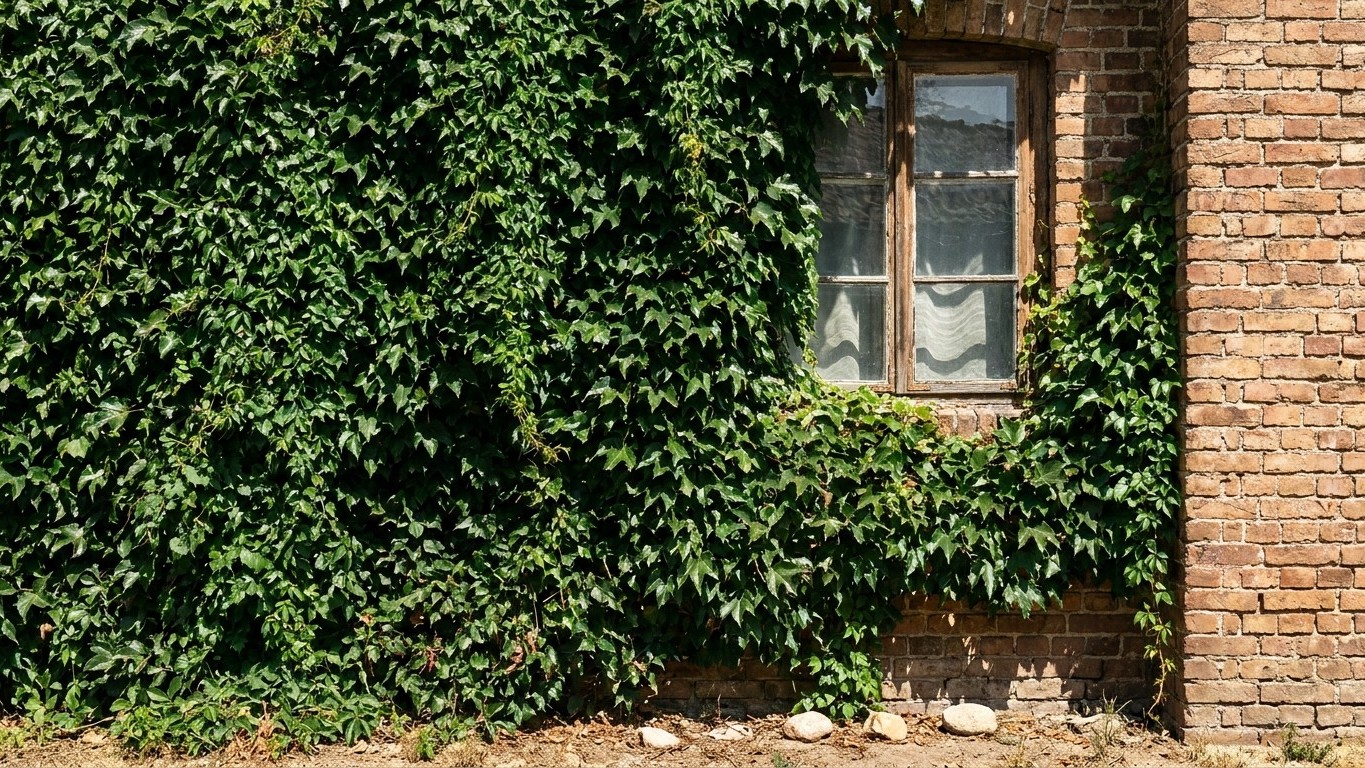
The summer heat hitting a wall at full force is not just a comfort issue. It’s a physics problem, and it turns out the solution was growing in your neighbor’s garden all along. Climbing plants trained against exterior walls do something that no coat of paint or synthetic insulation layer can fully replicate: they intercept heat before it ever reaches the masonry, then actively cool the surface through a biological process that runs entirely on sunlight and water.
Research from the RHS and the University of Reading has found that ivy is among the most effective plant covers for cooling buildings and reducing humidity. But the principle extends well beyond ivy. The mechanism at work here is twofold, and understanding both parts is what separates a garden that looks nice from one that genuinely changes how your home feels inside.
Key takeaways
- Wall plants use a biological process called evapotranspiration that cools like built-in air conditioning
- The right species can reduce interior wall temperatures by 2.5°C with just 10cm of coverage
- One thousand square feet of vegetation delivers cooling power equivalent to a full ton of AC
How a plant on your wall actually beats the heat
The cooling and energy-saving effects of climbing vegetation are mainly related to shading, evapotranspiration, thermal insulation, and wind barriers. Shading is the obvious one, a dense canopy of leaves blocks direct sunlight before it turns your brick or stucco into a radiator. Less obvious, but more powerful, is evapotranspiration. Plants release water into the atmosphere in response to hotter, drier air, much the same way humans sweat to cool themselves down. Your wall, in effect, gets its own built-in cooling system.
The numbers are striking. Surface temperatures of greened exterior walls measured up to 15.5°C lower than those of bare walls during hot summer periods. That’s not a marginal difference, that’s the gap between a wall you can comfortably press your hand against and one that would burn you. An average reduction of 2.5°C in internal wall temperature can be achieved through green walls with about 10 cm of climbing ivy coverage. Given that cooling a space by a single degree Celsius could save around five percent on an electricity bill, the math compounds fast.
When plants with high transpiration rates are grouped together, temperature drops of 5 to 10°F in the immediate area are achievable, and studies show that just 1,000 square feet of vegetation around your home provides cooling equivalent to a 1-ton air conditioning unit. One thousand square feet. That’s not a jungle — that’s a confident spread of Virginia creeper across a south-facing wall.
Which plants actually work, and where to put them
Research looked at three species in particular: common ivy (Hedera helix), Boston ivy (Parthenocissus tricuspidata), and climbing hydrangea (Pileostegia viburnoides). All three performed well in summer cooling tests. But they behave very differently on a wall, which matters as much as their thermal properties.
Virginia creeper (Parthenocissus quinquefolia) is one of the fastest movers. Sometimes overlooked in favor of flowering vines, this native climber is known for its fiery crimson hues in fall and its vigorous coverage of surfaces. It clings to brick or stone surfaces using adhesive “holdfasts” at the tendril ends, requiring no trellis, no wires, no hardware. Plant it at the base of a sunny south or west wall and step back. The problem, if you can call it that, is that you will need to keep it in check, it can become rampant and should be clipped back regularly, a recommendation echoed by experts at the Missouri Botanical Garden.
For a shadier wall or a more permanent, architectural look, climbing hydrangea is the right call. It’s a strong choice for sound masonry and cooler exposures, and a freestanding or offset trellis is usually safer than direct wall attachment. A separate trellis set a few inches off the surface preserves airflow, keeps stems off paint, and leaves inspection access around windows, gutters, and joints. Slower to establish than its cousins, potentially taking a few seasons before it really commits, but once it’s up, it’s there for decades.
Wisteria deserves a mention, with a caveat. Wisteria doesn’t only adorn a house with cascading blossoms in spring, it can also effectively protect walls from wind and the elements in both summer and winter. American wisteria produces lilac-blue flowers in spring that are considered preferable to its Asian cousin, which the USDA classifies as invasive for its tendency to crowd out native plants. Go native, prune twice a year, and build it a structure that can actually hold it — wisteria gets heavy.
The wall damage question (worth asking before you plant anything)
It comes up every time: won’t climbing plants destroy my walls? The honest answer is “it depends.” Common ivy produces strong aerial roots that can penetrate cracks in masonry, the RHS warns this can cause structural damage, but the aerial roots produced by Boston ivy and Virginia creeper are significantly weaker and are not associated with structural damage. If your walls are in good condition, Boston ivy and Virginia creeper are essentially safe bets. Ivy is a different conversation.
There have been concerns that green walls may increase relative humidity and cause damp issues, but research has demonstrated this is not the case. In fact, a canopy of climbing plants can prevent excessive heating and cooling, moderating freeze-thaw cycles, salt weathering, and other deterioration processes. The wall under a well-managed green façade is often more protected than an exposed one, not less. The key word being “well-managed”: gutters must stay clear, windows must remain accessible, and stems shouldn’t be allowed to work their way under flashing or roofing.
Deciduous or evergreen, one choice, two very different winters
Evergreen wall plants provide an extra layer of insulation that keeps homes warmer in winter and cooler in summer. That continuity is worth something if your goal is year-round energy performance. But deciduous plants offer a different advantage: summer shade while allowing low-angle winter sunlight to warm your home during the coldest months. Virginia creeper, Boston ivy, and wisteria all drop their leaves, which means your south-facing wall still catches passive solar warmth in January when you actually want it.
Beyond outdoor comfort, green walls also reduce indoor energy demands by buffering buildings against temperature extremes. In Mediterranean-type climates, cooling energy reductions average around 33.9 percent, and temperature drops of up to 6°C on building surfaces have been recorded during peak summer days. Even in temperate zones, the effect is measurable and persistent. The plants don’t clock out at sunset either, the insulating layer of air trapped between the foliage and the wall continues moderating temperatures through the night, which is when a house that’s spent the day absorbing heat finally starts releasing it indoors.
One detail that rarely makes it into gardening advice: the thermal performance of green walls is multifaceted, with climate, building skin type, and the density of plant coverage all playing key roles. A sparse, newly planted vine will do a fraction of what a dense, established one achieves. Coverage density, leaf area index, in research terms, matters more than species choice. The denser the canopy, the greater the cooling. That first summer may be modest. The fifth will surprise you.
Sources : sciencedirect.com | rhs.org.uk