
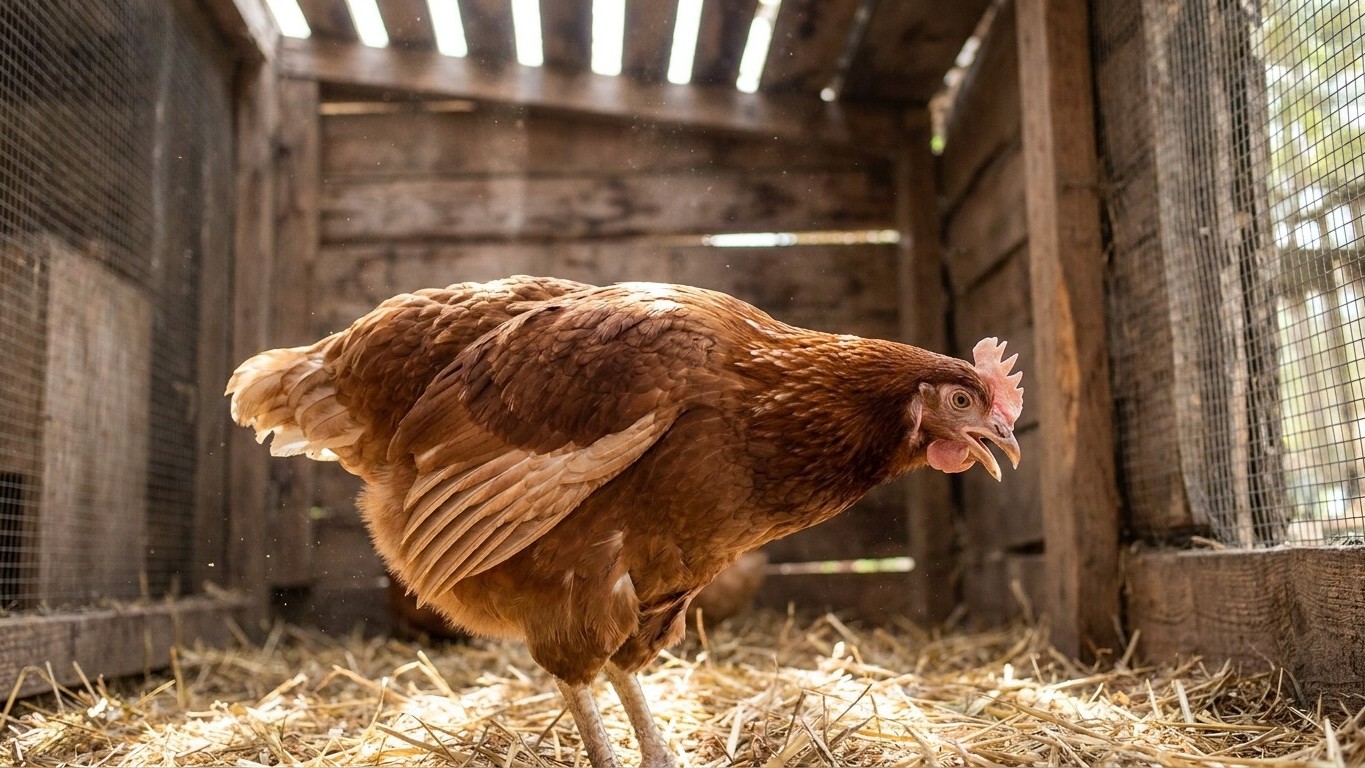
Panting beak-open isn’t a hen cooling off comfortably. It’s a bird burning through her last defense against heat stroke, and by the time you spot it at 93°F, she’s likely already lost her appetite, her egg production, and possibly her balance. A backyard poultry breeder in Georgia set me straight on this last summer, walking me through what’s actually happening inside a coop once temperatures climb past 86°F, and none of it looked like the peaceful backyard scene I’d imagined.
Chickens don’t sweat. They have no sweat glands anywhere on their bodies, so their only cooling mechanisms are panting, holding their wings away from their body, and seeking shade or cooler ground. Panting works by evaporating moisture from the respiratory tract, but it’s wildly inefficient compared to sweating, and it burns calories the bird needs for other functions. Past 86°F, according to poultry extension guidance from Mississippi State University’s Extension Service, chickens start diverting blood flow away from their digestive organs and toward their skin and respiratory system just to survive the heat. That’s not a minor inconvenience. That’s a full-body triage response.
Key takeaways
- 86°F is the threshold where chickens shift from mild stress into dangerous physiological changes—but most owners don’t realize it
- Panting is NOT the first sign of heat stress; birds go quiet and lethargic before you see the open beak
- A coop’s interior can run 10–15°F hotter than outside, turning an 88°F yard day into a 104°F death trap
What 86°F Actually Triggers Inside the Coop
The number 86°F isn’t arbitrary. Research from poultry science departments consistently marks this threshold as the point where chickens shift from mild heat stress into active physiological strain. Below that, birds pant occasionally and slow down a bit. Above it, cortisol levels spike, blood pH shifts toward alkalosis from rapid breathing, and calcium metabolism gets disrupted, which is why hens under sustained heat stress lay thinner-shelled eggs or stop laying altogether.
The breeder I spoke with keeps a thermometer clipped inside her coop at roost height, not outside in the yard, because the difference Matters More Than people expect. A coop with poor ventilation can run 10 to 15 degrees hotter than the ambient temperature outside, especially if it has a metal roof catching direct sun. She’s measured coops hitting 104°F inside when the yard read 88°F. At that point, birds aren’t just uncomfortable. They’re minutes from collapse, particularly heavier breeds like Orpingtons or Brahmas that carry more body mass and struggle to shed heat efficiently.
The Signs Most Owners Miss Until It’s Too Late
Panting is the obvious sign, but it’s actually a mid-stage warning, not an early one. Before that, hens go quiet. They stop foraging, stand instead of walking, and spread their wings slightly away from their bodies to expose more skin to air. Combs and wattles, normally bright red, can turn pale or even bluish as blood redirects away from extremities. A hen that’s lethargic, sitting with her eyes half-closed and wings drooped, has moved past simple discomfort into territory where dehydration and organ stress are setting in.
What really changed my thinking was learning how fast this progresses. A hen showing mild signs at 2 p.m. can be in full heat stress, stumbling and unresponsive, by 4 p.m. if nothing intervenes. The breeder described losing two hens in a single afternoon years ago, both older birds, both appearing fine at lunch. Heat stress doesn’t build gradually the way a slow summer afternoon feels to us. It compounds, because a stressed bird’s body temperature keeps climbing even as it tries harder to cool down, creating a feedback loop that’s hard to break without direct intervention.
What Actually Helps, Beyond a Bowl of Water
Fresh water matters, but temperature of that water matters just as much. Chickens will avoid water sitting in direct sun that’s climbed to 90°F or warmer, so shaded, frequently refreshed water stations make a measurable difference. Some keepers add electrolyte powders or a splash of unflavored Pedialyte to help replace what birds lose through rapid panting, though plain cool water refreshed multiple times a day covers most needs.
Ventilation beats fans in many setups, because moving hot air around a coop doesn’t cool it, it just circulates the same overheated air. Cross-ventilation, meaning openings on opposite walls that let a breeze pass through rather than dead-end, drops interior coop temperatures noticeably compared to a single vent or window. The breeder also swears by frozen water bottles placed in the coop’s shaded corners, giving birds a cool surface to lean against, and she mists the ground outside the run rather than the birds themselves, since direct water on feathers can trap heat rather than release it once the outer layer dries.
Diet shifts during heat waves too. Digesting feed generates internal heat, so many breeders switch to feeding in early morning and late evening instead of midday, letting birds’ digestive systems do their heat-generating work when ambient temperatures are lower. Some also offer frozen fruit like watermelon chunks, which double as hydration and a temperature-lowering treat birds genuinely seek out during a heat spell.
Knowing When It’s an Emergency
A hen lying on her side, unresponsive to touch, or showing labored gasping rather than steady panting needs immediate cooling, not a wait-and-see approach. Submerging feet and legs in cool (not ice-cold) water, or gently wetting the underside of wings where blood vessels sit close to the skin, can bring body temperature down faster than ambient shade alone. The breeder keeps a shallow tub specifically for this, filled with cool water from the tap, because ice water can send a bird into shock rather than helping her recover.
What surprised me most wasn’t the science, it was how normalized mild heat suffering has become among backyard flock owners. Panting gets dismissed as “just how chickens deal with summer,” when it’s actually the visible edge of a much more serious internal struggle. The next heat wave that pushes past 86°F, that open beak isn’t background noise. It’s the bird telling you exactly how close to the edge she already is.