
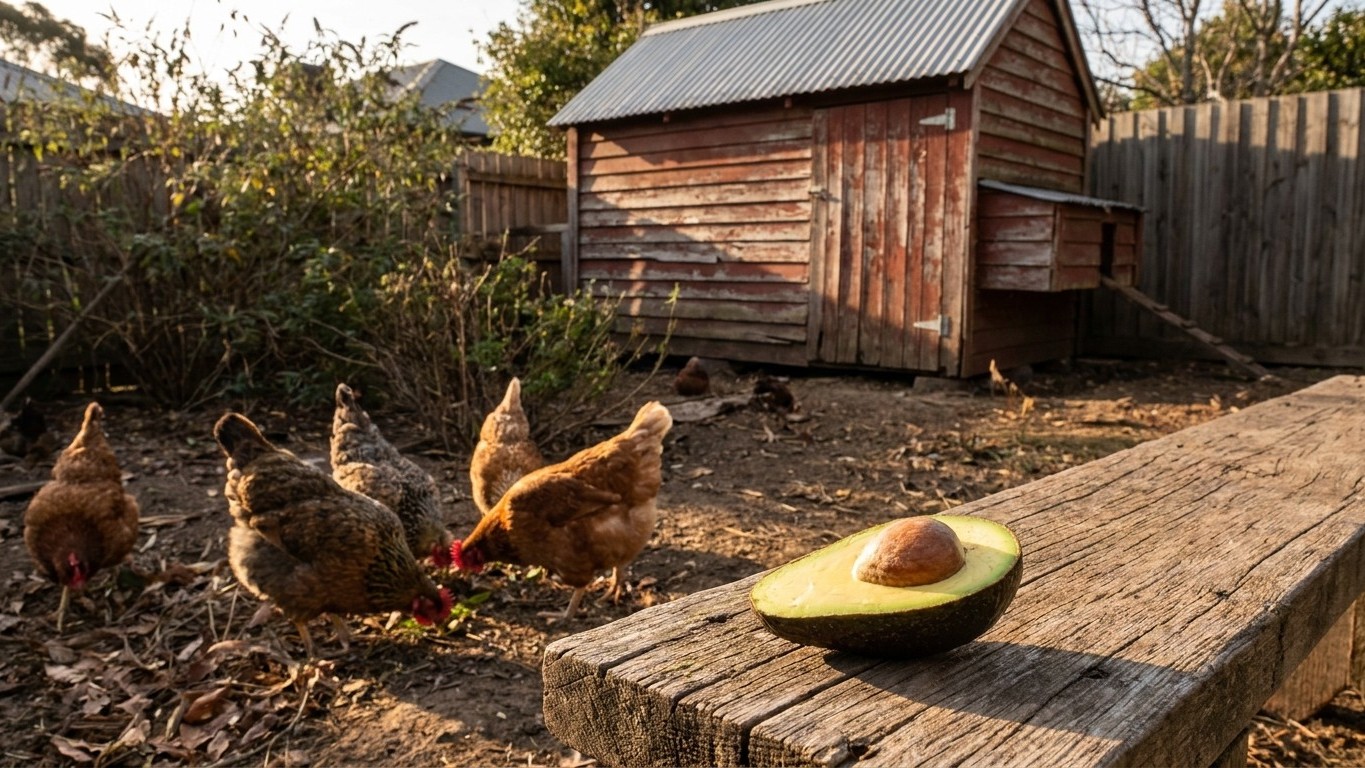
Backyard chicken keepers love turning kitchen scraps into flock treats. Apple cores, banana peels, watermelon rinds, carrot tops, it all seems to disappear happily into the run. But one popular fruit hides a compound that can drop a hen dead within hours: the avocado. Its skin, pit, and even its flesh contain persin, a fungicidal toxin that the fruit produces naturally, and it’s genuinely dangerous to poultry, even in small quantities.
Key takeaways
- One common kitchen fruit contains a toxin that poultry vets call uniquely dangerous—and most backyard keepers have no idea
- Symptoms can appear in minutes or hide for nearly a day, making this threat especially sneaky for flock owners
- Anecdotes of flocks surviving avocado exposure reveal a dangerous misconception about dose and individual bird vulnerability
What Makes Avocado So Dangerous for Chickens
Avocados and other parts of the avocado tree, Persea americana, are toxic to birds, containing a fat-soluble compound called persin, which is similar to a fatty acid except it’s an unsaturated diene that acts as a fungicidal toxin. The fruit evolved this chemical defense to fight off plant pathogens, not to harm animals, but birds turn out to be uniquely sensitive to it. Although it is harmless to humans, even a small amount can be deadly to birds if ingested.
That sensitivity gap is what makes the fruit so sneaky. Nobody worries about tossing an avocado peel in the compost because it’s a “superfood” for us. For a five-pound hen, the math looks completely different.
The skin and pit carry the highest concentration of the toxin, but don’t assume the flesh is a free pass. Certain parts of the avocado, especially the skin, pit, and even the flesh, contain a toxin called persin, which can be harmful or even deadly to chickens. Some sources note that ripeness and variety change how much persin is present, but there’s no reliable way to eyeball a “safe” avocado in your kitchen. Because it’s difficult to completely separate the edible portion from the more concerning parts, most experts recommend skipping avocado altogether and choosing a safer flock-friendly snack.
How Fast Persin Poisoning Actually Moves
This isn’t a slow-building deficiency you’ll catch weeks later. Clinical signs of toxicity vary widely and may develop as quickly as 15 to 30 minutes after ingestion of the fruit, but it may also be delayed up to 30 hours. That window makes it especially unsettling for flock owners: a hen can look completely fine at dusk and be in respiratory distress by morning.
Watch for a cluster of symptoms rather than one single red flag. Some of the most common symptoms seen in birds include weakness, depression, reluctance to perch, ruffled feathers, and difficulty breathing, and once respiratory signs develop, death will usually follow quickly. Other flock health resources describe similar patterns, including lethargy or lack of energy, loss of appetite, difficulty breathing, swelling in the abdominal area, and abnormal behavior such as lack of coordination. In severe cases, the damage isn’t just respiratory. When ingested by chickens, persin can cause heart tissue damage, breathing difficulties, fluid accumulation in the chest cavity, and death. Some sources put a rough clock on it too: avocado contains persin, a toxin that can cause heart failure, difficulty breathing and weakness in chickens, and high doses may result in death within just 12 to 24 hours.
Young and compromised birds fare worst. Owing to their delicate constitutions and greatly reduced body mass, even a tiny bit of persin is enough to kill a chick stone-dead. Older, sick, or already-weak hens in the same run are also more exposed, so a single tossed avocado skin can end up being far riskier for your most vulnerable birds than for your strongest layers.
Why “My Chickens Ate It And Were Fine” Isn’t Good Evidence
You’ll find no shortage of backyard forums where someone swears their flock pecked at avocado flesh without issue. That’s not surprising, and it’s also not proof of safety. Dose matters enormously with persin: a nibble from a large flock sharing one avocado is a very different exposure than one hen finishing off a whole pit-adjacent chunk alone. And cooking doesn’t neutralize the risk the way it does with some other food toxins. Cooking an avocado in any way does nothing to significantly reduce the amount of toxins present in the fruit.
There’s also no antidote once symptoms start. Treatment options are limited to supportive care, which is exactly why prevention matters more here than with most kitchen-scrap hazards. If you notice any of these symptoms, it is crucial to act quickly, removing any suspected food source and contacting a veterinarian specializing in poultry for proper guidance and treatment. Given that speed and the lack of a reliable “safe dose,” most poultry vets and hatcheries land on the same blunt advice: skip avocado entirely, rather than trying to calculate how much flesh might be tolerable for your particular birds.
What To Toss Into the Run Instead
The good news is that chickens are remarkably unfussy, and there’s a long list of scraps that genuinely work as treats rather than gambles. Watermelon rind is a standout: chickens can eat all parts of the watermelon, including the rind, flesh, and seeds. Carrots are another safe bet across the board, since chickens can eat all parts of the beet plant including beet greens, leaves, peels, pulp, shreds, and skins. Berries, apples (minus the seeds), and cooked pumpkin round out a rotation that keeps a flock entertained without the guesswork.
A few other fruits deserve a quick note of caution alongside avocado, even if they’re less severe. Apple, cherry, peach, and plum pits all contain compounds that release cyanide, so although apples make healthy treats for chickens, their seeds contain amygdalin, which can release cyanide when digested, and should be removed before offering apples to a flock. None of those come close to avocado’s speed or lethality, but they’re worth remembering the next time you’re scraping fruit trimmings into a bucket destined for the run.
One detail rarely mentioned: the danger isn’t limited to store-bought avocados. If you keep an avocado tree or houseplant near the coop, the leaves and bark carry persin too, so free-ranging birds that wander under a backyard avocado tree face the same exposure as a hen handed a peel straight from the kitchen counter.
Sources : fullyhealthy.com | theeasyhomestead.com