
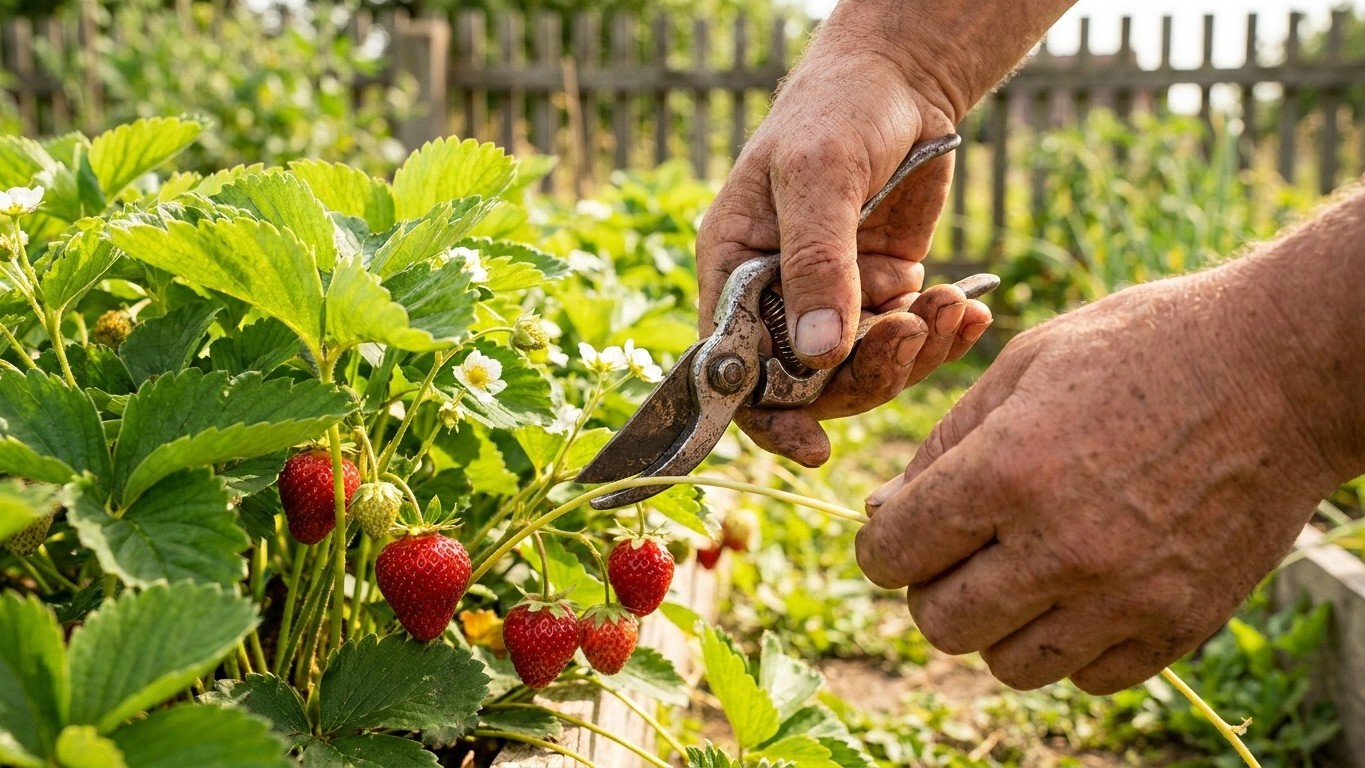
Every July, like clockwork, my father would grab a pair of shears and march into the garden to butcher what looked, to my teenage eyes, like a perfectly healthy strawberry patch. He’d snip away at the long, spindly stems shooting out from each plant, tossing them into a bucket while I stood there convinced he was ruining next year’s crop. Turns out he wasn’t destroying anything. He was protecting it.
Those stems he kept cutting are called runners, or stolons if you want the botanical term. They stretch out from the mother plant like botanical escape artists, siphoning energy that would otherwise go into plump, market-ready berries. Each runner can sprout a tiny plantlet at its tip, and if that plantlet touches soil, it roots and becomes a brand-new Strawberry plant, genetically identical to the one it came from. It sounds like a bonus. Free plants! But for anyone growing strawberries mainly to eat them, those baby plants come at a real cost.
Key takeaways
- Strawberry runners drain energy meant for plump, delicious berries—a problem costing U.S. farms $130 million annually
- July is the perfect timing: it redirects plant energy right when it would naturally shift toward runners anyway
- There’s a hidden benefit nobody mentions: removing runners prevents fungal diseases by improving air circulation
The Energy Math My Father Understood Instinctively
Strawberry plants operate on a strict energy budget. Strawberry plants have a certain amount of leaves, each with a certain capacity to photosynthesize every day, and as the plant uses sunlight, water, and carbon dioxide to produce energy, it naturally allocates certain amounts to different plant functions. Flowers and fruit are expensive to produce. So are runners. And a plant can’t max out both at the same time.
Flowering and fruiting require a lot of energy, so you don’t want the plant to use its valuable glucose stores to grow a bunch of runners when it could be growing fruit; removing the runners ensures that a maximum amount of energy is channeled toward producing tasty berries. This isn’t folk wisdom passed down through generations of backyard gardeners with too much time on their hands. It is scientifically proven that runner removal improves strawberry fruit yield. Researchers at Rutgers University, where strawberry physiology has been studied extensively, describe the same tug-of-war inside the plant. While runners are essential for strawberry propagation, their formation can sometimes be excessive, diverting energy from fruit production.
My father, of course, never cited a study. He just knew that a patch left to sprawl produced smaller, sadder berries the following season. Turns out this is such a widespread issue that it costs the U.S. strawberry industry real money at commercial scale. Strawberry growers pour roughly $130 million a year, nationally, into a surprisingly stubborn problem: a part of the plant that sabotages fruit production. That’s not a typo. Commercial farms spend that much annually just paying workers to do exactly what my dad did with his kitchen shears, minus the muttering about “wasted energy.”
Why July Specifically Matters
Timing wasn’t incidental to my father’s ritual either. There’s a biological logic to doing this in midsummer rather than, say, April or October. The sweet spot is right after the June-bearing harvest ends, typically mid-July, when fruit production is over and the plant’s energy shifts naturally toward runner production. Cutting at that exact moment redirects energy right as the plant is deciding where to invest it next: toward building a stronger crown and root system for the following year, instead of scattering resources across a dozen fledgling offshoots.
There’s also a disease angle my father never explicitly mentioned but clearly acted on. A tangle of unchecked runners creates a dense mat of foliage. Overcrowding reduces air circulation around the plants, which is a common invitation for fungal diseases like powdery mildew and gray mold, and it also makes it harder for sunlight to reach all the leaves, impacting overall plant health. A crowded patch is also just harder to work with. You can’t easily spot a sick leaf or a hidden pest when everything is knotted together like a briar patch.
Not every strawberry variety behaves the same way, either, which explains why my father was more aggressive with some rows than others. June-bearing varieties produce one large crop of berries in early summer and are also prolific runner producers, so if you have June-bearing plants and want a big harvest, runner removal is especially important. Everbearing types are gentler about it. They produce a couple of harvests, one in spring and another in late summer or fall, and tend to produce fewer runners than June-bearers, so you’ll still want to manage them, but perhaps not as aggressively.
When Letting Runners Grow Actually Makes Sense
None of this means runners are the enemy. If you’re trying to expand a strawberry bed rather than maximize this year’s harvest, they’re the cheapest multiplication tool nature offers. My father did this too, just on a separate, smaller patch he treated differently from his main producing rows. Oregon State University Extension draws a clear line: runners that root before September 1 are significantly more productive than late-rooted ones, because late-rooted runners don’t accumulate enough leaf area and crown mass before flower initiation in autumn.
If propagation is your goal, restraint still matters. Quantity over quality exhausts the mother plant and produces weak daughters, and three strong, early-rooted daughters are worth more than ten straggly ones. That’s essentially the same principle my father applied to his fruiting beds, just aimed at a different outcome. Keep a few, cut the rest, and never let a runner grow its own runners. Once a daughter plant starts sending its own runners, cut those off immediately.
Commercial breeders are now trying to engineer this problem away entirely. Researchers at the University of Florida are hunting for the genetic switches that control runner production, hoping to create varieties that stay compact in fruiting fields but still multiply freely in nurseries. Growers have found that removing runners from plants in the field improves both the quality and yield of the fruits, and it’s become a standard process for growers to trim runners from fruit-producing plants. Until those low-runner varieties become widely available at the garden center, the job still falls to a pair of shears and a bit of patience, exactly the tools my father reached for every July, decades before I understood what he was actually doing.
Sources : bloomingexpert.com | harvestny.cce.cornell.edu