
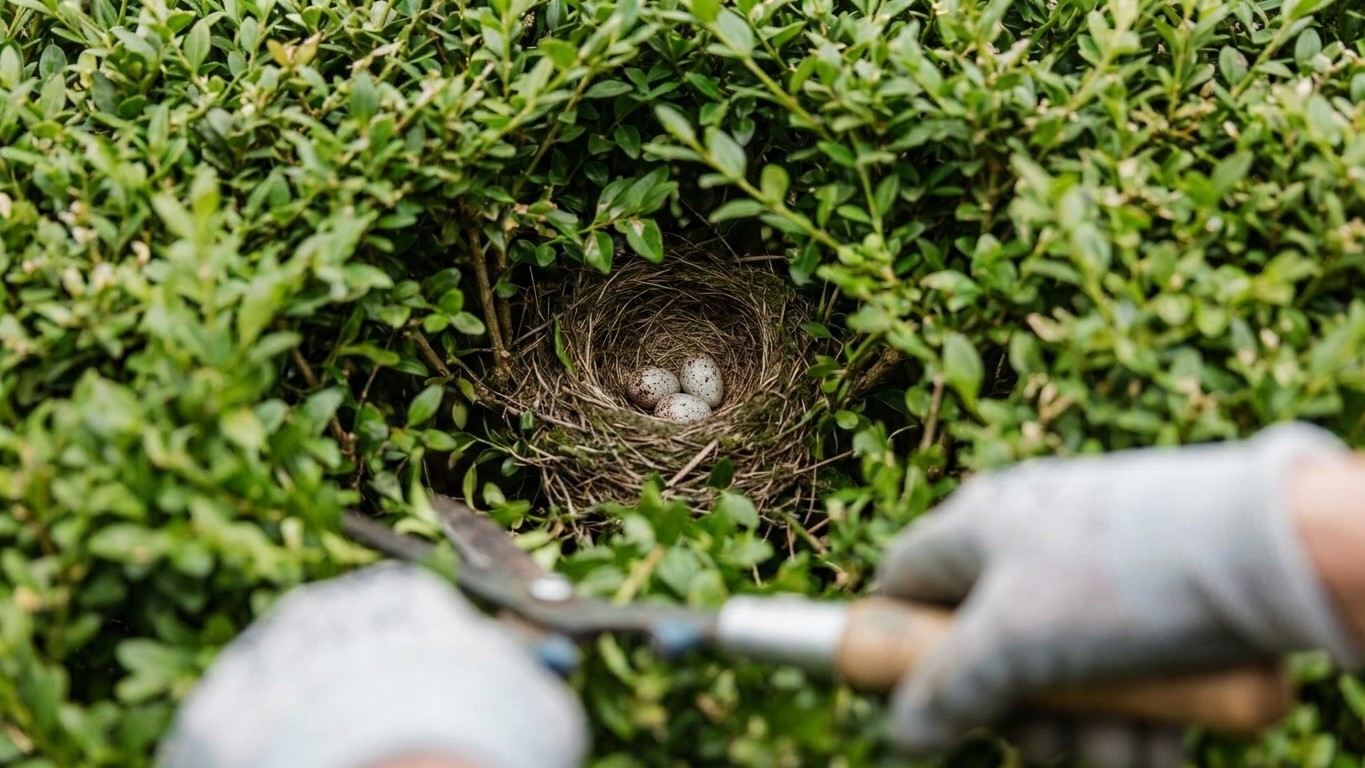
An “empty” hedge is rarely empty. Wildlife officials across the country point to the same recurring problem every spring: a homeowner reaches for the trimmer, sees no bird flying out, and assumes the coast is clear. Weeks later, a scattering of broken shells or a starving hatchling on the lawn tells a different story. The nest was there all along, tucked low where the leaves are thickest, exactly where a bird would build it so no one would notice.
The Federal Law Most People Have Never Heard Of
The Migratory Bird Treaty Act of 1918 is one of the oldest wildlife protection laws on the books, and it still governs what happens in your backyard hedge today. Under the MBTA it is illegal to destroy a nest that has eggs or chicks in it or if there are young birds that are still dependent on the nest for survival. The law doesn’t care whether the hedge belongs to a farm, a city park, or a rental property with a landscaping contract. It applies everywhere native birds nest.
What surprises most people is how the law treats intent. Penalties for violations aren’t symbolic. Federal guidance used by transportation agencies notes that penalties associated with MBTA violations may include six months in prison and a $15,000 fine, up to a felony violation with a maximum penalty of two years imprisonment and a $250,000 fine. States often stack their own rules on top. In California, regulators warn that fines can be up to $500,000 for destroying an active nest, whether the culprit is a homeowner, a landscaping crew, or a homeowners’ association that scheduled the work.
There’s a technical loophole worth knowing, and it explains why the timing advice matters so much. The MBTA does not contain any prohibition that applies to the destruction of a bird nest alone, without eggs or birds in it, provided that no possession occurs during destruction. Even though destruction of a nest by itself is not prohibited, nest destruction that results in the unpermitted take of migratory birds, or their eggs, is illegal and fully prosecutable. In plain terms: cut an empty nest, you’re probably fine. Cut a nest with eggs inside, even by accident, and you’ve broken federal law. The hedge doesn’t announce which kind you’re dealing with.
Why “I Didn’t See Anything” Doesn’t Hold Up
Songbirds are experts at hiding. Robins, wrens, and finches build low in dense foliage precisely because predators, including well-meaning gardeners, tend to look up and outward rather than down into the tangle. Federal wildlife officials acknowledge this directly, noting that some nests are hard to see and identify, making them more vulnerable to inadvertent destruction, and birds that nest in tree cavities or holes in the ground are particularly difficult to spot. A trimmer doesn’t ask permission before it reaches the interior branches.
The behavioral tells are there if you slow down and look for them. Repeated flights in and out of the same spot. A parent bird carrying nesting material, or returning with a beakful of insects. Constant chirping concentrated in one section of the hedge rather than spread across the whole thing. Guides from arborists who deal with this constantly describe exactly this pattern: if an adult can be seen moving twigs, straw, and grass up into a canopy or into a hedge, it is likely building a nest, and adults removing faecal sacs or returning with worms and small insects are also giveaways. None of that is visible from the driveway. It requires standing next to the hedge for a few minutes before firing up the blades, something almost nobody does on a Saturday morning with a to-do list.
Disturbance alone can be fatal even without a single cut branch. Wildlife agencies warn that if a nest with eggs or young is disturbed, the parent birds may abandon it entirely, leaving chicks to starve within hours. The chainsaw doesn’t have to touch the nest to end it.
The Calendar Isn’t the Same Everywhere
“Late August” is a useful rule of thumb, not a fixed date, and that’s where a lot of the confusion starts. Nesting season shifts with climate and latitude. One wildlife gardening expert put it plainly: the nesting season kicks off around February 1 in warmer southern regions like Phoenix, while up north in places like New York, it starts closer to the end of March. The same source adds that most people will want to get pruning done by the end of February, and won’t be able to trim again until late August, when most nesting is wrapping up for the year. That’s a six-month window in much of the country, longer than most homeowners expect when they’re staring at an overgrown boxwood in June.
Some regions push even further. Coastal California guidance notes breeding activity beginning as early as February, with most wrapping up by the end of August, though depending on location and conditions the breeding season may start earlier or extend later, and some species may even breed year-round. Multiple broods complicate things further. A pair of cardinals or robins can nest two or three times in a single season, meaning a hedge that looked clear in May might have a second family moving in by July.
None of this happens in a vacuum. Continental bird populations have already taken a historic hit. Since 1970, the combined avian population of the United States and Canada shriveled by a net of more than a quarter, or almost 3 billion birds, according to research published in Science. Habitat loss, not any single hedge trimmer, drives that number. But every nesting season that gets interrupted in a backyard is one less contribution to the recovery conservationists are trying to build.
What Actually Works
The safest approach isn’t complicated: heavy pruning in early spring before nest-building starts, or after fledglings have left in late summer, with a genuine walk-around inspection before any cut in between. If a hedge shows signs of activity, the fix is patience, not permission. Wait a few weeks. The birds move on, the hedge keeps its shape, and nobody has to explain themselves to a wildlife officer over a broken branch and an empty shell on the ground.
Sources : homesandgardens.com | science.org