
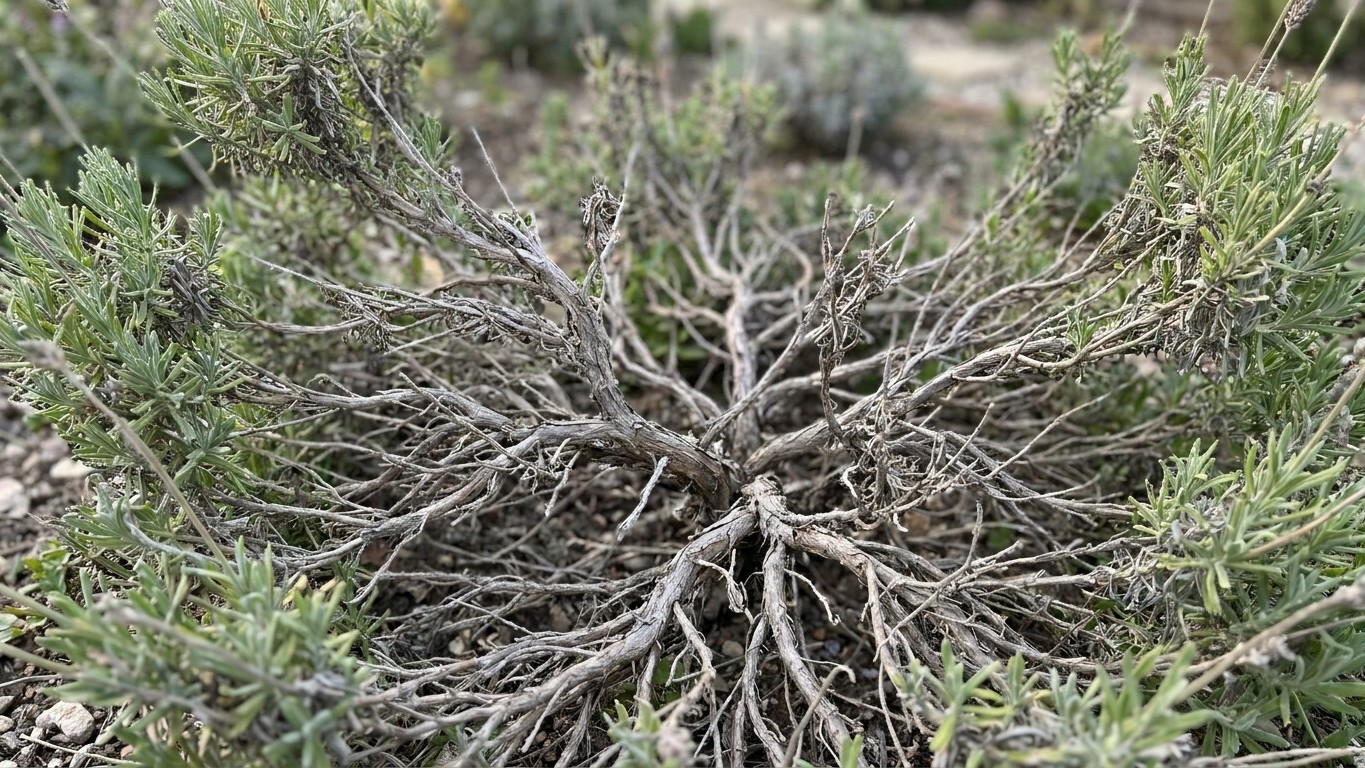
The bald spot doesn’t announce itself. One season your lavender mound is round and generous, cushioned with silvery foliage. The next, you part the branches to check on it and find nothing there. Just gray, brittle wood, split open like a bad haircut, with all the green pushed out to the edges. That’s the moment you realize the hands-off approach you thought was “letting nature take its course” was actually a slow-motion collapse.
Key takeaways
- Lavender isn’t like other shrubs—its woody skeleton never produces new shoots once it hardens, making one missed year dramatically different from roses or peonies
- The moment you spot a bare center is often the moment you can no longer save the plant the way you think you can
- There’s a narrow window and a precise fraction that separates a thriving 15-year plant from one destined for the compost heap
Why skipping the post-bloom cut backfires so badly
Lavender isn’t a true perennial in the way roses or peonies are. Lavender is a subshrub, not a true perennial. That distinction Matters More Than most gardeners realize, because it means the plant builds a permanent woody skeleton every year, and that skeleton never produces new shoots once it hardens off. The practical consequence: skip your annual prune, and the green zone, the band of living, bud-bearing stem above the woody base, retreats further up the plant each year. Eventually the green zone is only at the outermost tips, perched on two feet of bare grey wood.
Left alone through several flowering cycles, the plant essentially cannibalizes its own center. As the head gardener at Norfolk Lavender’s National Plant Collection puts it plainly: “If left unpruned, plants become too tall, woody and gappy, splay open and finally collapse.” That splaying isn’t just cosmetic. It will also grow misshapen or ‘leggy,’ splitting at the base while the branches get longer and heavier, causing the stems to be unable to support the flower heads, flopping over and drooping under the weight. The plant you loved for its tidy dome starts looking like it’s trying to escape its own pot.
The rule that separates a rescue from a funeral
Here’s where things get tricky, and where a lot of well-meaning gardeners make it worse. The instinct, once you spot a bare center, is to cut hard and hope the shock triggers regrowth. With most woody herbs, that would work. Not with lavender. Never cut them back, hoping to stimulate new growth. The plant cannot produce new growth from the woody parts. The brown, lignified wood has no dormant buds waiting to activate. Rejuvenating an old, woody lavender plant can be a bit of a gamble, as lavender generally doesn’t readily sprout new growth from old, bare wood.
So the safe zone is narrower than you’d think. Cut just above the green growth, avoiding the woody stems. This encourages new growth without harming the plant. Most guides converge on the same fraction: remove roughly a third of the plant’s growth, staying in living tissue. Prune back by about one-third. Using a sharp pair of hand pruners or hedge shears, cut plants back by at least one-third the length of each stem to remove leggy growth, cutting approximately 2″ above the woody part of the stems. Go further into the brown zone and you’re not pruning anymore, you’re amputating something that won’t grow back.
Timing matters just as much as depth. Established lavender plants that have some woodier growth at the bottom are generally tidied and maintained with just one annual cut, straight after flowering in late August/September, once the bees are no longer interested. Miss that window entirely, and you’re not without options, but the margin shrinks. Some gardeners follow up with “another light prune in early spring, mid-March. This tidies up ‘loose ends’ and gets them back into shape.”
What actually happens once the center is already bare
If you’re past the point of prevention, one popular fix is layering, essentially coaxing the plant to root itself again from the outside in. A variation of the layering method is to bury the trunk and main branches of the old lavender plant with potting mix. This is easy if the center is already bare with long branches falling over to every side. Spread the main branches around in a star-shaped pattern. The buried sections, kept moist and shaded from competing foliage, can eventually put down their own roots and sprout fresh growth from what used to be dead-looking wood.
Patience becomes non-negotiable at this stage. A note about patience: all methods for rejuvenating lavender require time. Your lavender will look like a work in progress for 3-4 years. It won’t look nice but it’ll be fun to see it grow! And even then, success isn’t guaranteed. There’s no guarantee the plant will recover, especially if it’s extremely old, severely woody with no visible green growth, or has been stressed. One nursery’s blunt advice for the worst cases: “remember it won’t rejuvenate on old wood. So, if that’s what you are dealing with, it’s time to replace your deadwood with something new.”
There’s a quieter lesson buried in all this, too. Gardeners who prune lightly twice a year, once after the first flush and again after any second bloom, rarely end up staring into a bare center at all. With proper care and regular pruning, lavender plants can thrive for several years, often up to 10-15 years or more. A plant that could have anchored a border for a decade shouldn’t be traded away after three seasons of neglect, and the fix, annoyingly enough, was never complicated. It just required showing up with the shears before the flowers had fully faded, not after.
Sources : bloomingexpert.com | bloomingexpert.com