
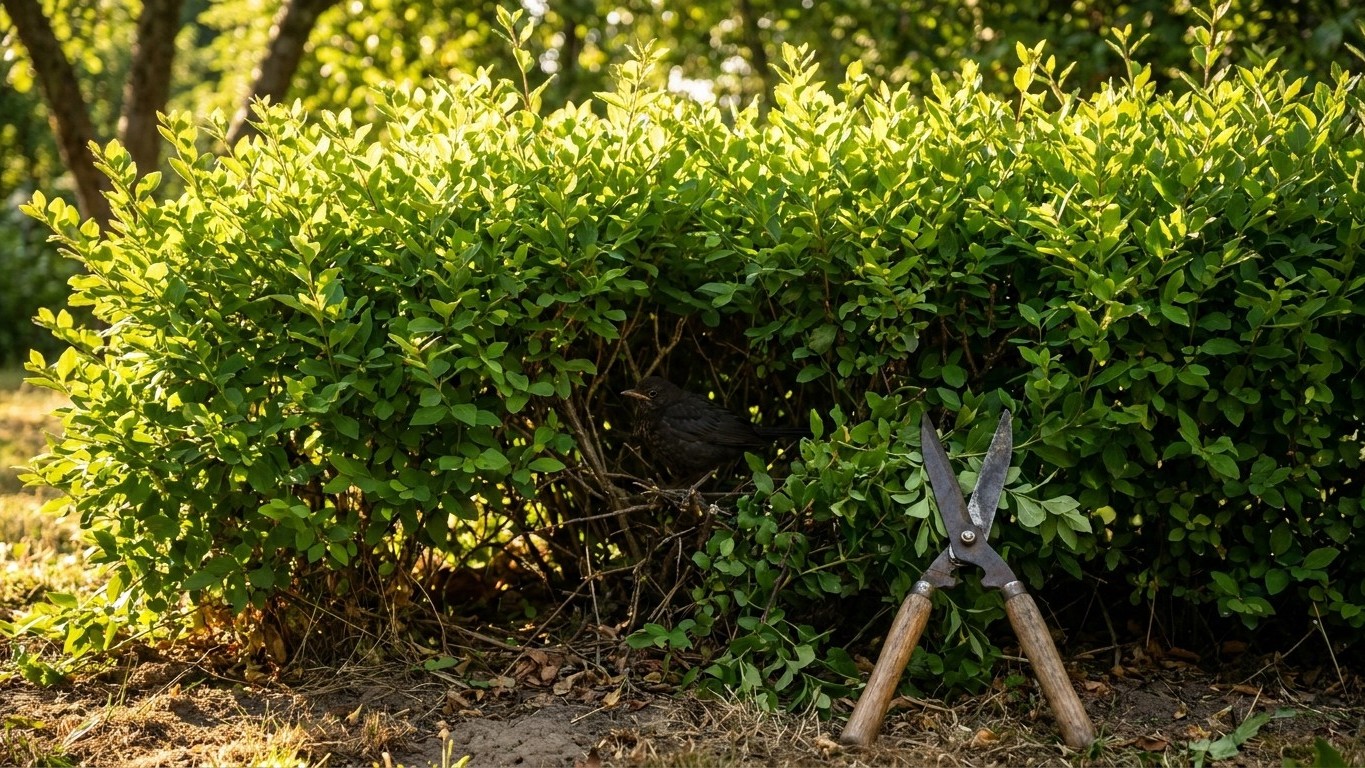
A hedge that looks abandoned in July is often the opposite. Adult blackbirds go quiet and stop the frantic in-and-out flying once chicks are close to leaving the nest, which tricks a lot of gardeners into thinking the coast is clear. By July many first broods have fledged, and you’ll start seeing family parties moving through parks, woodland edges and hedgerows. That silence isn’t an ending. It’s a pause between broods, or a fledgling crouched low in the branches waiting for a parent to bring the next beakful of caterpillar.
This is the trap. You grab the trimmer, tidy up the lines, and never see the two or three baby birds tucked into the densest part of the hedge, because they’re not supposed to be visible. That’s the entire point of where they’re sitting.
Key takeaways
- Blackbirds raise multiple broods through July, and silent hedges often conceal second or third nests you can’t see
- Fledglings spend 2-3 weeks hidden and dependent after leaving nests—prime trimming season makes them vulnerable
- Disturbing active nests is a federal crime with penalties up to $500,000, even in ‘innocent’ yard work
What’s actually still in there
Blackbirds are unusually persistent breeders. According to the British Trust for Ornithology, blackbird breeding season runs from March through July, and a pair may raise two or even three broods per season. One successful nest doesn’t mean the birds are done with your hedge for the year. Even if one nest has finished, the adults may start another nesting attempt nearby. They rarely reuse the exact same cup of moss and grass, either. Blackbirds do not always reuse the same nest, though they may return to the same garden or territory and often build a fresh nest for a new brood. So a hedge that hosted a family in May can be hosting a completely different, harder-to-spot nest by the second week of July.
The trickiest phase is right after the chicks leave the nest but before they can fly properly. After leaving the nest, fledglings remain dependent for another two to three weeks, spending much of that time hopping around low branches or sitting on the ground while a parent shuttles food back and forth. Fledgling blackbirds often spend time on the ground or hidden in low vegetation while the parents continue to feed them nearby, and if you find one it is usually best to leave it alone unless it is in immediate danger. A running trimmer, a dog off leash, or a sudden gap cut into the hedge wall can scatter that family before the young birds are ready to survive on their own.
The legal reason to hold off, not just the sentimental one
This isn’t only about being a good neighbor to the local wildlife. Disturbing or destroying active native bird nests is actually illegal under the Migratory Bird Treaty Act in the US. The law is broader than most homeowners assume. In the United States, the Migratory Bird Treaty Act makes it illegal to “take,” which includes disturbing, moving, or destroying, any active nests of native bird species without a permit. An active nest doesn’t have to contain adults sitting on eggs to count. An active nest is one that has eggs or chicks or is being actively constructed, and unless you have a valid permit, it is both ethical and legal to let those nests be.
The enforcement risk is real, not theoretical. Any action that causes nest failure for a protected species during the breeding season can constitute a federal violation, including vegetation trimming and construction near active nests. Some states have layered on their own rules that don’t loosen even if federal enforcement priorities shift. California’s law codifies that the taking, possessing, or destroying of migratory birds, their nests, or their eggs is unlawful, regardless of any changes to federal MBTA enforcement, reinforcing that state law will safeguard these species even if federal protections weaken. Fines aren’t a rounding error either. Fines can be up to $500,000 in cases pursued under California’s parallel statutes. Most homeowners will never see a fine that steep, but the numbers show how seriously wildlife agencies treat an “innocent” afternoon of yard work.
How to check before you cut, without turning it into a science project
You don’t need a biology degree to figure out whether your hedge is still occupied. Watch it for a few quiet minutes before you touch the trimmer. Position yourself behind the hedge so the sun shines through it to illuminate everything inside, and look out for birds flying in and out of the shrubbery. Listen, too. Nestlings and fledglings will cheep to their parents regularly, and that faint peeping from inside a leafy wall is usually the giveaway that no landscaping should happen this week.
If you spot activity, the fix is simple: wait. Most birds nest between March and July, when food is most abundant and the warmer days present a safer environment for young chicks. Many extension offices and wildlife groups suggest treating the whole stretch from early spring through late summer as a season to avoid heavy pruning altogether, saving structural cuts for fall or late winter when nests are reliably empty. If a hedge genuinely needs to come down a few inches for safety reasons, a light hand with small shears rather than a power trimmer reduces the odds of destroying a nest you didn’t know was there, and gives a startled parent bird a chance to come back once you’ve moved on.
One more detail worth knowing: not every bird nesting in your hedge gets the same legal protection. Since only a few birds encountered in most areas, such as European starlings and house sparrows, are not protected, it is safe to assume that any nest you encounter should be avoided. In practice, that means the safest habit isn’t learning to identify every species by call and plumage. It’s simply assuming, from March through August, that the hedge is spoken for.
Sources : homesandgardens.com | gsgardens.co.uk