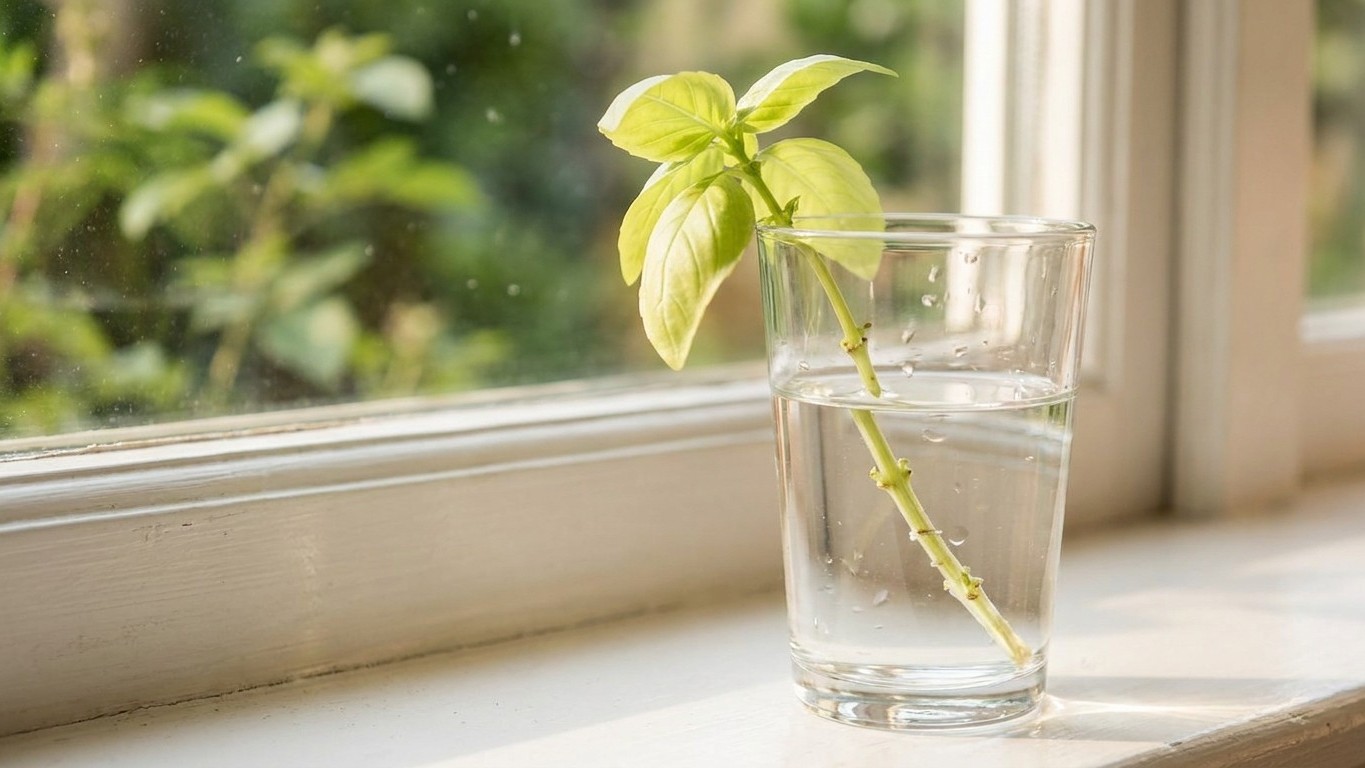
The theory sounded foolproof: basil and mint are cousins in the same botanical family, so if mint roots effortlessly in a glass on the windowsill, basil should behave the same way. It didn’t. A week after setting both cuttings side by side in August, the mint had already grown pale, thread-like roots. The basil stem just sat there, leaves drooping slightly, no roots in sight. The difference wasn’t luck or water quality. It came down to one detail I’d overlooked when snipping the stem: a tiny flower spike at the tip, quietly siphoning off the energy the cutting needed to root.
Key takeaways
- A single flower spike on a basil stem can halt root development entirely—even if you don’t notice it at first
- Mint forgives timing mistakes; basil has a narrow window before it bolts and becomes nearly impossible to propagate
- The fix is simpler than you think, but timing matters more than you’d expect in late August
Why the Flower Spike Changes Everything
Basil and mint both belong to the Lamiaceae family, sharing square stems and a knack for sprouting new roots from cut nodes. Perennial herbs in the mint plant family propagate really well from cuttings, with rosemary, oregano, sage, thyme, lavender, and mint all producing roots fairly quickly when placed in water or sand. Basil fits into that same easy-rooting category. There’s one more herb in this family that propagates really well, though it’s an annual herb, and that’s basil, with one type (African blue basil) that can only be grown from rooted cuttings.
But basil has a habit mint doesn’t share quite as aggressively in late summer: it bolts. By August, many basil plants are pushing out flower spikes as daylight patterns shift and the plant senses it’s time to reproduce. That spike isn’t decorative. This is a natural part of the plant’s lifecycle, as it has entered its reproductive phase, and the flowers mean the plant is shifting its energy from producing leaves to producing seeds. Every cutting taken from a stem already carrying that spike inherits the same redirected priorities, and rooting simply isn’t one of them.
Multiple growing guides converge on the same warning. The best time to propagate basil is in early summer before it bolts, because flowering requires a lot of energy that gardeners want directed toward new root production instead. Another source puts it plainly: it’s best to choose stems that are not flowering, since flowering means the plant’s energy is focused on reproduction rather than growth, making those stems less likely to root successfully. My week-old, root-free glass was a textbook case.
What Actually Happened, Node by Node
Mint doesn’t face the same metabolic tug-of-war, at least not on the same timeline. Left unpinched, it will flower too, but its rooting mechanism is almost absurdly forgiving. Growing mint from cuttings generally results in a 100% success rate if you use the right techniques. New roots form on both stem and stolon cuttings within two to four weeks, and when placed in water, newly cut mint stems will develop roots at the leaf nodes under the water. The mint in my kitchen didn’t need ideal timing. It needed water and a node, full stop.
Basil, by contrast, is far pickier about the stem’s reproductive status. The advice is to choose healthy, actively growing branches and avoid any with flowers or buds, since they might focus energy on flowering rather than rooting. One propagation guide goes further, noting that it’s best to avoid taking basil cuttings from stems that have already started to flower or appear to be infected with disease or pests. When I finally went back to the same plant and cut a fresh, non-flowering side shoot, the results flipped almost overnight. Just a week after being placed in water, that basil cutting had lovely one-inch-long roots and was ready for transplanting.
The timing window matters too, and August sits right at the edge of it. Cuttings are best taken during late spring through summer when plants actively grow, usually April through early August in temperate climates, and gardeners should cut before flowering begins. Push past that window without checking for spikes, and you’re rolling the dice on every stem you snip.
How to Spot a Compromised Cutting Before You Waste a Week
The fix isn’t complicated once you know what to look for. Before cutting, run your fingers along the top few inches of any basil stem and check for a tight cluster of tiny buds or an elongated spike, even a small green nub can signal the plant has already shifted gears. As tempting as it might be to use a flowering stem, these cuttings often struggle to root. If you spot one, snip it off and use the section just below instead, choosing a stem that’s still purely vegetative.
The physical prep matters just as much as the source stem. Aim for medium thickness stems around 3 to 4 mm in diameter, non-flowering branches showing active vegetative growth, two to three visible nodes along a 4 to 6 inch cutting length, and disease-free surfaces without pest damage or discoloration. Strip the lower leaves so the submerged nodes are bare. Gently removing the leaves from the lower half while leaving several at the top reduces moisture loss and directs the plant’s energy toward root development at the node points.
Once conditions are right, basil isn’t actually slow. Under good light and clean water, careful selection and preparation should mean cuttings start developing roots within one to two weeks, giving you a vibrant new plant in no time. Some gardeners see it happen almost accidentally: stems left in a kitchen glass for cooking purposes end up rooting on their own within a similar span, simply because nobody thought to remove a flower bud that was never there to begin with.
One quirk worth knowing if you’re propagating in August specifically: even a stem that looks flower-free at the moment you cut it can push out a spike a few days later while sitting in the glass, especially if the parent plant nearby has already started blooming. Check your cuttings every couple of days, and pinch off any surprise buds immediately. That single habit, more than water freshness or sunlight placement, is usually what separates a rooted basil cutting from one that’s still floating in the same glass three weeks later.
Sources : homesteadandchill.com | freshharvesthaven.com