
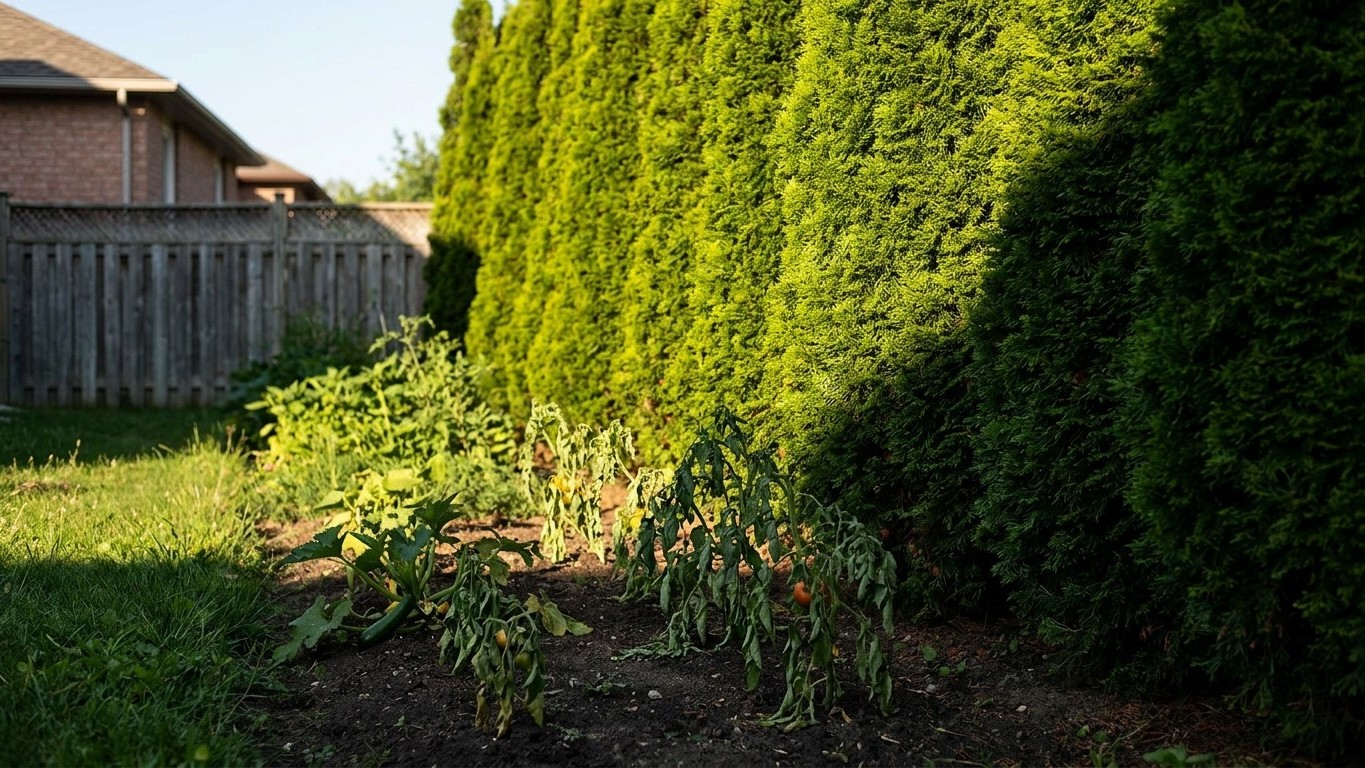
Four meters of unbroken green wall, and every summer the tomatoes on one side of the yard just… give up. That’s the reality for a lot of gardeners living next to an overgrown conifer hedge, and the frustrating truth is this: in the United States, there is no blanket right to sunlight on your own property. The law simply doesn’t work the way most people assume it does.
Key takeaways
- Most of America has no legal ‘right to sunlight’—blocking someone’s garden with a hedge is almost never a violation
- Spite-fence laws exist in most states, but proving malicious intent is brutally difficult and hedges have a higher bar than fences
- Before lawyering up, try one conversation, check your HOA documents, and document everything with dates and photos
Why “It’s blocking my sun” rarely wins in court
Start with the disappointing part. Unlike England, where a homeowner can appeal to the local council under high-hedges rules, American property law takes a different stance entirely. In the United States, property law generally does not recognize a right to receive light, air, or a scenic view over a neighbor’s property, meaning a neighbor can grow trees as tall or bulky as they like, even if it blocks a garden, unless a law or agreement limits this. A California legal resource puts it just as bluntly: unlike some states, California does not have a statewide law giving homeowners the right to sunlight for general purposes like gardening, and ancient legal doctrines about light and air exist but rarely apply to modern residential disputes.
Someone might picture a friendly conversation with the local zoning office resolving everything. That conversation, in most towns, will go nowhere. One former code enforcement officer, who worked in the field for 14 years, said they never issued violation letters concerning trees that caused shade, since there were no laws addressing the issue. A stunted zucchini patch, however maddening, doesn’t rise to the level of a legal violation on its own. In most of the U.S., there is no legal right to light, air, or a view across a neighbor’s land, so a neighbor generally isn’t required to trim healthy trees just because they block a view or sunlight.
The exceptions that actually change the outcome
Here’s where the story gets interesting. Blanket rules don’t exist, but a patchwork of local and state exceptions can absolutely apply, and knowing which one fits a situation is what separates a wasted summer from an actual fix. Exceptions exist in the form of local view or solar-access ordinances, HOA rules, spite-fence and spite-tree statutes, and the right to trim branches that actually cross a property line.
The spite-fence doctrine is the one worth knowing best. Separate from height ordinances, most states have some form of spite fence law, targeting structures, including hedges, that serve no useful purpose other than annoying a neighbor, meaning a hedge grown to fifteen feet purely to block sunlight or a view can be declared a spite fence and ordered cut down. California actually codifies this. California Civil Code Section 841.4 states that any fence or other structure in the nature of a fence unnecessarily exceeding 10 feet in height, maliciously erected or maintained for the purpose of annoying the owner or occupant of adjoining property, is a private nuisance. New Hampshire has similar language on the books, dating back further than most people expect. New Hampshire has a statute, RSA 476, titled “Spite Fences,” that was enacted in 1887.
Proving spite, though, is the genuinely hard part of any case. Courts don’t just look at height, they look at motive. Courts examine factors like the hedge’s usefulness to the owner, whether it was planted or allowed to grow only after a dispute began, and whether the height is grossly disproportionate to any legitimate landscaping purpose. A hedge planted decades ago for privacy, long before anyone argued about vegetable beds, is a much weaker target than one that shot up suspiciously right after a property-line dispute. And a practical note worth remembering: natural fences like trees and hedges are not typically considered spite fences because they usually serve some purpose to the owner, which means the bar for winning this argument sits higher than most homeowners expect.
Tennessee stands out as an outlier worth mentioning, since its courts have gone further than most. In some cases, Tennessee courts will order a tree owner to trim or remove a tree that’s blocking a neighbor’s sunlight, though it’s not an automatic right and these cases are harder to win than a straightforward overhanging branch dispute, with the argument typically centering on whether the shading constitutes an unreasonable interference with use and enjoyment of the property. One state’s odd exception, can matter enormously if it happens to be the one you live in.
What actually works before hiring a lawyer
Self-help remains the most reliable tool in this whole mess, and it costs nothing but a Saturday afternoon. Anyone can trim what overhangs their side of the line, down to the property line, without harming the tree. That won’t fix a hedge sitting entirely on the neighbor’s side, but for branches that creep across, it’s a legitimate and immediate remedy. The right to trim any branches that extend over a property line exists as long as the tree isn’t harmed in the process.
Beyond that, checking the fine print of local rules matters more than most people realize. Generally speaking, there is no widespread tree height rule across the U.S., though local ordinances and HOAs may set their own restrictions. A homeowners association covenant, buried in a document nobody reads at closing, sometimes caps hedge height at six or eight feet, solving in one paragraph what months of neighborly tension couldn’t. Solar panel owners get an added layer of protection in some states too: California’s Solar Shade Control Act prohibits planting or allowing trees to shade more than ten percent of a neighbor’s solar panels during certain hours. No equivalent statute protects a raised bed of kale, unfortunately, but it shows regulators can and do draw specific lines when the interest is deemed important enough.
Before any letter, lawyer, or lawsuit, the advice from actual experts is almost embarrassingly simple. Legal experts recommend amicably settling the matter by talking it over face-to-face first, politely explaining that the shadow blocks the sun from reaching a vegetable garden, since many homeowners don’t realize this and are usually kind enough to trim the hedge once they know it’s causing a problem. If that conversation goes nowhere, the next move isn’t a subpoena, it’s a notebook. Documenting everything with dates and timestamps builds the record that turns a shrug into a spite-fence case, should things ever escalate that far. A tape measure, a phone camera, and a little patience go further than most people expect against four meters of unwelcome shade.
Sources : gardeningknowhow.com | tomsguide.com