
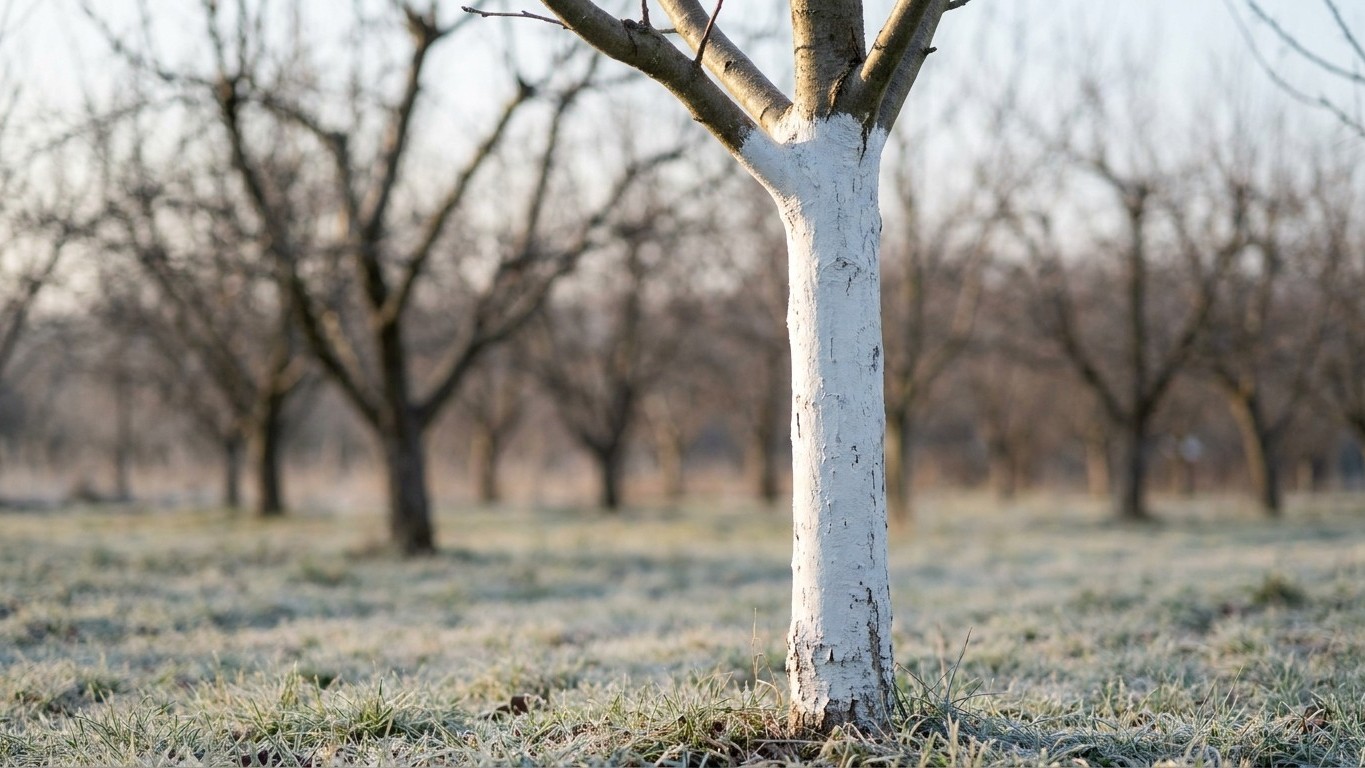
Every November, like clockwork, my neighbor grabs a bucket of white paint and coats the bottom three feet of his apple and pear trunks. Ask him why, and he’ll shrug: “keeps the bugs off.” He’s partly right, but he’s missing the real story. The main reason orchardists have done this for centuries has almost nothing to do with insects and everything to do with what happens to bark when a sunny winter afternoon collides with a freezing night.
Key takeaways
- Dark bark absorbs winter sun heat, causing dangerous expansion and contraction cycles that crack the trunk open
- White paint reflects sunlight, keeping bark temperature stable and preventing frost damage before insects ever arrive
- Young fruit trees with thin bark are most vulnerable—a technique unchanged for 3,000 years, from the Nile to modern orchards
The real threat is temperature whiplash, not bugs
On a cold but sunny winter day, the sun can heat up the dark bark on the southwest side of a tree, and this warmth wakes up the cells, causing them to expand, but as soon as the sun sets, the temperature plummets, and the bark rapidly freezes and contracts, and this violent expansion and contraction can cause the bark to split open, creating a long, vertical wound called sunscald or a frost crack. That crack isn’t just cosmetic. These cracks are open doors for diseases, fungi, and boring insects. So the insects show up after the damage, not before it.
The mechanism is almost embarrassingly simple. Dark bark absorbs heat like a black car parked in a summer lot. In colder months, trees face a condition where bark warms up during the day and freezes at night, and as temperatures drop, the area that was warmed during the day becomes vulnerable to damage due to a loss of its cold tolerance, according to Michigan State University Extension. Paint the trunk white, and that heat absorption drops sharply. A coat of white paint reflects the intense winter sunlight, keeping the bark temperature more stable and preventing this damaging cycle from ever starting.
Young fruit trees are the most exposed to this risk, for a reason that has nothing to do with age and everything to do with anatomy. Even though a tree may grow well in full sun, it’s more vulnerable to sunscald and other weather effects while young, since saplings have thinner bark than mature trees, and as a result, the bark is more susceptible to the sun’s heat. A five-year-old apple tree simply doesn’t have the bark thickness to buffer those swings the way a fifty-year-old oak does. That’s why you’ll see whitewashed trunks in commercial orchards far more often than in old-growth forests.
An Egyptian trick that outlived empires
This isn’t some internet gardening hack from the last decade. The ancient Egyptians painted their fruit trees with a lime-based mixture to protect them from sunscald. The technique traveled and stuck around: the use of lime-based whitewash dates back to ancient Greece and Rome and gained popularity during the medieval period in Europe. By the industrial age, it had become standard orchard practice across the continent, and in the 19th and early 20th centuries, whitewashing became a common practice in fruit tree orchards, and it’s a widespread practice in traditional farming communities throughout many cultures around the world.
What’s striking is how little the core logic has changed in three thousand years, even as the ingredients did. The primary reasons for whitewashing tree trunks may have not changed much over time, but the materials and techniques used have evolved, with modern paints and proprietary coatings designed specifically for tree protection now supplementing traditional lime-based whitewashes. Your neighbor with his paintbrush is essentially performing the same ritual as a farmer on the Nile delta, minus the papyrus.
Pest control is real, just secondary
None of this means the insect angle is pure myth. It’s just not the headline reason. Winter moths are attracted to dark tree trunks when searching for a site to lay their eggs, and cankerworms may find it more difficult to crawl up a trunk that’s been whitewashed to reach the foliage. Some growers also lean on the coating for a second, less obvious benefit: spotting trouble early. The paint can help identify and alert to any infestation of boring beetles. A fresh trail of sawdust against bright white bark stands out in a way it never would against gray bark.
There’s a fungal angle too, worth mentioning because it rarely gets airtime. Cryptogamic diseases caused by fungi in bark crevices, like moniliosis, scab, peach leaf curl, and canker in fruit trees, can be limited by lime milk’s antifungal action. So the whitewash is doing triple duty: reflecting heat, discouraging a handful of pests, and slowing down a few fungal problems. Insects just happen to be the part that’s easiest to explain over a fence.
Getting the timing and the mix right
Doing this correctly matters more than most people assume. The best time to paint tree trunks white is in late fall through early winter, typically November through January in most zones, since this timing provides maximum protection during the coldest months when temperature fluctuations between day and night are most extreme. Apply it too late, after the first hard freeze has already stressed the bark, and you’re closing the barn door after the horse left.
Growers generally reach for one of two approaches:
- Diluted white latex paint, water-based and breathable, which many home orchardists prefer for convenience
- Traditional lime-based whitewash, sometimes boosted with a touch of copper for extra antifungal punch
It is recommended to use water-based latex white paint, and to dilute the paint rather than applying it straight from the can, since a thick, glossy coat can trap moisture against the bark and invite the rot it’s supposed to prevent. Coverage matters too: most guides suggest painting the trunk up to at least 45cm (18 inches) above the ground.
Not every tree needs this treatment, and that’s the detail most articles skip. In mild climates with little temperature variation, tree painting may be unnecessary, and gardeners are often better off focusing instead on mulching and proper watering. If you live somewhere with genuinely cold, sunny winters and grow young stone fruit or citrus, the paint bucket earns its place in the shed. If your winters barely dip below freezing, your neighbor’s ritual might be more habit than necessity, and that’s fine too. Traditions survive because they work often enough, not because they’re required everywhere.
Sources : greenygardener.com | fruittreehub.com