
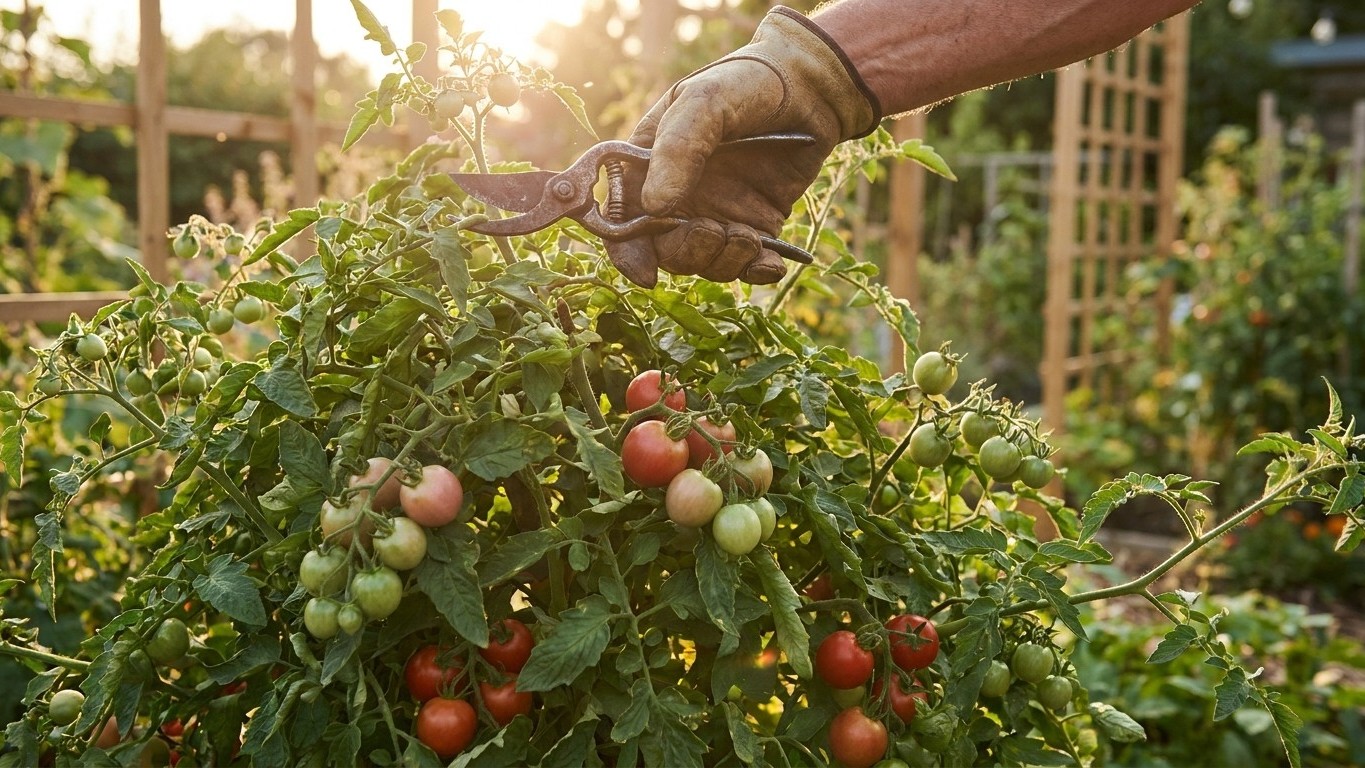
Cut off the growing tip of every tomato plant right after the last cluster of fruit, and something almost mechanical happens inside the plant: it stops trying to grow taller and starts pouring everything it has into the tomatoes already hanging on the vine. Gardeners have called this “topping” for generations, and the old-timers who did it religiously in the last week of August weren’t just tidying up the garden. They were racing a calendar only the plant couldn’t see.
Key takeaways
- Removing a tomato plant’s growing tip triggers an internal shift that redirects nutrients away from new growth and toward ripening existing fruit
- The timing isn’t arbitrary—late August hits the sweet spot because tomatoes need 6-8 weeks to ripen before autumn frost arrives
- Grocery tomato shortages in 2026 are reviving this old practice, transforming what was once family tradition into practical economics
What Actually Happens When You Snip the Tip
A tomato plant, left alone, behaves like it has infinite time. Indeterminate varieties in particular set only lateral flower clusters and continue to grow taller (or sprawl more) all season. That’s fine in June. It’s a problem in September, when as autumn approaches, many of those fruits won’t get a chance to ripen.
Removing the growing tip changes the plant’s internal accounting. Topping is a specific pruning technique where you remove the growing tip of the main stem, which stops the plant from getting any taller. Instead of reaching for the sky, the plant redirects its hormones and nutrients toward the fruit that is already on the vine. There’s no more decision to make about where to send sugars. Topping tomatoes removes the plant’s options. It can no longer keep setting fruit and growing larger, so the only option left for the plant is to put that energy into making the existing fruit the best it can be.
Why the Timing Was Never Random
Here’s the math the old-timers ran in their heads without ever writing it down. A tomato flower needs roughly six to eight weeks to become a ripe fruit. From flower to ripe fruit usually takes around 6–8 weeks, depending on the cultivar, and if your first frost is coming in October or early November, those flowers are wasted energy. Work backward from your local frost date, and late August lands right in the sweet spot for most of the country. A good rule of thumb: plan to top your tomatoes four to six weeks before your average first frost date, giving the plant enough time to finish ripening the fruit it already has.
Wait too long and you’ve fed a bunch of blossoms that will freeze on the vine. Fruit needs about 45 to 65 days to go from flower to fully ripe tomato, and any flower that opens after mid-August is unlikely to produce a tomato you can actually eat. That’s the piece that got lost as backyard gardening declined for a couple of generations. Nobody explained the biology; they just knew that a plant left untopped in September was mostly growing tomatoes for the compost pile.
There’s a second, less romantic reason the practice mattered: gravity. By the time August ends, cages are straining and stems are cracking under the weight of fruit that took all summer to load up. When plants are six feet tall and flopping over, topping helps reduce some of that weight, since they can get top-heavy in a hurry at the peak of the season, resulting in broken plants. Cutting the top wasn’t only about ripening speed. It was structural triage.
Why 2026 Is Bringing the Habit Back
Grocery store tomatoes have had a rough year, and that’s part of why this old technique is suddenly relevant again instead of a curiosity in a gardening almanac. Due to unseasonable weather, fuel prices, and tariffs on imported foods, tomatoes are facing price hikes and scarcities in 2026. The numbers are not subtle. At the end of March 2026, the average price per pound reached $2.26, according to the US Bureau of Labor Statistics, and by spring the trend had accelerated further: the average price of fresh tomatoes increased by over 15% since March 2026, putting prices nearly 40% higher than they were this time last year.
When every tomato on the vine suddenly represents real grocery money saved, gardeners stop treating late-season fruit as an afterthought. A container plant on a patio, a few staked vines in a raised bed, none of it matters if half the crop never colors up before frost. That’s pushed a renewed, practical interest in techniques that squeeze every usable fruit out of a plant before the season ends, topping included. It’s not nostalgia. It’s arithmetic dressed up as tradition.
Doing It Without Wrecking Your Harvest
The technique only works for the right plant and the right cut. Determinate, bushy varieties that ripen all at once don’t need it and can actually yield less if you interfere. Topping determinate tomatoes is generally not recommended, as it can significantly reduce your yield, since they naturally stop growing at a manageable height. Save the shears for sprawling indeterminate types like Brandywine, Cherokee Purple, or Sungold.
Restraint matters just as much as timing. Strip away too much foliage along with the growing tip and you’ve sabotaged the very fruit you’re trying to save. Use a clean pair of pruners to remove the growing tip above the highest cluster of tomatoes you want the plant to finish, but don’t remove large amounts of healthy foliage, since tomatoes still need their leaves to produce energy and shade fruit. A few things worth doing at the same time: pull off any new blossoms that opened this month, harvest anything showing its first blush of color so it can finish ripening on the counter, and leave the plant’s remaining leaves alone unless they’re diseased.
One quirk surprises most first-timers: even after topping, some green tomatoes will still be on the vine when frost finally arrives, and that’s not a failure. Green tomato relish and fried green tomatoes exist precisely because generations of gardeners figured out what to do with the fruit that almost, but not quite, made it to red.
Sources : hunker.com | thisismygarden.com