
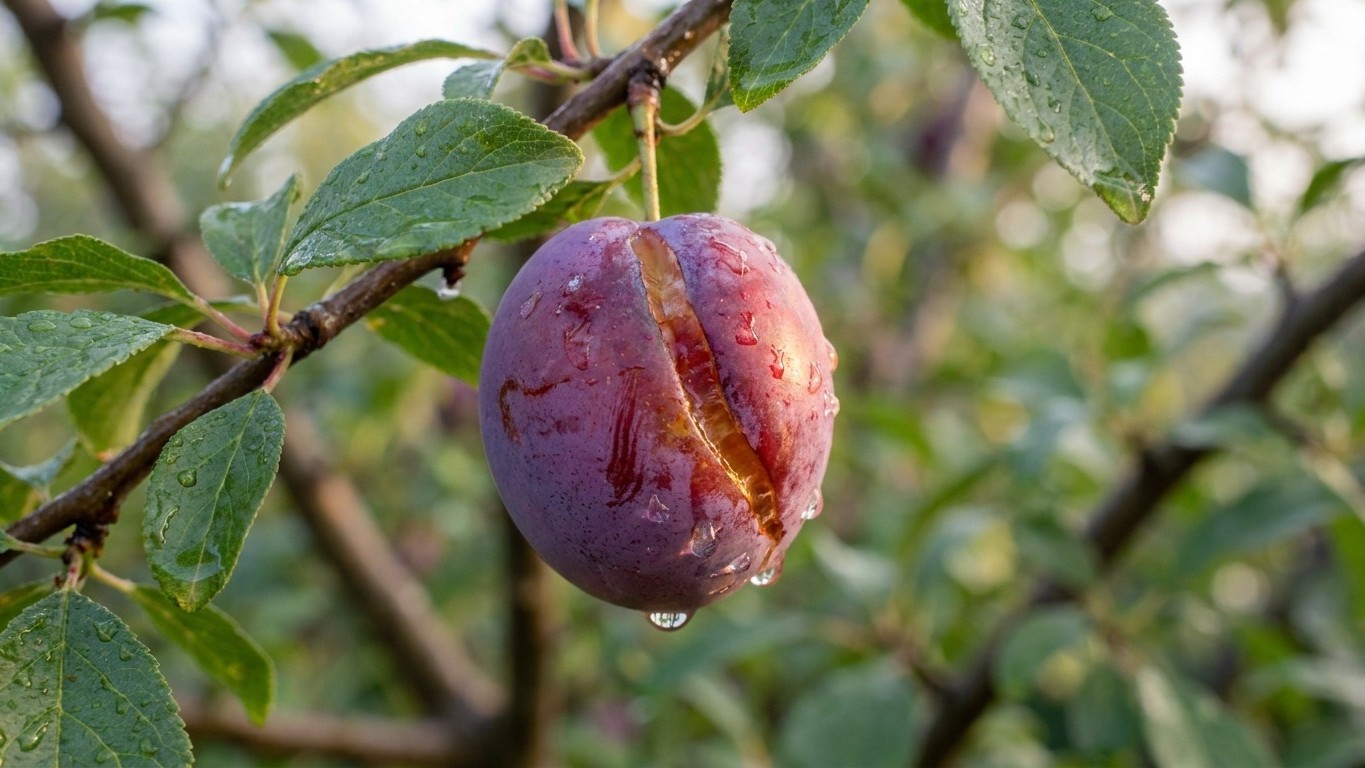
Three extra days on the branch, and what looked like a simple crack turned into something else entirely. A grayish fuzz crept along the wound. A wasp had bored deeper into the opening. The flesh beneath had gone soft and sour instead of syrup-sweet. That’s the gamble every backyard grower takes after a late-summer downpour: the split itself is rarely the real problem. What moves in afterward is.
Key takeaways
- Water absorption through the plum’s skin, not root uptake, causes the fruit to swell and split during heavy rains
- A single crack becomes an open invitation for brown rot fungus, wasps, and flies to colonize the fruit simultaneously
- Three extra days on the branch is often the difference between trimming a small blemish and discarding the entire plum
Why a Downpour Splits a Plum in the First Place
As a plum ripens and accumulates sugars, fruit exposed to extended periods of wetness from rain, dew, or high humidity will absorb water through the skin and swell until it cracks. It isn’t the roots pulling up extra water that causes the damage. It’s the absorption of water directly through the fruit’s outer skin, or cuticle, that causes the splitting. That’s why a tree can sit in soaked soil for days without incident, then split wide open within hours of a single hard rain hitting the fruit itself.
The setup matters just as much as the storm. Prolonged periods of drought followed by heavy rains or heavy irrigation during the later stages of fruit development can lead to severe cracking in many stone-fruit species. Picture a plum that spent three dry, stressed weeks building up sugar and thickening its skin, then got hit with an inch of rain overnight. Irregular watering causes growth spurts, and the flesh of the fruit takes up water faster than the skin can grow to accommodate. The result is a mechanical failure, plain and simple: the interior expands, the skin can’t keep pace, something has to give.
What Actually Opens Up in That Wound
Here’s where the story gets more interesting than “the plum split.” A crack in stone fruit is essentially an open door, and very little in an August orchard resists walking through an open door. Brown rot enters through wounds, splits caused by irregular watering, and the punctures left by wasps or other insects, and once it’s established in a cluster of fruit, it spreads to its neighbors with quiet efficiency. That grayish fuzz isn’t cosmetic. It’s a fungus actively colonizing tissue that, three days earlier, was still perfectly good fruit.
The fungus responsible has a name and a habit. Brown rot announces itself as a small brown patch on a ripening fruit, usually around a blemish or a wasp hole, and that patch expands within days as the flesh collapses and rings of dusty grey-white spore pustules appear. Left three extra days on the tree, a split that started as a hairline fracture has plenty of time to become exactly that.
Wasps complicate things further, and not just by stinging the person trying to harvest. Where wasps damage plum fruit, this often quickly attracts flies that feed on the damaged areas, and those flies can cause further problems while also helping transfer diseases to the fruit. It’s an ugly little relay race: the split invites the wasp, the wasp’s puncture invites the fly, and the fly’s visit can seed the wound with whatever pathogen it last touched.
Spotted wing drosophila adds another layer that many home growers don’t expect, because unlike common fruit flies, it doesn’t wait for damage. The female deposits her eggs directly in undamaged, ripening fruit, and once the eggs hatch, the larvae tunnel and feed around the egg-laying site, causing noticeable depressions. When that happens on top of an existing split, opportunistic bacteria and fungi often invade the site and cause additional damage. A single crack can end up hosting three separate problems at once, each one making the fruit less appealing than the last.
Is Sweetening on the Tree Worth the Risk?
The instinct to leave split fruit on the branch a little longer isn’t wrong. Tree-ripened stone fruit genuinely does develop more sugar and better flavor than anything picked early and finished on a counter. This is exactly why growers who want fully tree-ripe fruit run into trouble with cracking, and why earlier harvest, followed by ripening off the tree, is often recommended as a workaround. The math is a trade-off, not a guarantee: every extra day of sweetness is also an extra day for rot, wasps, and flies to find the opening.
Fruit that’s already split isn’t automatically ruined, at least not right away. When fruit has split, it’s still perfectly edible, though it will quickly attract wasps and other pests and diseases that will spoil it even more. That window, the gap between “just split” and “compromised,” is exactly what shrinks with each extra day of exposure. Three days is often the difference between trimming off a small blemish and tossing the whole plum.
Reducing the Odds Before the Next Storm
None of this is entirely unavoidable. Consistency in soil moisture matters more than any single response to a downpour. Erratic watering is the main driver of plum fruit split, and the cure is ensuring a consistent supply of moisture, which is best achieved by mulching deeply around the tree, at least 30 centimeters past the edge of its canopy. A layer of wood chips does more for split prevention than most growers give it credit for, simply by keeping the soil from swinging between bone-dry and saturated.
Orchard hygiene plays a bigger role than most home gardeners assume, too. Mummified, infected plums can hang on the tree through winter and act as a reservoir for next year’s infection, so the first line of defense against brown rot is timing and hygiene rather than chemistry, which means removing mummified fruit from the tree and the ground before winter is out and disposing of it rather than composting it. Thinning helps as well. Thinning heavy crops in June or early July so remaining fruit isn’t touching matters because contact between fruit acts as a highway for brown rot spores.
Next season, the fix might be less about the weather and more about what’s already in the fruit’s skin. Fruit with higher levels of calcium and boron in the skin has greater firmness and stronger cell walls, and calcium sprays targeted at the fruit have been shown to increase calcium content and reduce cracking in plums and cherries. It won’t stop every storm from splitting a plum. But it might buy an extra day or two of margin, which, as this season proved, is exactly the difference between a sweeter plum and a ruined one.
Sources : fgv.com.au | mumsnet.com