
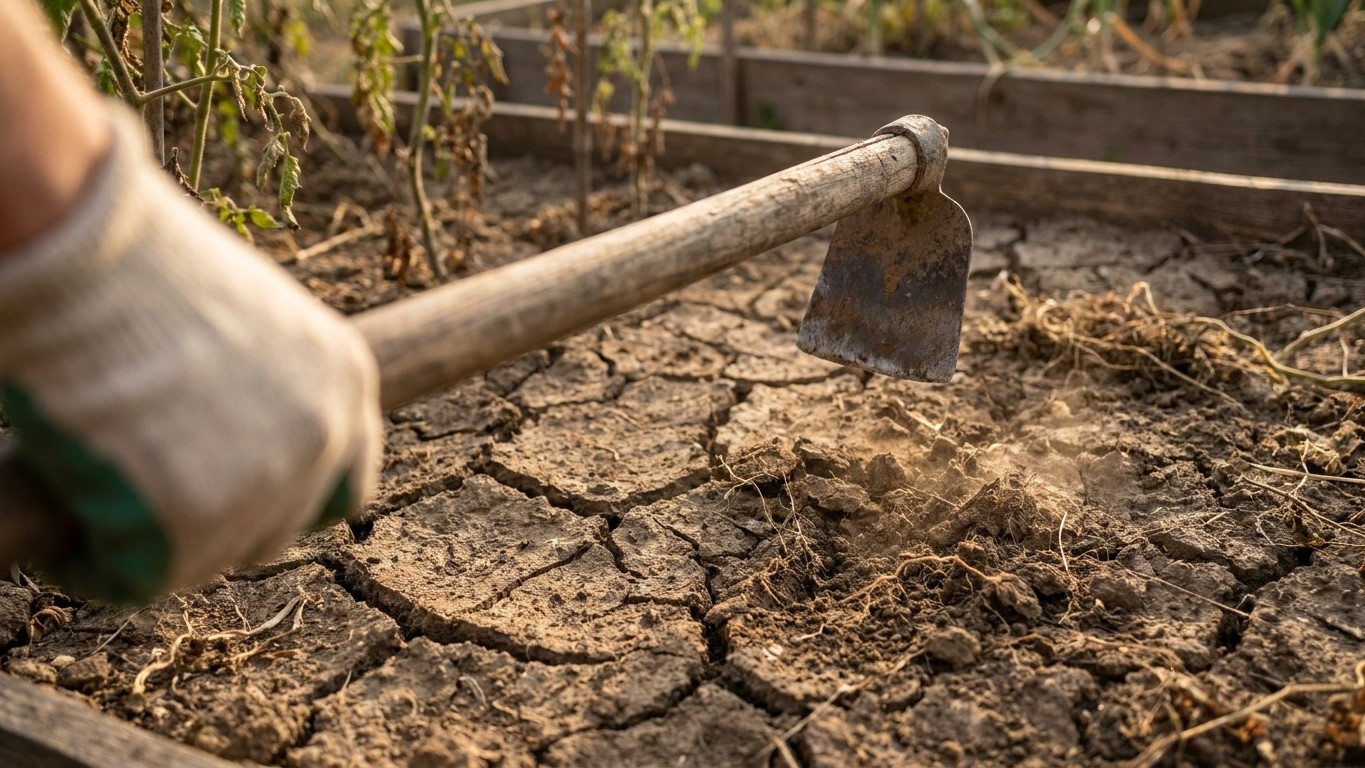
Three weeks of faithful hoeing, and the dust crust didn’t save a single drop. If anything, the opposite happened: the beds that got the driest, cracked treatment were thirstier than the ones left alone. That’s not a fluke of one garden season. It’s the predictable outcome of a century-old gardening belief that soil scientists have been quietly dismantling for decades.
Key takeaways
- A cherished gardening practice shows the opposite result when actually measured with scientific instruments
- The original theory about how water moves through soil turns out to be fundamentally wrong
- What gardeners spread instead of what they hoe makes a dramatic difference in soil moisture retention
The logic behind breaking up the crust
The idea sounds reasonable enough on paper. Hoe the surface into a fine, loose layer of dust, and you supposedly interrupt the tiny capillary tubes that wick moisture up from deeper soil to the surface, where the sun and wind steal it away. According to proponents, dust mulching breaks the soil capillarity, reducing the evaporative loss of soil moisture. The technique itself is simple: mulches are created by intensively hoeing the soil surface, creating a finely-textured layer of soil.
This wasn’t some fringe trick passed around at a farmers market. Dryland farmers relied on it for generations, especially in regions where irrigation wasn’t an option and every bit of soil moisture mattered for a crop’s survival. The theory made its way into gardening manuals, extension bulletins, and grandparents’ advice long before anyone thought to test it rigorously with actual measuring equipment in the ground.
What the measurements actually show
Here’s where things get uncomfortable for anyone who’s spent August afternoons dragging a hoe across bone-dry rows. The earliest research on moisture conservation by dust mulches found, in fact, that water was not conserved. That’s not one lonely study getting overturned later. Multiple independent trials across different decades reached the same conclusion.
The physics explains why. The whole premise rests on a mental picture of water climbing up from moist subsoil like sap through a straw, ready to evaporate the moment it reaches open air. But in contrast to popular thinking, soil moisture does not move up from below to replace that lost through evaporation. Once the surface layer dries out, it dries out. There’s no underground reservoir feeding a steady upward flow for the dust layer to intercept. Hoeing doesn’t sever a connection, because that connection barely exists in the way the old theory assumed.
Worse, the dust layer can backfire. Dust mulches can raise the soil temperature enough to increase evaporation and possibly damage or kill fine roots. A dark, loosened, exposed surface absorbs heat efficiently and radiates it right where a plant’s shallow feeder roots are trying to survive. Instead of shielding moisture, the crust can accelerate the very loss it was meant to prevent, and it exposes the tender roots near the surface to a heat spike they didn’t sign up for.
Where the water actually went
So if it wasn’t rising up and evaporating through some capillary shortcut, where did three weeks of soil moisture disappear to? Straight up, through bare exposed dirt, no different than any uncovered patch of ground baking in the sun. The hoeing didn’t create a barrier. It created more surface area for wind and heat to work on, and it stripped away whatever protective texture the undisturbed soil had built up.
There’s a second cost that rarely gets mentioned in gardening lore: erosion. Good mulches reduce the risk of soil erosion, but since dust mulching deliberately creates fine particles of soil, there will be higher risk of erosion by wind or rain. Historically, this wasn’t a minor side effect. Dust mulching was identified as one of the primary causes of agricultural erosion many decades ago. On a larger scale, the consequences reached beyond individual fields. More recently, researchers have found dust mulching to be a major source of particulate air pollution. A backyard vegetable patch isn’t going to trigger a dust storm, but the same mechanism, fine loosened soil with nothing holding it down, plays out at whatever scale you’re working.
Compare that to what happens under an actual mulch layer, the organic kind made of straw, wood chips, or shredded leaves. A widely cited University of Florida lysimeter study measured evaporation from soil-filled containers directly, finding total evaporation was 3 liters for non-mulched containers versus 2 liters for mulched, meaning there was much greater water loss from soil when the pots were not mulched. That’s a real, physically verified difference, not a folk theory resting on assumptions about how water moves through soil.
What to spread instead of what to hoe
Extension horticulturists have been consistent on this point for years. Mulch helps conserve soil moisture, reducing evaporation and the need for watering. The material matters less than people expect. Straw, wood chips, shredded bark, even pine needles work through the same basic mechanism: they physically block sunlight and airflow from reaching the soil surface, slowing the process of evaporation instead of trying to interrupt a capillary flow that doesn’t behave the way 1940s garden columns imagined. Pine needles get a bad reputation for supposedly souring the soil, but they make an excellent mulch that conserves moisture, suppresses weeds and adds nutrients over time.
A two to three inch layer spread after the soil has had a chance to warm in spring does more in one afternoon than a whole summer of hoeing dust. It also skips the erosion risk, skips the heat spike to surface roots, and it slowly feeds the soil as it breaks down instead of stripping it bare. The old dust-mulch habit isn’t just outdated advice, it’s a documented case of a plausible-sounding theory outliving the evidence against it by nearly a century, largely because nobody thought to dig a little deeper and check.
Sources : gardenprofessors.com | sciencedirect.com