
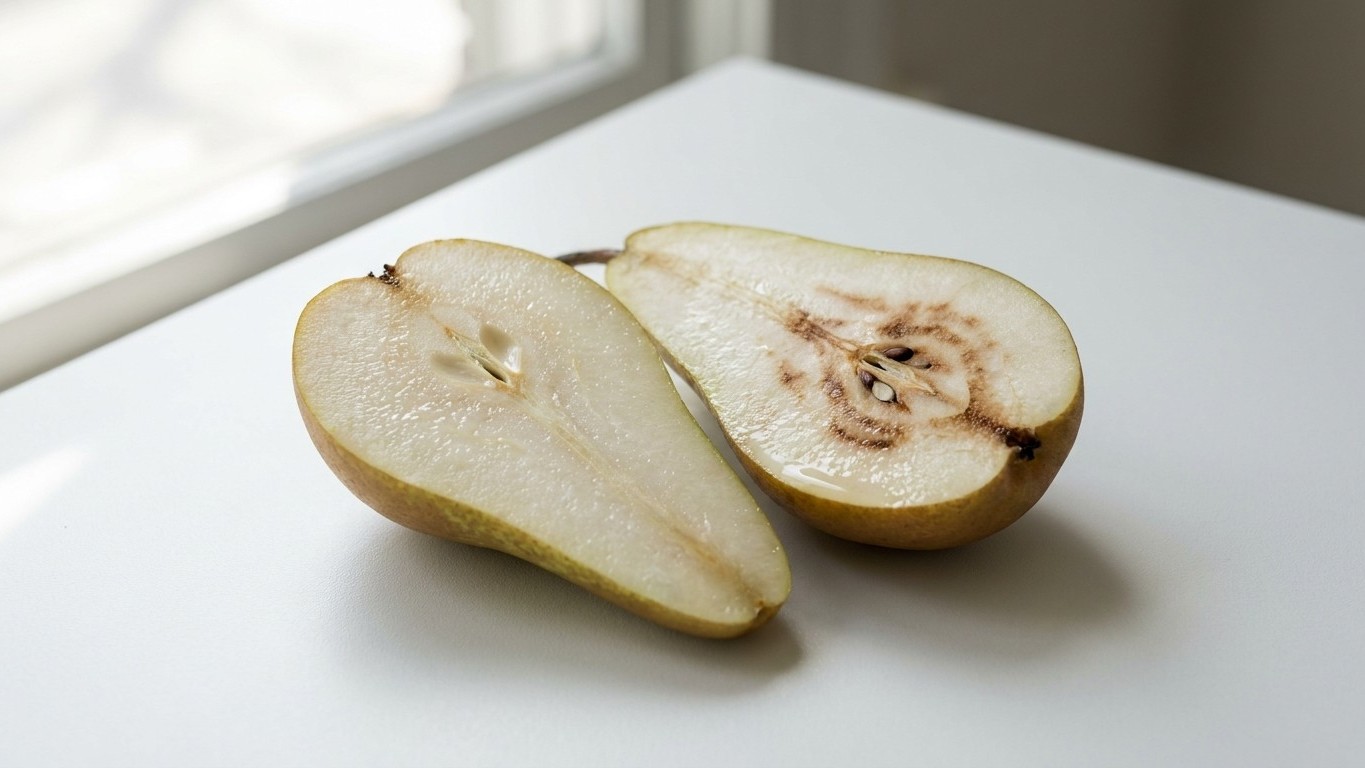
Ten extra days seemed harmless. The pears looked plump, the skin had that faint golden blush Conference fruit gets when it’s finally ready, and patience felt like the responsible move. Then the knife went in. The outer flesh was fine, pale and crisp, but the center around the core had turned into a soft, wet, brown mess that smelled faintly fermented. That’s not bruising. That’s a physiological disorder called core breakdown, and it’s one of the best-documented reasons pear growers everywhere tell you to ignore your instincts and pick the fruit while it’s still rock hard.
Key takeaways
- Conference pears ripen on a completely different timeline than their skin suggests
- The brown core breakdown is a senescence disorder caused by antioxidant depletion, not bruising or rot
- Picking hard fruit and cold storage are the only ways to catch the narrow window before internal collapse
Pears ripen backwards, and that changes everything
Apples ripen on the branch and give you plenty of warning. Pears don’t play by that rule. Unlike many other fruits that reach peak ripeness while still attached to the plant, European pears must be harvested before they ripen. Leave them hanging past that window and the fruit doesn’t ripen evenly from the outside in the way a peach or a plum does. If left on the tree too long, pears begin to ripen from the inside out, and by the time they feel soft on the outside, the interior may be overly ripe or have a mealy texture. That’s exactly the trap with Conference: the skin gives almost no reliable signal, so growers who wait for visual cues end up waiting too long.
A fruit forum thread from British pear growers puts it plainly for this exact variety. Conference is one of those varieties that you need to pick while still hard; if you leave them on the tree until they start to yellow and ripen, you will find the core will have started turning to brown mush by the time the outer flesh is ready. Ten days of extra hang time on the tree is more than enough to tip a batch from “almost ready” to “cored out and mushy,” because the interior tissue is running on a completely different clock than the skin.
What’s actually happening inside the pear
The brown, wet zone at the core isn’t rot in the everyday sense, and it isn’t impact damage either. Postharvest scientists classify it as a senescent disorder, meaning the tissue has simply aged past the point of being edible before the rest of the fruit caught up. It’s a senescent disorder resulting from storing fruit beyond its postharvest life, producing a brown, soft breakdown of the core and surrounding tissues. Researchers studying Conference specifically describe it the same way: this physiological disorder is characterized by internal browning of the fruit tissue and the development of cavities.
The chemistry behind it comes down to the fruit running out of its own antioxidant defenses. As pear tissue ages, levels of ascorbic acid (the same compound as vitamin C) drop, and once they fall below a certain threshold, oxidative browning takes over in the core before it shows anywhere else. The symptoms are internal and cannot be observed visually without cutting the fruit in half, and studies on Conference pears in particular have shown the disorder is usually induced by adverse storage conditions, an imbalance between oxidative and reductive processes, and the accumulation of reactive oxygen species, while components of the antioxidant system protect the fruit against browning. In plain terms: the core simply runs out of chemical protection first, because it’s the part of the fruit that ripens fastest and hits its expiration point earliest, tree-hung or not.
Here’s the part that trips people up. On the tree, the countdown to core breakdown starts the moment the fruit reaches physiological maturity, whether or not you’ve picked it yet. The symptoms are consistent with the fruit having matured a bit too much on the tree, as one extension expert put it when a home grower described the exact same brown, mushy core on pears that still looked flawless outside. Ten extra days on the branch isn’t a gentle grace period. It’s ten extra days of internal senescence racing ahead of what your eyes can see.
Getting Conference pears right next season
The fix isn’t complicated, but it does require overriding the urge to wait for a pear that “looks ripe.” Commercial growers and extension services converge on the same approach for Conference and most European dessert pears:
- Pick when the fruit lifts easily from the branch with a gentle upward twist, while it’s still firm and green, not when the skin starts to yellow.
- Move harvested pears into cool storage immediately, ideally close to freezing, to slow the internal clock before it starts ticking toward breakdown.
- Bring only what you plan to eat that week to room temperature, letting it finish ripening off the tree over several days.
Conference pears keep for a long time when stored at a cool temperature, and commercial growers store them at around 32°F in a carbon dioxide-saturated atmosphere to stretch that window even further. Home growers obviously don’t have access to controlled-atmosphere rooms, but a cold garage, unheated shed, or the crisper drawer of a fridge does a reasonable version of the same job. Fruit becomes ripe, then overripe, and then core breakdown occurs as part of the normal ripening and senescence sequence, and in freshly harvested pears the gap between ripe and breakdown is only about a week, shrinking the longer the fruit sits in storage. That’s the real lesson hiding in a mushy Conference pear: the margin for error was never as wide as it looked from the outside.
One more detail worth filing away: this isn’t unique to backyard trees or amateur timing. The same disorder shows up in commercial cold storage warehouses, sometimes appearing in fruit that was picked at textbook-perfect maturity but simply sat in the crate too long before shipping. Senescent scald, a related browning disorder, is often associated with core breakdown in stored Bartlett and Bosc pears, which means even professional growers battle the same inside-out timing problem you just found in your own kitchen, just on a bigger scale.
Sources : postharvest.ucdavis.edu | fruitforum.wordpress.com