
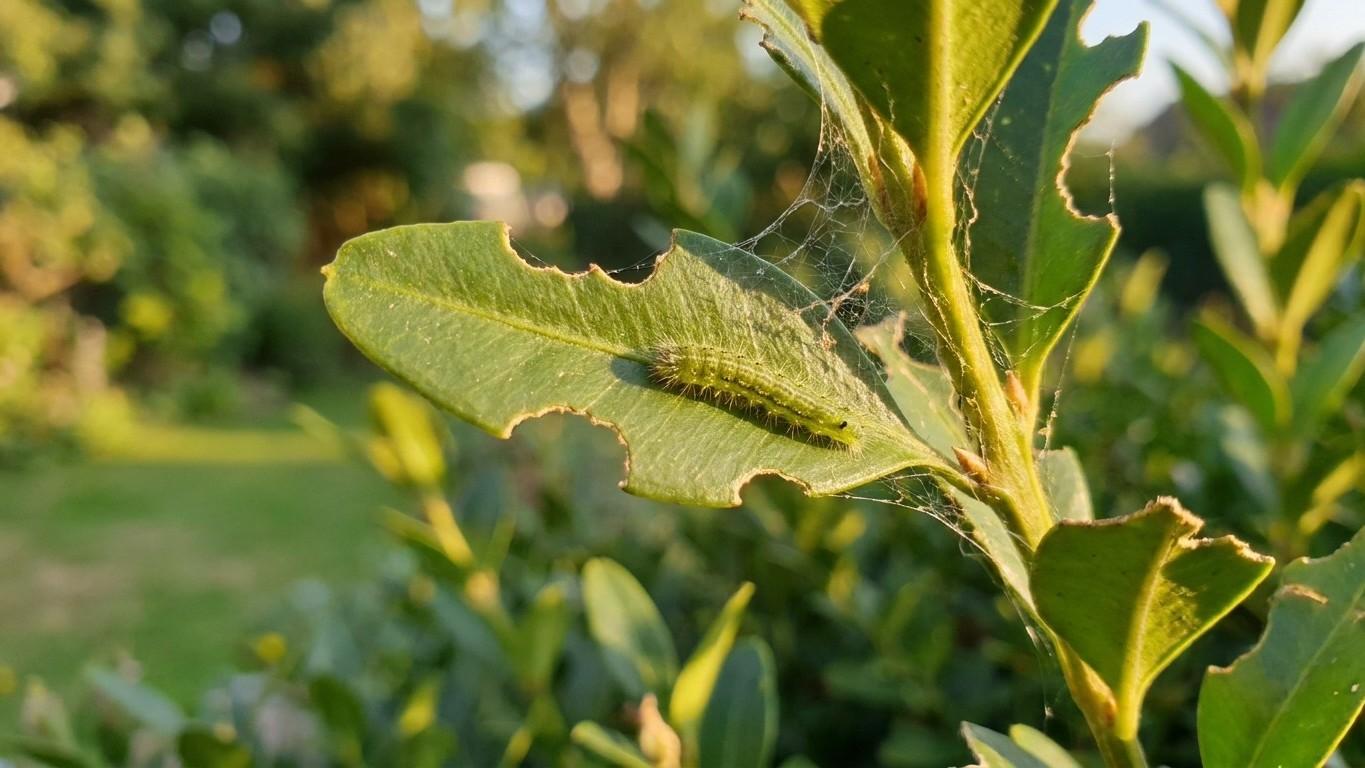
Three days. That’s how long it took to go from “problem solved” to standing in front of a boxwood hedge watching caterpillars keep chewing like nothing had happened. If you sprayed Btk (Bacillus thuringiensis var. kurstaki) at high noon expecting a clean kill, the leftover damage isn’t a mystery, and it isn’t a new infestation either. It’s the predictable result of three overlapping issues: sun exposure, biology, and timing that most home gardeners get wrong on their first attempt.
Key takeaways
- Btk breaks down in intense sunlight within hours, not days—midday spray timing destroys the product’s effectiveness before caterpillars even feed
- Btk doesn’t kill on contact; caterpillars can still visibly chew for 1-3 days while the bacteria works through their digestive system
- Young box tree moth caterpillars hide inside silk-webbed leaf structures where standard spray applications never reach them
Why Midday Sun Wrecked the Spray Before It Had a Chance
Btk is a living bacterial product, not a chemical poison, and that distinction matters enormously once it hits a sunlit leaf. While it can survive for years in the ground if adsorbed to soil particles, Bt is rapidly inactivated by the UV radiation in sunlight. Spraying at noon under a cloudless sky is close to the worst possible timing you could choose. Btk breaks down in the environment very quickly, in three to seven days, faster with sunlight. That’s the outer bound under decent conditions. Blast it with several hours of intense UV right after application, and the effective window shrinks dramatically, sometimes to just a few hours before the bacterial spores and protein crystals are degraded past usefulness.
Extension entomologists are blunt about this. Bacillus thuringiensis products are highly susceptible to degradation by sunlight, so the best time to spray your garden is early morning or evening. There’s a second reason evening wins beyond just avoiding UV: caterpillars tend to feed in the evening, so a dusk application puts fresh, potent Btk on the leaves right before the pests start eating in earnest. Spraying at noon means the product is already breaking down by the time the caterpillars’ peak feeding hours roll around that night.
Btk Doesn’t Kill on Contact, Even When Timed Perfectly
Here’s the part that trips up almost every first-time user, regardless of when they sprayed. Btk is not a nerve agent. It has to be eaten. When you apply it to the leaves the caterpillars will eat, they ingest it and it ruptures their guts causing death. That process is not instant. It can take 1-3 days for the pest to die, and you should not expect an instant knockdown effect like you would see with a contact poison. A caterpillar that ate treated foliage on day one can still be visibly moving, and even still nibbling, on day two or three while the toxin works through its digestive system.
Box tree moth specifically follows this exact pattern. Product guidance for boxwood-specific Btk formulations notes that within a few hours after treatment, the caterpillars will stop their feeding, and after 3-5 days they will die and fall off the plant. So the caterpillars still chewing on day three might simply be stragglers finishing their last bites before the toxin catches up with them, not evidence the spray failed.
But there’s a more likely explanation if damage genuinely continued at full pace: those caterpillars never ingested a lethal dose in the first place, often because they were hiding when you sprayed. Pennsylvania State Extension points out that box tree moth is an invasive insect native to East Asia that defoliates boxwood plants, and younger larvae in particular tend to shelter inside silk-webbed leaf nests. Ohio State’s applied entomology bulletin flags this as one of the most common application failures: Btk is a “stomach poison” that must be consumed by the BTM caterpillars, and young BTM caterpillars commonly feed within small structures made from leaves and debris tied together with silk, meaning a light, quick spray pass often never reaches them at all.
Multiple Generations Mean the Problem Rarely Ends in One Shot
Box tree moth also breaks a rule most gardeners assume applies to all caterpillar pests: one hatch, one spray, done. It doesn’t work that way here. Extension advice for boxwood owners is explicit that Btk will have to be reapplied according to the label directions as BTM have up to 3 different generations of caterpillars each year. That means eggs laid before, during, or shortly after your spray will hatch into a fresh cohort of larvae feeding on leaves where the Btk has already broken down, creating the illusion of an untouched population when it’s really an overlapping one.
Age matters just as much as timing. Btk must be applied when caterpillars are present, and young and small, because when caterpillars are small, they do not have to consume as much plant material for the bacteria to be effective. Larger, later-instar caterpillars need to eat far more treated tissue to absorb a fatal dose, which means they survive doses that would have killed a first-instar larva outright, and they keep chewing visibly the entire time. If your hedge had a mix of caterpillar sizes when you sprayed, the biggest ones were always the least likely to die quickly, sun exposure or not.
Getting the Timing Right the Next Time
None of this means Btk failed as a product. It means midday sun and a mixed-age caterpillar population stacked the odds against a single, one-shot success. Ohio State’s box tree moth guide stresses monitoring afterward rather than assuming failure: it’s imperative to closely monitor infested boxwoods long after a Btk application to gauge whether a second, or even third, application is required to eliminate a BTM infestation. Reapplication isn’t a sign you did something wrong. It’s baked into how the product and the pest’s life cycle actually interact.
For the next round, spray at dusk rather than noon, aim the nozzle with enough pressure to punch through any silk webbing where young larvae hide, and coat both leaf surfaces since caterpillars graze from all angles. Skip watering the hedge for a day afterward if you can, since most of these products adhere to the foliage for less than a week following application and the period shortens with rain or overhead watering. Check back in five to seven days, not three, before judging whether the treatment worked. And keep in mind that box tree moth’s arrival on the East Coast is recent enough that its US behavior is still being documented in real time, so what worked on a hornworm-infested tomato patch doesn’t automatically translate to a dense, shaded boxwood hedge where coverage is the hardest part of the whole job.
Sources : ncbi.nlm.nih.gov | amazon.com