
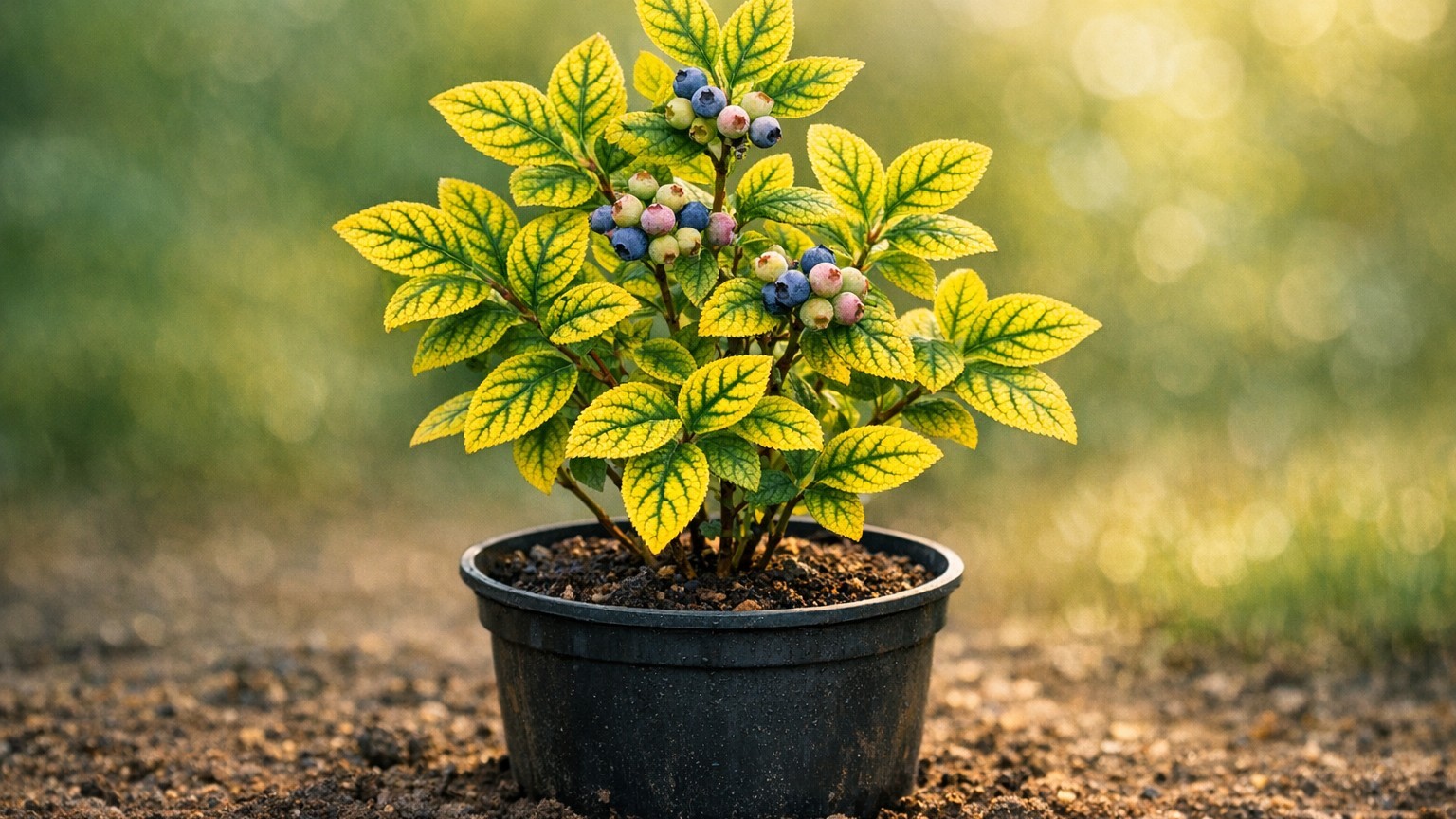
Yellow leaves with green veins running through them like tiny rivers. That’s not a blueberry bush begging for more water. That’s a plant that’s been drowning in the wrong kind of water all along, and by August the damage finally shows on top growth where it’s impossible to miss.
Container-grown blueberries are notoriously picky, and the symptom described here has a name: iron chlorosis. Interveinal yellowing is caused by iron deficiency, but is symptomatic of high soil pH. A high soil pH (>5.2) results in the inability of the blueberry plant to use iron, causing a lack of chlorophyll production. The plant isn’t starving because there’s no iron in the pot. It’s starving because the chemistry around its roots won’t let it absorb the iron that’s already there.
Key takeaways
- Your tap water might be silently sabotaging your blueberries’ ability to absorb iron that’s already in the soil
- Iron chlorosis looks nothing like drought stress—but most gardeners mistake it for thirst and make it worse
- Fresh potting mix and rainwater next spring could have prevented months of leaf yellowing
How to tell it apart from drought stress
Thirsty leaves droop, curl, and go uniformly dull or crispy at the edges. Iron chlorosis looks completely different, and once you’ve seen it, you won’t confuse the two again. Iron deficiency symptoms include stunted plant growth and interveinal chlorosis of leaves, where leaves turn yellow or redden between the veins. The pattern shows up first where new growth is happening, not on the oldest leaves. Iron deficiency symptoms develop first in young leaves. That’s a useful diagnostic shortcut: check the newest leaves at the branch tips before you check anything else.
Left uncorrected, the picture gets worse. The result is iron chlorosis: leaves turn light green or yellow while the veins stay darker green, and as the deficiency worsens, leaf edges scorch and turn brown, and branches can start dying back. Some growers make it worse without knowing it, because high levels of nitrogen or phosphorus in the soil make this worse by binding up whatever iron remains available. A well-meaning dose of general-purpose fertilizer in July can accelerate exactly the problem it was meant to solve.
Why tap water is the quiet culprit
Blueberries occupy an unusually narrow comfort zone. Blueberry plants are sensitive to water pH, salinity, chloride, boron, and sodium, and these fruits thrive in acidic soil with a pH of 4.0 to 5.5. Municipal tap water, by contrast, is treated to sit close to neutral or slightly alkaline, and it usually carries dissolved minerals that work directly against that acidity. One of the biggest hidden causes of iron chlorosis is bicarbonate-rich irrigation water, since excess bicarbonates continuously neutralize acidity around the roots, slowly increasing substrate pH and causing iron to precipitate into forms the plant cannot absorb.
Here’s the part that makes this frustrating for anyone doing everything else right: the shift happens gradually, glass by glass, week after week. Re-testing your soil every two to three years is a smart idea after your first test and amendment, particularly if you water with alkaline tap water. A pot that started the season at the right pH in May can drift out of range by August purely from mineral buildup delivered through the hose. And containers have essentially no buffering capacity compared to open ground, which is why potted plants show trouble faster and more visibly than the same variety planted in a bed.
Getting the color back
The fix isn’t more fertilizer. It’s restoring acidity so the iron already in the pot becomes usable again. Elemental sulfur is the standard slow-acting correction, though it works on a timeline measured in months rather than days, since iron sulfate (ferrous sulfate) works within days, and it dissolves in soil water and immediately releases hydrogen ions that lower pH. For a container showing symptoms right now, that faster route often makes more sense than waiting on sulfur to do its slow microbial work.
A foliar or soil application of chelated iron can also green leaves back up while the underlying pH problem gets sorted. That said, don’t reach for aluminum sulfate as a shortcut. Aluminum sulfate also acts rapidly and is widely sold for acidifying soil, but it’s a poor choice for blueberries specifically, since the aluminum it introduces can accumulate to toxic levels in acidic soil, damaging roots and reducing plant health over time. Swapping one root problem for another isn’t a fix.
Worth clearing up a persistent myth while we’re at it: dumping coffee grounds on the soil won’t rescue a chlorotic blueberry. While fresh, unbrewed coffee is acidic, the brewing process extracts most of the acid, and used grounds are close to neutral and won’t bring soil pH anywhere near the 4.0 to 5.5 range blueberries need. It’s a nice ritual for the compost pile, not a soil amendment strategy.
The water itself deserves attention too. Switching to rainwater collected in a barrel, or letting tap water sit uncovered for a day so some dissolved gases escape, won’t undo months of mineral buildup, but it stops adding to the problem going forward. For anyone irrigating multiple pots regularly, testing the tap water’s bicarbonate content is a one-time step that explains a lot about why “acid-loving” plants in containers struggle even when the potting mix started out perfectly blended.
Come next spring, the smarter move is to repot into a fresh acidic mix rather than trying to chase the pH downward in old, mineral-loaded soil. Fresh pine bark and peat give the roots a clean start, and a season of rainwater or acidified irrigation from the beginning means the yellowing this time won’t be a late-summer surprise. Sometimes the most useful lesson a wilting-looking leaf can teach isn’t about watering more. It’s about paying attention to what’s actually in the water going in.
Sources : farmprogress.com | bloomingexpert.com