
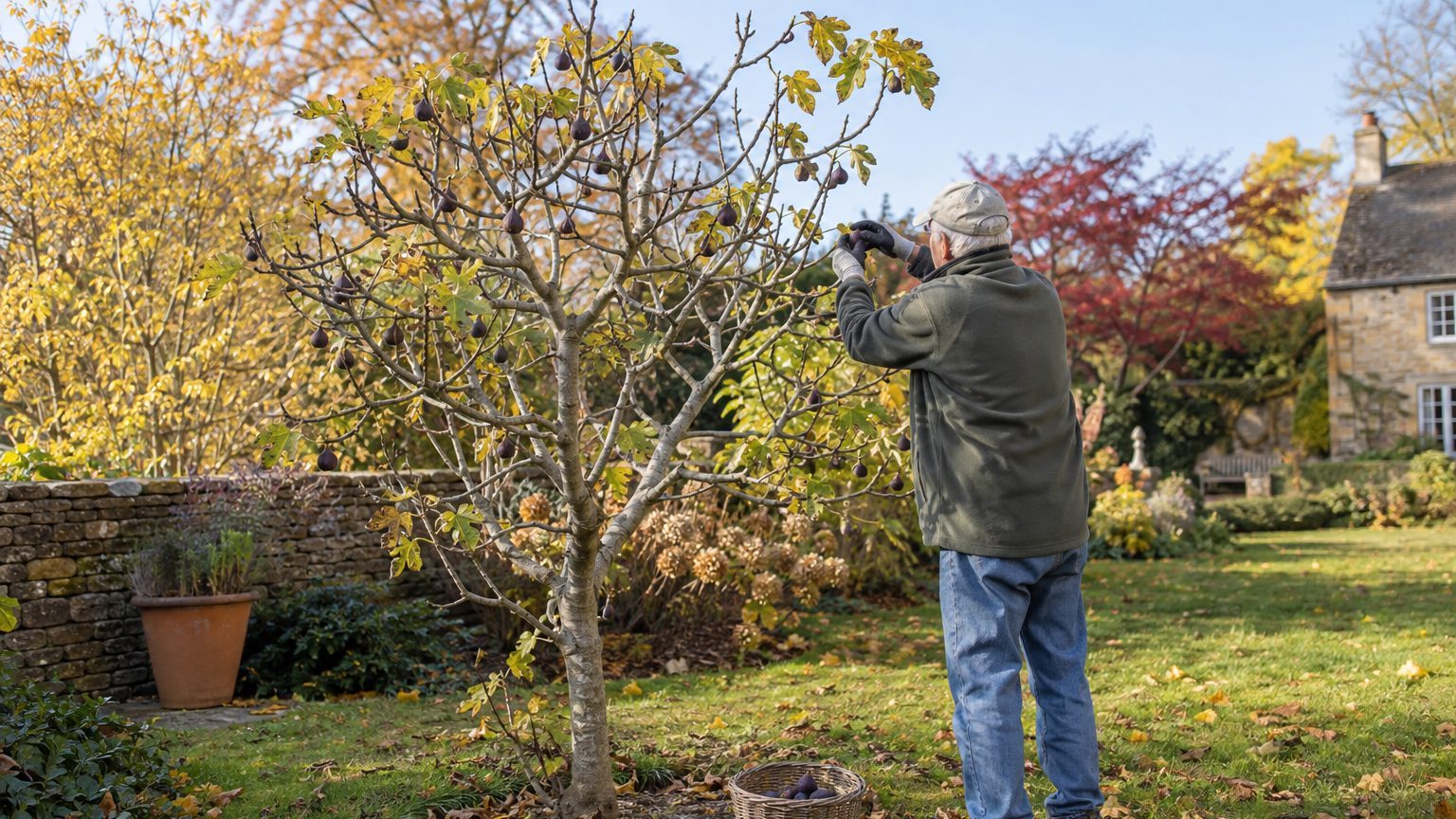
Yes, in most cold-winter regions, with one small exception. A fig that is still hard and green when nights drop toward freezing will not ripen, and it will not survive the winter in any useful form. Off it goes.
Figs do not ripen once picked, so timing matters.
The common fig (Ficus carica) can set two crops a year. The first, called the breba crop, forms on last year’s wood and ripens in early summer. The main crop develops on the current season’s growth and ripens from late summer into fall. In northern gardens, it’s the main crop that gets caught: a branch loaded with walnut-sized fruit in mid-October, a frost warning on the phone, and a tree that has already sunk a lot of energy into figs it can’t finish.
- Figs larger than a pea should be removed in late fall in cold-winter regions.
- Tiny embryonic figs smaller than a pea can overwinter in leaf joints and resume growth in spring.
- Rotting fruit left on the tree attracts fruit flies, sap beetles and wasps and harbors fungal disease.
Why green figs don’t belong on a bare winter branch
After the first hard frost, leaves blacken and drop, and the tree shuts down for the winter. Unripe figs left behind freeze, shrivel or turn to mush.
Mush is the real problem. Rotting fruit draws fruit flies, sap beetles and wasps, and it gives fungal diseases such as botrytis a place to live through winter. Mummified figs that hang on into spring can release spores right when new fruit is forming. Removing them costs you ten minutes and a pair of gloves.
Sanitation is the unglamorous secret of clean fig harvests.
There’s also a plain cosmetic argument, which I find more persuasive than gardeners usually admit. A tree wrapped for winter, or even just left bare, looks better and is easier to inspect without a hundred brown, wrinkled fruits dangling from it. You can see dead wood, scale insects and cankers when the branches are clear.
The size rule: what to pick off, what can stay
The working rule among growers in marginal climates is about size. Figs larger than a pea should come off in late fall. Tiny embryonic figs, pea-sized or smaller, can stay.
The logic is developmental. Those tiny fruits sit in the leaf joints near the shoot tips and can sometimes sit through winter on protected wood, then resume growth in spring as the early breba crop. Larger fruits, from roughly olive size upward, are too far along and too full of water. They are the ones that freeze, split and rot. Results vary by variety and by how hard the winter turns, so treat the pea rule as a good bet rather than a guarantee.
Honest caveat: in zones 5 and 6, where many gardeners let the tree die back to the ground or wrap it heavily, overwintering fruit is unreliable. Frost-killed wood takes any embryonic figs with it. Gardeners who grow a fig as a dieback shrub also have no breba crop to protect, since the tree fruits only on new growth. For them, the simplest approach is to strip everything.
Ripe fruit is a different story, and you should pick it immediately. A ready fig droops on its stem, the neck bends, the skin softens and the color deepens, and sometimes a drop of nectar forms at the base, the small opening called the eye. Pick it the same day, because a ripe fig on the branch in cool, damp weather won’t last long.
A bland, chewy fig was picked too soon.
What about the in-betweens, the figs that are nearly there when a frost warning arrives? Throwing a frost cloth or old blanket over the tree for a night or two, or rolling a potted tree into the garage, can buy a few more days. Sometimes that is enough to finish a handful of fruits. It rarely rescues figs that are still hard.
How to do it without hurting the tree
Aim for the point when growth has stopped and nights hover in the 40s Fahrenheit, which usually means late October in zones 5 to 7. Don’t wait for the first hard freeze to do the cleanup. Wear gloves and long sleeves, since the milky sap of a fig tree can irritate skin, especially in sun. Twist or snip each fruit at the stem with clean pruners rather than tugging, which can tear bark and leave an entry point for disease.
Gather what has fallen as well. Bin it or bury it deep rather than leaving it under the tree, where it will feed pests until spring.
Mild climates change the answer. In zones 8 to 10, the main crop often keeps ripening through November, and in warm years into December, so you pick ripe fruit and remove only the split or moldy ones. Cutting off perfectly healthy green figs there would be throwing away harvest.
Container figs deserve their own note. Before you move a pot into an unheated garage or basement for dormancy, take off every fruit. Stored in humid, still air, even a few leftover figs can mold and spread problems to the stems.
Fixing the problem at its source next season
If you strip a laden tree every October, the real lesson is that the tree is fruiting too late for your climate. Gardeners in cold regions often pinch off the growing tips of shoots in midsummer, around late June or July. That stops new leaf growth and redirects the tree’s energy to figs already set, which then have time to ripen.
Easing off water and nitrogen fertilizer in late summer helps as well, because lush, late growth produces late fruit. Choosing an early-ripening or cold-tolerant variety matters even more, and local nurseries or your state’s cooperative extension office can tell you which ones perform in your zone.
Even with good care, expect some failures. Figs generally need a couple of months of warm weather between setting and ripening, so a fruit that appears after mid-August in a cold region is unlikely to finish, and it’s the first one to take off the branch.