A closet that fights back
You know the moment: you’re late, you need one specific top, and the closet gives you a small avalanche instead. Hangers clack, a belt snakes to the floor, one shoe disappears like it pays rent elsewhere. Result? You start your day negotiating with a cupboard.
A budget closet organization makeover isn’t about building a walk-in or buying a perfectly curated system. In March 2026, with prices still feeling jumpy in many places, the smartest upgrades are the ones that cut daily friction for the cost of a few takeaways. Think: more visibility, less clutter, and a closet that behaves.
This guide sticks to real, concrete changes you can do in a weekend, without reconstruction. You’ll get a diagnostic, a budget range you can trust, DIY storage you can actually make, and small aesthetic moves that make the space feel intentional.
Evaluate your current closet: diagnosis and potential
Full inventory: sort to organize
Start with a blunt fact: you can’t organize what you haven’t counted. Pull everything out. Yes, everything. Clothes, shoes, bags, the “I’ll fix it later” pile, the mystery tote.
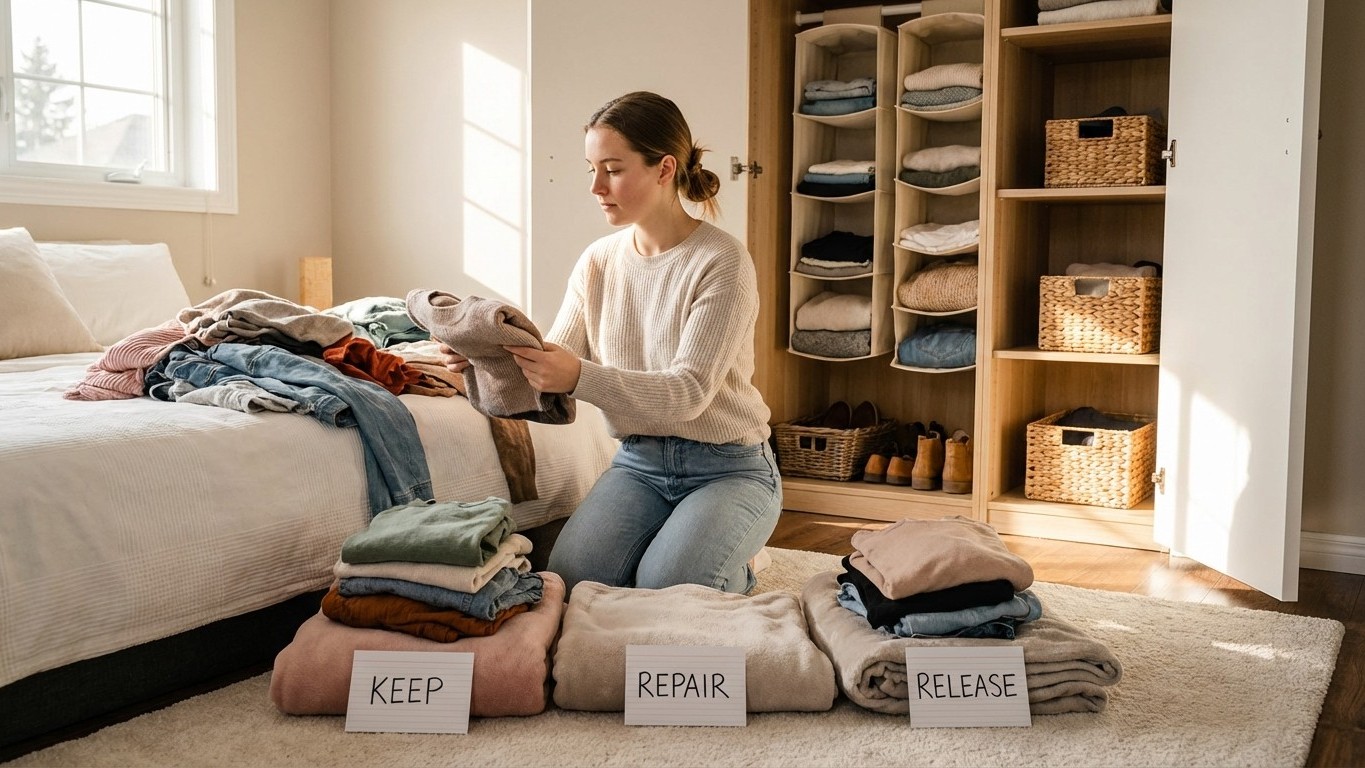
Make three zones on the bed or floor: keep, repair/alter, release. If you want a KonMari-inspired check, hold each item and ask one practical question: “Would I wear this in the next 30 days if it were clean?” That avoids the guilt spiral and keeps the focus on how you live now.
Example that changes decisions fast: try on five “maybe” pieces in a row. If three feel itchy, tight, or fussy, that’s not a storage problem. That’s a wardrobe problem.
Find problem zones and underused space
Closets usually fail in the same three places: the floor becomes a dumping ground, the top shelf turns into a graveyard, and the middle section gets overcrowded because it’s the easiest to reach.
Walk through your closet like you’re scanning a fridge. Where do items block each other? Where do you lose things? A quick test: if you can’t see it, you won’t wear it. That’s why “perfectly folded” stacks often underperform in real life.
Look up. Vertical space is your hidden square footage. Even in a small wardrobe, the top 30 to 40 cm often sits unused, while shoes pile below like a traffic jam.
Set a realistic budget for your closet makeover
A functional makeover usually lands between 50 and 200 euros, depending on what you already have. The trick is splitting the budget by impact, not by category.
- 50–80€: declutter + basic organizers (hooks, a few boxes, slim hangers) + labels.
- 80–140€: add lighting + one vertical upgrade (stackable shelves or a second hanging level) + nicer storage for accessories.
- 140–200€: include paint or peel-and-stick paper + hardware refresh + a more cohesive set of bins/baskets.
My opinion: spend first on visibility. If you can see what you own, you buy less duplicates and your closet stops “expanding” into chairs and doorknobs.
Budget organization solutions: maximize what you already have
DIY storage using reclaimed materials
Before you buy anything, “shop” your home. Delivery boxes, glass jars, shoe boxes, even sturdy packaging can become systems. What matters is consistency in size and purpose.
Concrete example: turn two identical shoe boxes into drawer zones. Cut the lids down to create open trays, wrap them in leftover paper (or plain kraft for a clean look), and label: socks, underwear, workout gear. Suddenly, drawers stop being a fabric soup.
If you have spare tension rods, they’re closet gold. Use one low in the closet to hang scarves with shower rings, or create a small “front-of-closet” barrier to keep bags upright.
Affordable organizers: where to find them and how to choose
Budget organizers are everywhere in 2026: discount home stores, secondhand apps, charity shops, office-supply aisles, and even Kitchen sections. The danger is buying random pieces that don’t work together.
Choose by measurement, not by vibes. Measure your shelf depth, your hanging width, and the height between shelves. Then pick organizers that fit those numbers, not the other way around.
- Prefer clear or open-front bins for daily items, so you don’t forget what’s inside.
- Pick stackable shapes for top shelves, they turn “air space” into storage.
- Go for slim hangers if your rail is crowded, they can reduce bulk fast.
One more filter: avoid organizers that require perfect behavior. If a box needs you to fold items in a specific way every time, it will fail during busy weeks.
Vertical optimization: use height without big spending
Vertical thinking is the closest thing to “free space.” Add a second hanging level for shorter items like shirts or kids’ clothes, then keep long pieces (coats, dresses) on one side.
A simple approach: use a hanging extender hook or a second bar solution to create two rows. The top row holds shirts; the lower row holds trousers or skirts. You just doubled capacity without widening anything.
Don’t ignore the back of the door. Over-the-door hooks can hold bags, hats, tomorrow’s outfit, or a small laundry bag. That keeps your closet floor clear, which makes the whole space feel bigger.
Visual closet refresh: affordable aesthetic upgrades
Paint and wallpaper: style for under 50€
A closet makeover feels more “real” when the background changes. Even a small paint job inside the closet shifts the mood from storage to dressing space.
Keep it simple: one light color increases perceived space and helps you see true colors when you get dressed. If you want personality, use peel-and-stick wallpaper on the back panel or on the inside of doors. One surface is enough.
Budget tip: repaint only what you see. Closet interiors don’t need museum-level coverage. Clean, patch obvious holes, and focus on the back wall and the first 60 cm of side walls.
Affordable LED lighting: visibility and ambiance
Most closets are lit like a parking stairwell, if they’re lit at all. Add stick-on LED strips or motion-sensor lights so you can actually see textures and shades.
Place lighting where it helps choices: above the hanging rail, under the top shelf, or along the door frame. Warm-white feels cozy, neutral-white feels like a dressing room. Pick based on how you want mornings to feel.
Real-life payoff: fewer “why does this look different outside?” outfit surprises. That saves time, and it saves laundry.
Handles and hardware: small details, big effect
If your closet has doors or drawers, updating handles is one of the cheapest ways to make the whole unit look intentional. It’s also oddly satisfying, like putting new shoes on an old outfit.
Bring one handle with you when shopping, so you match screw spacing. If you can’t, choose a style that comes with options or be ready to fill and redrill. Budget-friendly does not mean “make extra work for yourself.”
Category-based organization: a Marie Kondo-inspired method that works on a budget
Clothes: folding and hanging, optimized
The KonMari approach gets quoted a lot, but the useful part is simple: store items so you can see them. Visibility beats volume.
Hang what wrinkles and what you reach for often. Fold what is forgiving and benefits from drawer visibility, like tees and knitwear. If you don’t have drawers, use open bins as “drawer substitutes” on shelves.
Example: fold t-shirts vertically in a bin so every shirt edge is visible like files. You stop digging, and you stop stretching collars.
Shoes in a small space: creative, low-cost solutions
Shoes are space bullies. They’re heavy, awkward, and they multiply. In a small closet, the goal is to store them by frequency, not by category.
- Daily pairs at eye-level or near the door, easy grab.
- Occasional pairs higher up, in labeled boxes or dust bags.
- Off-season pairs fully out of the prime zone.
Try a simple riser solution so one pair sits above another, doubling shelf capacity. If you already have sturdy cardboard, you can prototype spacing before buying anything.
Accessories and jewelry: visual sorting systems
Accessories disappear because they’re small. Make them visible and they become usable again.
Use jars for rings, a shallow tray for watches, and hooks for belts and bags. If you’re short on wall space, attach adhesive hooks to the inside of the closet door for belts and necklaces. Keep tangles away by spacing hooks more than you think you need.
A daily-life connection: when accessories are easy to see, you’ll style outfits faster, which reduces the “I need new clothes” feeling that often comes from boredom, not need.
DIY projects for a functional closet: 10 ideas under 30€
These projects stay intentionally small. Each one targets a specific friction point, the kind that makes you abandon the closet system after two weeks.
- Homemade drawer dividers: cut sturdy cardboard or thin wood to fit, cover with paper, and create lanes for socks, underwear, tees.
- PVC additional hanging bar: create a lower rail for shirts or kids’ clothes using PVC pipe and brackets, measure carefully before drilling.
- Personalized storage boxes: wrap shoe boxes in kraft paper or fabric offcuts, label clearly on the front edge.
- Scarf organizer from shower rings: clip rings onto a hanger and loop scarves through, one per ring.
- Bag “parking” zone: add hooks or a repurposed towel bar inside the closet wall for bags that slump.
- Shelf dividers from binders: repurpose magazine files to keep sweaters upright and prevent pile collapse.
- Small-item trays: use lids from boxes as catch-alls for keys, lint roller, sewing kit, the tiny things that roam.
- Label system that lasts: use consistent labels for bins, not cute names, practical ones like “gym,” “work,” “winter.”
- Hidden laundry solution: a hanging bag or slim bin prevents the “clothes chair” from migrating into your bedroom.
- Outfit staging hook: one hook for tomorrow’s outfit reduces morning chaos and keeps decision fatigue down.
Step-by-step: DIY drawer dividers
Measure the drawer interior. Cut strips to the drawer height minus a few millimeters so they slide in easily. Create a simple grid using slots cut halfway through each strip, then assemble like a puzzle.
Cover with paper tape or leftover wallpaper so edges don’t snag. Result? Every item has a lane, and your hands stop “searching” in the morning.
Step-by-step: PVC extra rail (without overcomplicating it)
Measure the closet width where you want the new bar. Cut PVC to length, then attach brackets to side walls at the same height. Keep enough clearance for hangers below the top rail, test with a few hangers before final tightening.
Place it where it makes daily sense: if you wear shirts and trousers often, use the extra rail for shirts and fold trousers below. If dresses dominate, skip it and use vertical bins instead.
Step-by-step: upgrade basic boxes into “real” organizers
Choose boxes that match in footprint so shelves look calmer. Wrap, label on the front, and assign one category per box. No mixed categories, that’s how you create a “miscellaneous” monster.
Keep one intentionally labeled “temporary.” Life produces odd items. Give them a place, then empty that box once a month.
Keep it organized: routines that prevent backsliding
Seasonal rotation system
Rotation is how small closets stay functional. Store off-season items up high or under the bed, in clearly labeled bins. When seasons change, swap categories, not individual pieces, it’s faster and you’re less likely to leave strays behind.
Think of it like a pantry. You don’t keep every ingredient on the counter year-round. Your closet deserves the same logic.
Monthly mini-declutter rules to stop accumulation
Set one rule you can keep even when you’re busy. Here are three options that work without turning your life into a project:
- One in, one out for clothing categories that overflow easily, like tees or jeans.
- A 10-minute reset every month: rehang, refold, put shoes back, empty the “temporary” box.
- A “repair day” once a month: sew buttons, remove pilling, decide if an item earns its place.
Clutter often returns when clothes need maintenance. Fixing small issues protects your closet from becoming a holding pen for “almost wearable” pieces.
Evolve the system as your needs change
The best closet organization isn’t static. Job changes, lifestyle shifts, body changes, even a new hobby can rewrite what “daily wardrobe” means.
Keep your structure flexible: bins that can change labels, hooks you can move, shelf zones that can switch from sweaters to sports gear. A closet that adapts stays tidy longer.
A weekend plan, plus before/after inspiration you can actually use
Saturday morning: empty and sort. Saturday afternoon: clean, patch, and set the new layout. Sunday: add organizers, lighting, and labels, then put items back by category.
For before/after motivation, take three photos before you start: doors open, doors closed, and a close-up of the messiest zone. Photos don’t need to be pretty. They make progress visible, which helps you finish when you hit the boring part.
If this closet makeover spills into the room around it, that’s normal. The closet is connected to your bedroom rhythm, your laundry habits, and how you start your day. You might like pairing this project with a budget bedroom makeover or browsing cheap bedroom decorating ideas to keep the momentum going beyond the closet doors.
Closet to home: making small upgrades feel like a bigger change
A budget closet organization makeover often becomes a gateway project. Once one storage zone works, you notice the next friction point, the nightstand clutter, the entryway pile, the “random cables” drawer.
If you’re in that phase, it helps to think in systems rather than rooms. One weekend, one zone, one repeatable method. That’s the logic behind a broader budget home makeover, and it’s also why small DIY projects, like diy headboard ideas on a budget, can make a home feel more “yours” without a renovation.
Now the real question: once your closet stops overflowing, what part of your daily routine suddenly feels easier, and what would you redesign next to keep that feeling going?