
Every August, the same scene plays out in millions of American households: backpacks piling up by the door, school supply lists taped to the fridge, and a kitchen table that suddenly needs to double as a homework station, a video-call backdrop, and a place to eat dinner. The back-to-school rush isn’t just about pencils and lunchboxes anymore. It’s about carving out functional space in homes that were never designed to host a classroom and an office at the same time.
Roughly 28 million Americans worked from home at least part-time in 2025, according to the U.S. Census Bureau’s American Community Survey data. Add school-age kids doing homework, virtual assignments, or hybrid learning days, and you get a household juggling two sets of screens, two sets of deadlines, and often one shared table. The result is friction that shows up in small but constant ways: a parent’s conference call interrupted by a math worksheet emergency, a kid’s Chromebook charger tangled with a laptop cord, notebooks scattered across a countertop that was supposed to stay clear.
Key takeaways
- Why kitchen tables fail as dual-purpose workspaces and what’s really missing from most setups
- The surprising science behind vertical storage, desk lighting, and how clutter affects focus
- A charging station placement tweak that improves homework focus AND kids’ sleep quality
Why Shared Spaces Fail Without a Plan
The instinct is to throw money at the problem: a new desk, a bigger table, maybe a whole room conversion. But organization professionals consistently point to a simpler issue. Most home offices and study nooks fail not because of square footage, but because there’s no defined zone for each activity. When a kitchen island serves as a mail drop, a snack bar, and a homework station, everything piles up because nothing has an assigned spot.
Think of it like grocery store layout. Milk sits in the back because it forces you past everything else. Home spaces need that same intentionality, just reversed. The goal isn’t to make kids and parents walk further. It’s to give every object, from a stack of graded worksheets to a parent’s charging cable, exactly one place it belongs. Once that’s in place, the daily reset takes minutes instead of becoming a nightly negotiation.
Vertical space solves more of this than people expect. Wall-mounted shelves above a desk, pegboards for supplies, or a simple corkboard for schedules keep surfaces clear without requiring a bigger footprint. A 2023 study from Cornell University’s Department of Design and Environmental Analysis found that visual clutter measurably increases stress responses and reduces task focus, particularly in shared or multi-use rooms. That’s a strong argument for keeping desktops nearly empty and pushing storage upward or into closed cabinets.
Setting Up Separate Zones That Actually Work
Parents managing both a work-from-home schedule and a kid’s homework routine benefit from physical separation, even in small apartments. That doesn’t mean two full rooms. A room divider, a bookshelf turned sideways, or even a curtain can visually and psychologically split one space into two distinct zones. Kids tend to focus better when their workspace has a clear boundary, something child development researchers have linked to reduced distraction during homework sessions.
For younger children, the desk height matters more than most parents realize. A desk sized for an adult forces kids into poor posture, which shortens their attention span before the assignment even gets read. Adjustable-height desks or simple risers under chair legs cost little and pay off in longer stretches of focused work. For teenagers, the priority shifts toward outlets and charging access, since most high school assignments now run through laptops or tablets rather than paper.
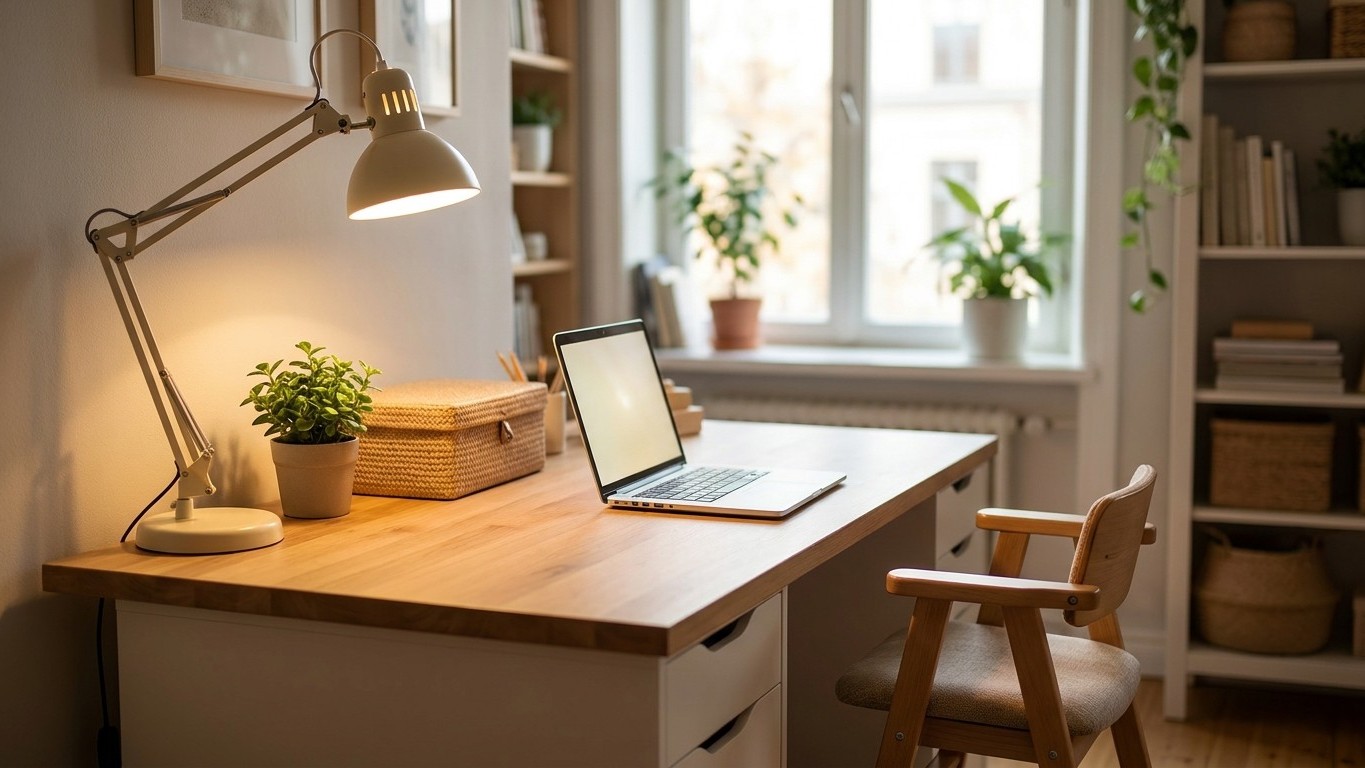
Lighting deserves more attention than it typically gets. Overhead lighting alone creates glare on screens and flattens a workspace, making both reading and video calls harder. A dedicated desk lamp, ideally with adjustable warmth, reduces eye strain during long study or work sessions. The American Academy of Ophthalmology has noted that inadequate task lighting contributes to digital eye strain, a complaint that spikes every fall when screen time jumps back up with the school year.
Storage That Grows With the School Year
September’s supply list looks nothing like April’s. Folders multiply, art projects pile up, and seasonal gear (winter coats, spring sports equipment) competes for closet space. Static storage solutions bought in August often fail by January because they weren’t built to flex.
Modular storage bins, labeled by subject or by week rather than by rigid category, tend to survive the school year better than fixed drawer systems. Rotating what’s accessible, keeping only the current month’s materials at arm’s reach while archiving the rest, prevents the slow creep of clutter that swallows a desk by winter break. A simple file box with hanging folders labeled by month costs under twenty dollars and handles what an expensive filing cabinet often can’t: flexibility.
Parents working from home should apply the same logic to their own supplies. Cable organizers, a small tray for daily mail, and a designated spot for the items that migrate constantly (chargers, headphones, a planner) cut down on the five minutes spent searching for something every single morning. Multiply that across a school year and it adds up to hours reclaimed, not just tidiness for its own sake.
Small Changes That Make the Biggest Difference
Not every fix requires new furniture. A wall calendar visible to the whole family reduces the daily “what do I have today” conversation that eats into morning routines. Color-coding by family member, one hue per kid and one for parent obligations, makes the calendar readable at a glance rather than requiring anyone to squint at overlapping entries.
A charging station away from the bedroom, positioned instead in the shared workspace, has a side benefit beyond organization: it nudges devices out of sleeping areas, which pediatric sleep researchers have linked to better rest in school-age kids. It’s a small architectural choice with a ripple effect on bedtime, not just on desk clutter.
The families who navigate this season with the least friction aren’t the ones with the most expensive setups. They’re the ones who treated the home office and the homework station as connected systems rather than separate problems, built around how mornings and afternoons actually flow, not how a furniture catalog says a room should look.