
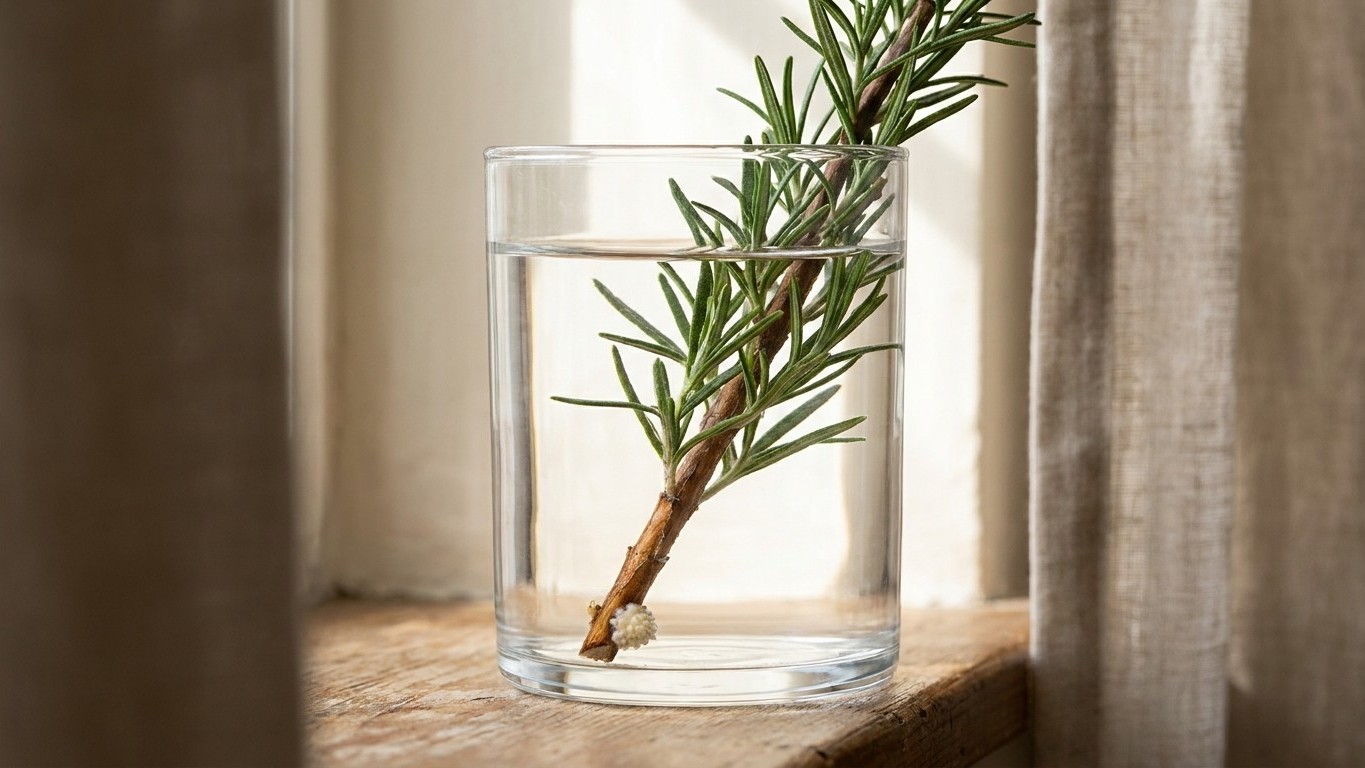
That white, waxy knob at the cut end wasn’t a root. It was a callus, the thick scar tissue rosemary forms before it even thinks about growing roots, and it’s the reason so many people give up on this herb after weeks of staring at an unchanged glass of water.
Mint spoils us. Drop a stem in water on a Tuesday, and by the following week you’ve got thread-like roots dangling like fishing line. Rosemary plays by different rules entirely. Rosemary is fairly stubborn about rooting, though the transparency of water propagation actually improves your success rate compared to soil, where overwatering and hidden rot kill most cuttings. The stem you pulled from the glass, with its odd swollen base, was doing exactly what a woody Mediterranean shrub is supposed to do: protecting itself before committing energy to new growth.
Key takeaways
- That mysterious waxy knob isn’t what you think it is—and most people throw away their cuttings at this exact stage
- Rosemary’s woody structure makes it behave nothing like mint, and confusing the two almost guarantees propagation failure
- One critical detail about stem softness determines whether your cutting will callus or rot in silent darkness
Why rosemary refuses to behave like mint
The botanical difference comes down to stem structure. Mint has soft, herbaceous tissue that’s practically primed to sprout roots at any node touching water. Rosemary, on the other hand, is woody at its core, closer in construction to a small tree branch than to a garden herb. That woodiness is exactly why cuttings need patience: the cutting will sit there looking unchanged for 7-10 days, and this is normal. Around week two, you’ll start seeing tiny white root tips at the cut end.
One gardener who experimented with rooting other Mediterranean shrubs in water documented almost the exact bump you likely saw. At the end of two months, the stems didn’t appear callused, swollen, or ready to sprout roots, but the part of each stem that was under water was covered with wartlike nodes. That’s the callus stage, a kind of biological waiting room where the plant heals the wound from pruning shears before switching its cells over to root production. Skip this phase by rushing the cutting into soil too soon, and you risk snapping off the very tissue that would have eventually produced roots.
Softwood versus semi-hardwood: the detail most people miss
Not every rosemary stem behaves the same way in a glass of water, and this is where a lot of kitchen windowsill experiments go sideways. Soft, new spring growth looks tempting to snip, but it’s also the most likely to rot before anything useful forms at the base. Water propagation works especially well for hardwood cuttings in the fall, while softwood cuttings tend to rot in the water before they can root. If your cutting turned mushy and brown instead of forming that callus knob, the culprit was probably picking a stem that was too tender, too young, too eager to look green.
Timing plays into this too. Softwood cuttings, taken early in spring, root faster but are also at a higher risk of rotting in water, which is why semi-hardwood cuttings are preferred for water propagation, though they take longer to develop roots, about four to six weeks. A semi-hardwood stem, one that bends slightly before snapping rather than folding like a blade of grass, holds enough structural integrity to sit in water for a month without collapsing.
Turning that callus into an actual root system
The good news: a callus isn’t a failure. It’s a checkpoint. Left undisturbed in clean water, most of those swollen bases will push out fine white root threads within another week or two. By week 3-4, most cuttings have developed several roots that are about an inch long. The mistake would be tossing the cutting because nothing “root-like” appeared right away, or worse, fishing it out repeatedly to check, which only stresses tissue that’s trying to heal.
A few habits make the difference between a callus that eventually roots and one that just rots in place:
- Strip every leaf that would sit below the waterline, since submerged foliage breeds the bacteria that clog stems and cause the whole cutting to blacken.
- Change the water every few days rather than topping it off, since stagnant water is where rot organisms take hold.
- Keep the jar somewhere with bright, indirect light rather than a dim countertop corner, since low light slows the whole process down.
- Resist moving or nudging the cutting once it’s settled, since disturbed tissue struggles to callus evenly.
Once roots finally appear, resist the urge to leave the cutting floating indefinitely out of sentimental attachment to watching it grow. Propagating rosemary cuttings in water is fast, but results in weaker roots that suffer transplant shock more easily when transitioning back to soil. The fix is simple: move the cutting into a well-draining mix, something light with perlite or coarse sand, as soon as those water roots reach roughly an inch, rather than waiting for a dense tangle to form. Water roots and soil roots are structurally different, and the longer a cutting stays submerged past that point, the harder the adjustment to solid ground becomes.
Here’s the detail that surprises most people who’ve only ever propagated mint or basil this way: even under near-perfect conditions, rosemary cuttings simply don’t all make it. Take several cuttings, as only half of them are likely to root. That’s not a sign you did something wrong with your particular glass of water. It’s just the nature of a shrub whose ancestors evolved on sun-scorched Mediterranean hillsides, not in a puddle. Drop five or six stems in at once, expect a couple of failures, and treat every swollen white knob at the base as good news rather than a dead end.
Sources : quora.com | growingthehomegarden.com