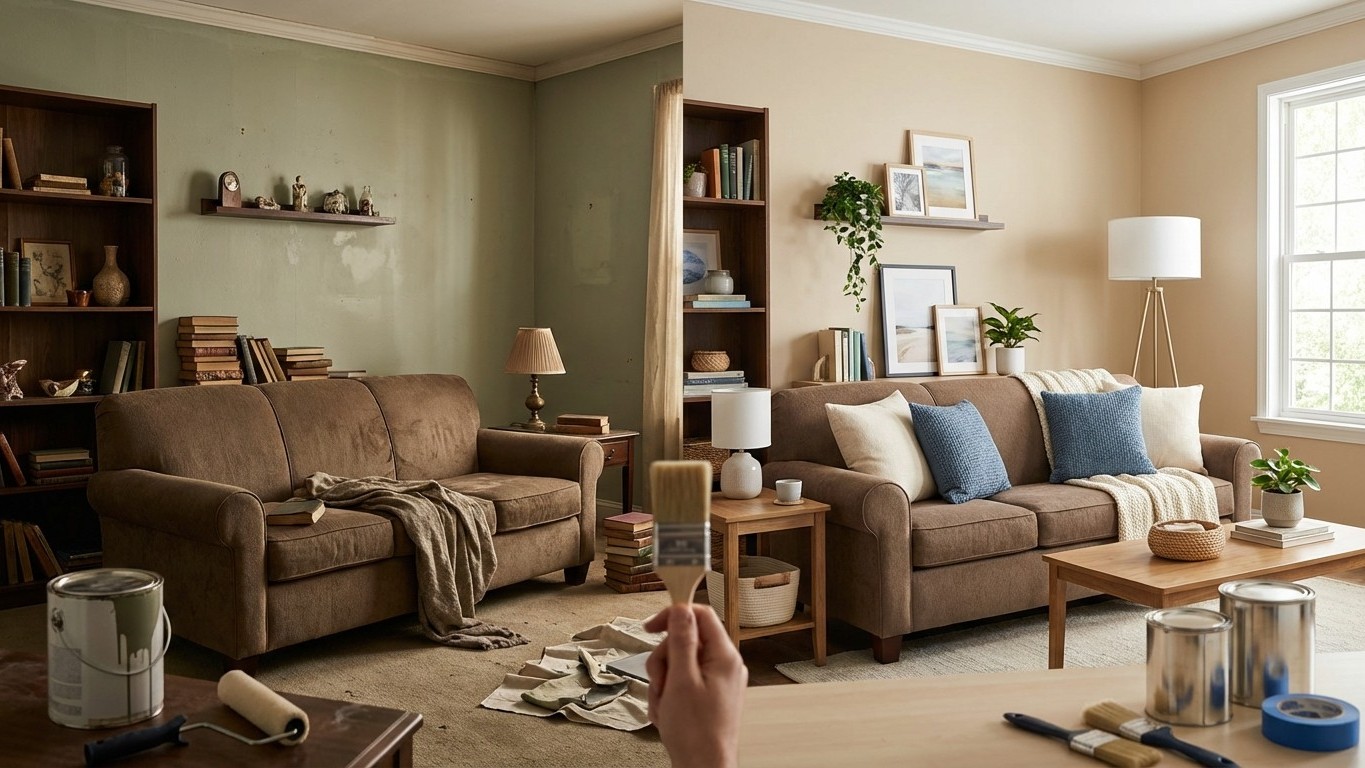
Your living room feels tired. The kitchen cabinets are scuffed. The bedroom looks exactly like it did five years ago, and not in a nostalgic way. You want change, but your bank account has other ideas. Here’s what most home makeover content won’t tell you upfront: the most dramatic transformations rarely come from the biggest budgets. They come from strategy, creativity, and knowing exactly where your dollar will do the most work—whether it’s budget living room makeover ideas, budget kitchen makeover ideas, a budget bedroom makeover, or a budget bathroom makeover that can completely transform your space.
A budget home makeover isn’t about settling for less. It’s about understanding that a $30 can of paint, applied with intention, can outperform a $3,000 accent wall installation. It’s about seeing your existing furniture not as dead weight but as raw material. This guide covers everything you need to know about how to plan a budget home makeover, from the initial room-by-room audit to mastering DIY home makeover techniques to the final shopping trip, so you can walk through your front door feeling genuinely proud of what you built, without having drained your savings to do it.
What a Budget Home Makeover Actually Means (And Why It Works)
The Philosophy Behind Transforming Your Space Affordably
The word “budget” has an unfortunate reputation. In home decor circles, it often gets paired with “temporary” or “compromise.” That framing is wrong, and it’s worth addressing head-on. A budget home makeover is a discipline, not a limitation. Think of it the way professional chefs think about cooking with seasonal, local ingredients: the constraint forces creativity that expensive imports simply don’t demand.
Interior designers will tell you privately that client budgets rarely correlate with final results. What correlates? Clarity of vision. A homeowner who knows exactly the mood they want to create, the colors that speak to them, and the functional problems they need to solve will outperform a client with unlimited cash and no direction, every single time. Money buys options. Vision produces results.
Three Principles That Make Budget Renovations Succeed
The first principle is impact-to-cost ratio thinking. Every decision you make should pass a simple mental test: does this change significantly affect how the room looks or feels, relative to what it costs? Paint always wins this test. Swapping hardware on kitchen cabinets wins this test. Buying a new sofa with incremental improvements over your current one? Often fails. Train yourself to ask “how much difference will this actually make?” before spending anything.
The second principle is sequencing. Transformations that happen room by room, in a planned order, feel dramatically more satisfying than scattered improvements across the whole house. Finishing one room completely, even on a modest budget, gives you momentum and a proof of concept. You can see what works. You carry those lessons into the next room.
The third principle is patience as a competitive advantage. People who are willing to wait six weeks for a secondhand dresser to appear on Facebook Marketplace, or who time their paint purchases around holiday sales, consistently get more per dollar than impulsive buyers. Urgency is expensive in home decor. Patience is free.
Dismantling the Luxury Myth
Scroll through any high-end home design account and you’ll see the same visual language: linen textiles, aged wood surfaces, soft neutral palettes, layered lighting. None of these aesthetics are inherently expensive. The aged wood effect can come from a thrift store find and a sanding block. Linen textiles show up at estate sales regularly. The luxurious layered lighting look? Often achievable with a $25 lamp and a warmer bulb. What you’re paying for in luxury home decor is largely the curation and the brand story, not the physical materials themselves.
Diagnosing Your Home Before Spending a Dollar
The Room-by-Room Audit
Before you buy anything, open a notebook or a notes app and walk through your home with honest eyes. In each room, write down three categories: what genuinely bothers you, what you’d miss if it were gone, and what you’ve stopped noticing but probably should address. That last category is where budgets hemorrhage money, because you end up fixing problems you’ve mentally accepted rather than the ones that actually affect your daily quality of life.
Pay attention to what photographs badly. Take actual photos of each room on your phone. The camera reveals things your eye has learned to overlook: the cluttered corner, the mismatched scale of furniture to room, the way one dark wall makes the space feel closed. These photos become your working document throughout the makeover process.
The Inventory Audit: What You Already Own
Most homes contain a surprising amount of usable material that’s simply deployed wrong. The lamp in the guest bedroom might be perfect for the living room. The end table you’ve been storing in the garage might anchor a bedroom corner beautifully with a coat of paint. Before the shopping phase begins, spend an afternoon moving pieces between rooms, testing combinations, and asking whether items you already own might solve problems you were planning to spend money on.
Pull everything out of closets and storage. Seriously. Pillows, throws, artwork, decorative objects, lighting. Lay it all out. You will almost certainly find things you forgot you owned, and some of them will fit perfectly into your new vision. This exercise alone can save hundreds of dollars.
Defining Your Style and Transformation Goals
Vague goals produce vague results. “I want the living room to feel more cozy” is a start, but it won’t help you make decisions at the store. “I want the living room to feel warmer, with softer lighting, more textile texture, and less visual clutter” is actionable. Save thirty to forty reference images, look at them collectively, and identify the three to five recurring elements. That’s your design direction, and every purchase should connect back to it.
Building and Optimizing Your Makeover Budget
How to Allocate Money Across Your Home
A practical approach used by many renovation-savvy homeowners divides the total available budget by weighted room priority. The kitchen and living room typically generate the most daily use and visual impact, so they absorb a larger share, often 30-35% each. Bedrooms and bathrooms can often be transformed with smaller investments, especially when DIY techniques are applied. Secondary spaces like hallways, laundry rooms, and home offices get the remainder.
The specific percentages matter less than the act of allocating deliberately. Without a category budget, every exciting purchase feels justified in isolation, and the total spirals. With a room-specific budget, you’re forced to choose your highest-impact options within a defined envelope.
Emergency Budget vs. Pleasure Budget
Home renovations have an uncomfortable habit of revealing structural surprises. A wall you open up for a simple update turns out to have moisture damage. A floor you planned to refinish has deeper issues underneath. Every budget home makeover plan should set aside 15-20% of the total as a reserve that does not get spent on décor, full stop. It exists for discoveries, not splurges.
The pleasure budget, by contrast, is the discretionary slice you allow yourself for one or two items that aren’t strictly necessary but bring genuine joy. A piece of art you love. A specific light fixture you’ve been eyeing for months. Denying yourself every indulgence tends to produce a home that feels efficient but not personal. The pleasure budget is intentional permission to invest in feeling at home.
Tracking Tools Worth Using
Apps like Sortly and the basic spreadsheet-plus-receipt-photo method both work well for tracking makeover spending. The key habit isn’t which tool you use, it’s logging every purchase the day it happens, including materials and small hardware items that seem too minor to track. Those $4, $8, and $12 purchases add up to hundreds of dollars over a makeover timeline. Seeing them in real time helps you recalibrate before the damage is done.
The Core Techniques That Actually Move the Needle
Paint: The Highest Return on Investment in Home Décor
A gallon of quality interior paint costs between $40 and $70. Applied to the right surface, it can make a room feel twice as large, completely modern, or dramatically cozy, depending on color choice. No other home improvement comes close to this return on investment. Painting an accent wall, a dated fireplace surround, outdated kitchen cabinets, or even a vinyl floor (yes, with the right primer and paint) can be genuinely transformative at a fraction of what any other intervention would cost.
Color strategy matters here. Lighter values on walls and ceilings create a sense of space. Deep, saturated colors on a single wall or in a small room create intimacy and visual drama. Painting all walls and trim the same color, a technique popular in high-end interiors right now, makes awkward architectural details disappear and gives any room a polished, intentional look. A good primer is not optional.
Decluttering and Reorganization: The Zero-Dollar Transformation
There’s an uncomfortable truth buried in most cluttered homes: the rooms don’t need more stuff, they need less. Decluttering doesn’t just clear surfaces, it changes the spatial perception of a room in ways that furniture arrangement and new décor can’t replicate. A room with half the objects reads as more luxurious and intentional than the same room packed with twice as much. Edit ruthlessly before buying anything new.
Furniture arrangement is part of this same zero-dollar transformation category. Most people place furniture against walls by instinct, which actually makes rooms feel smaller. Floating furniture pieces toward the center, creating conversation groupings, and ensuring clear traffic paths fundamentally changes how a room functions and feels. Try at least two arrangements before settling on one.
Strategic DIY: When Doing It Yourself Becomes Worth It
For diy home makeover techniques, the key is selecting projects where the labor savings are significant and the skill ceiling isn’t prohibitively high. Painting is the obvious example: professional painters charge $200-$600 per room for labor alone. Tile removal, furniture reupholstery for simple pieces, cabinet door replacement, and wallpaper installation all have learnable skill floors and meaningful cost differences between professional and DIY approaches.
Where DIY becomes a false economy: plumbing, electrical work, anything involving load-bearing structures, and projects requiring tools you’d use once and then store. Renting tools for a single-use project makes sense. Buying a $200 orbital sander for one refinishing job that could have been done with $40 of sandpaper and some patience does not.
Upcycling: Your Existing Furniture Is Raw Material
That particleboard dresser from a decade ago isn’t a liability if you approach it correctly. New hardware can modernize it completely. A coat of chalk paint, sanded back at the edges, gives it a Restoration Hardware look for about $35 in materials. Adding legs to a piece that sits low on the ground (simple hairpin legs from Amazon or a hardware store) transforms its entire visual weight. These interventions take a Saturday afternoon and produce results that genuinely look expensive.
Room-by-Room Strategy: Maximum Impact Per Dollar
Kitchen: High Impact Without a Full Renovation
Kitchen renovations are the most expensive per square foot of any room in the house. A full gut renovation averages between $15,000 and $50,000 nationally. But the visual elements that make a kitchen feel dated, and therefore updated, are often surface level and surprisingly affordable to address. For complete strategies, the dedicated budget kitchen makeover ideas resource covers cabinet painting, hardware swaps, backsplash solutions, and lighting upgrades in full detail. The short version: cabinets and lighting account for roughly 80% of a kitchen’s visual impact, and both can be addressed without touching a single pipe or wire.
Living Room: The Social Heart of the Home
The living room gets more visual attention than any other space, which makes it the right place to concentrate a meaningful portion of your budget, and also the right place to be strategic. A sofa in good condition but wrong color can be slipcovered for $100-$200, extending its life by years. A coffee table can be spray-painted, resurfaced with contact paper, or swapped with a thrift store find. For a full breakdown of approaches, budget living room makeover ideas walks through the specific decisions, from rug selection to gallery wall installation, that generate the biggest returns in this room.
Lighting deserves special mention here. Most living rooms rely on a single overhead fixture that creates flat, harsh illumination. Adding two or three lamps at different heights, ideally using warm bulbs in the 2700-3000K range, transforms the evening ambiance of a room without touching the wiring. This single change is responsible for more “this room feels so much better” moments than almost any other affordable intervention.
Bedroom: Building Your Personal Sanctuary
The bedroom is the most personal room in the home, and often the one where people are most hesitant to invest. That’s backwards. You spend roughly a third of your life in this room. The quality of your rest and your morning mood are directly affected by how the space feels. For specific techniques and product strategies, the budget bedroom makeover guide covers everything from bedding layering to headboard DIY projects that cost a fraction of retail versions.
One underrated lever in bedrooms: window treatments. Heavy curtains hung high and wide (mounted 4-6 inches above the actual window frame and extending several inches beyond the frame on each side) make ceilings appear taller and windows appear larger. A bedroom can feel like a boutique hotel room with curtains installed correctly and bedding layered with at least three textures. Neither of these changes requires a significant financial investment.
Bathroom: The Spa Effect on a Real-World Budget
Bathrooms present a specific challenge: the expensive elements (tile, fixtures, vanity) are often fixed, and replacing them involves permits, plumbing costs, and significant disruption. The bathroom refresh approach focuses instead on what can change without touching the infrastructure: mirrors, lighting, towel bars, shower curtain and rings, paint on the walls and ceiling, and accessories. For a comprehensive approach to bathroom transformation without structural work, the budget bathroom makeover guide offers a detailed methodology that has helped homeowners dramatically shift how their bathrooms feel without the renovation price tag.
Where and How to Shop Without Overpaying
Secondhand Markets: Where the Real Value Lives
Facebook Marketplace, OfferUp, Craigslist, and local estate sales represent the single most powerful source of affordable, quality home furnishings available to American consumers right now. The inventory changes daily, prices are negotiable, and the quality range goes from junk to genuinely excellent vintage and solid-wood pieces. The key skill isn’t knowing where to look, it’s knowing what to look for: solid wood construction, good bones, simple shapes that translate well across styles. The upholstery can be changed. The paint can be changed. The structure cannot.
Thrift stores deserve specific mention for one category: art. Original artwork at thrift stores is consistently underpriced, and a wall of three to five small original paintings (mismatched frames painted the same color for cohesion) creates far more visual interest than a matching print set from a mass-market retailer.
Timing Your Purchases for Maximum Savings
Major home retailers run predictable sales cycles. Labor Day, Presidents’ Day, Memorial Day, and the post-holiday window in January consistently produce the deepest discounts on furniture, bedding, and rugs. Paint goes on sale regionally, with hardware stores often running “paint weekends” with 20-30% discounts that serious DIYers learn to track. Waiting four to eight weeks to time a purchase around a known sale event on a $400 item saves $80-$120 with no effort beyond patience.
The DIY vs. Buy Decision Matrix
A practical way to make DIY vs. purchase decisions: estimate the cost of materials plus the realistic value of your time, then compare to buying the finished result secondhand (not retail). If the DIY version costs as much as a thrift-store equivalent once your time is included, buying wins. If DIY produces something unique, of better quality, or at meaningfully lower cost even factoring in time, DIY wins. The decision changes depending on the item. Custom shelving: almost always DIY-favorable. A simple wooden accent piece you could source used for $15: almost always buy-favorable.
Planning the Transformation: Timeline and Methodology
Which Room to Start With
Start with the room you spend the most time in and hate the most. That sounds obvious, but many people default to starting with the easiest room or the smallest room. The motivation boost from seeing your most-used space transformed is significant, and that energy carries you through the harder rooms. The living room or kitchen typically fits this description for most households.
An alternative strategy: start with whichever room will generate the most savings through the DIY/repurposing techniques you’ll develop. Mastering cabinet painting in a small bathroom, for example, gives you the skills and confidence to tackle the kitchen cabinets, where the same technique saves three to five times more money.
Building a Realistic 3 to 12-Month Timeline
A full-house budget makeover attempted in a single month almost always produces regret. Decisions made under time pressure tend to be expensive and misaligned with the overall vision. Spreading the work across three to twelve months allows you to: build skills progressively, wait for good secondhand finds to appear, catch sales on planned purchases, and absorb each room’s transformation before making decisions for the next.
A reasonable pace for most households: one room or major area every six to eight weeks. That’s enough time to plan, execute, allow the paint to cure and the dust to settle, and genuinely assess whether the vision was achieved before moving forward.
Handling Surprises Without Budget Collapse
The 15-20% reserve mentioned earlier is the primary protection, but there’s a strategic layer beneath it: scope discipline. When unexpected costs emerge, the instinct is often to keep everything else on the plan and absorb the hit. The smarter move is to identify one or two planned elements that can be deferred or simplified to offset the surprise. This keeps the reserve intact for genuine emergencies rather than depleting it on the first complication you encounter.
Tools, Materials, and Smart Equipment Decisions
A functional makeover toolkit doesn’t require professional-grade equipment. The high-use basics: a quality 2-inch angled brush and a 9-inch roller frame with covers for painting, a putty knife, a stud finder, a cordless drill, a good level, and basic measuring tape. Those tools handle 80% of what budget home makeover projects require and can be assembled for under $150 total.
For materials, paint primer, spackling compound, painter’s tape, and sandpaper in multiple grits are the consumables that show up repeatedly across projects. Buying slightly more than you think you need on each prevents the mid-project hardware store run that costs time and often results in color or batch mismatches.
Equipment rental makes sense for tools used once or twice: floor sanders, steam wallpaper removers, tile saws. Home Depot and Lowes both offer rental programs that give you professional-grade equipment for a day at 5-10% of the purchase cost. For anything you’ll use across multiple rooms, own it. For single-use equipment, rent it.
Mistakes That Will Cost You More Than They Save
The Seven Most Common Budget Traps
Buying the cheapest paint available is the most widespread and costly mistake in DIY renovation. Cheap paint requires more coats, covers less area per gallon, and often looks obviously cheap on the wall. A quality paint at $55 per gallon is less expensive per finished square foot than a $25 paint requiring three coats. Buy quality paint. Cut costs elsewhere.
The second trap: buying small quantities for testing without a plan to scale. That $8 sample pot is useful for testing a color, but committing to “figure out the final color as you go” leads to visible patches, re-painting, and wasted materials. Know your color, confirm with a large sample panel, then buy everything you need at once.
Skipping surface preparation is the third trap, and one of the most expensive in terms of wasted time. Paint over a greasy kitchen wall without degreasing first, and the paint peels within months. Install wallpaper over unprepared drywall, and removal will damage the substrate. Preparation seems slow and boring until you understand that it’s what makes the result permanent.
Furniture scale mistakes, impulse purchases because something was cheap, ignoring the importance of lighting, and over-investing in trendy pieces rather than durable classics round out the common errors. Each one is entirely avoidable with the planning discipline this guide describes.
When to Call a Professional Despite the Budget
Any project involving electrical panels, load-bearing walls, or main plumbing lines should involve a licensed professional, full stop. The cost of a botched DIY attempt on these systems dwarfs the cost of professional labor. A weekend DIYer who incorrectly wires a light fixture creates a fire risk. A homeowner who removes the wrong wall can compromise structural integrity. These aren’t areas for learning curves.
The signal that you’ve crossed from budget-smart DIY into risky territory: when the project requires a permit in your jurisdiction and you’re considering skipping it. Unpermitted work can complicate home sales, void insurance claims, and require expensive remediation. The permit fee exists for good reasons.
Real Transformations: What Budget Makeovers Actually Achieve
Three Complete Makeover Examples With Actual Numbers
Consider a 350-square-foot studio apartment transformed on a $1,200 total budget. The work: full apartment painted in a warm white with one deep-green accent wall ($220 in paint and supplies), secondhand sofa reupholstered with drop cloth fabric ($85 in fabric and staples), thrift store lamp, side table, and bookshelf found over two months ($140), new bedding with layered textures ($190), curtains hung ceiling-height on a $30 tension rod system ($75 for two panels), and remaining budget allocated to a vintage rug purchased at an estate sale ($280). The result photographs like a professionally designed space. The budget was disciplined and deliberate.
A suburban kitchen refresh on $800 illustrates the power of surface-level transformation. Cabinets painted in a navy blue (leaving the existing hardware in place except for drawer pulls, swapped for $40 in brushed brass), new pendant lights replacing a dated flush-mount fixture ($160 for two), new faucet installed by homeowner ($95 in parts), and open shelving added above the counter using brackets and a stained pine board ($55). The total: $390, with $410 held in reserve. The kitchen no longer resembles its “before” state in any meaningful way.
A primary bedroom converted from functional to genuinely restful on $600: new curtains installed properly high and wide ($90), DIY upholstered headboard using plywood, foam, and a linen remnant ($75), two bedside lamps replacing a single overhead light ($80 for the pair), paint in a dusty sage ($65), new bedding set layered with a throw and four pillow covers ($180), and a thrift store mirror with a painted frame ($40). Six hundred dollars and eleven hours of work. The room before could have been any generic bedroom. After, it has a specific, personal feeling that no showroom replication could produce.
What Consistent “Before and After” Results Tell Us
The transformations that consistently impress across thousands of documented budget renovations share a pattern. They start with a clear visual direction. They invest heavily in paint. They edit aggressively before adding anything new. They address lighting almost always. And they resist the temptation to add decorative objects until the foundational elements are right. It’s the discipline of the process, more than any specific technique, that separates the stunning results from the incremental ones.
Budget home makeover success isn’t really about how much money you have. It’s about whether you treat your home as a design problem worth solving deliberately. The homeowners who achieve the most dramatic transformations at the lowest cost are the ones who slow down, plan carefully, and spend money only where it will genuinely change how the space feels. That approach is available to anyone. The budget is secondary to the mindset.
Ready to start? Pick one room. Take the photos. Write down what genuinely bothers you about it. Then revisit the sections of this guide that apply to that specific space, and begin with paint. What you build from there, one room at a time, might surprise you.