
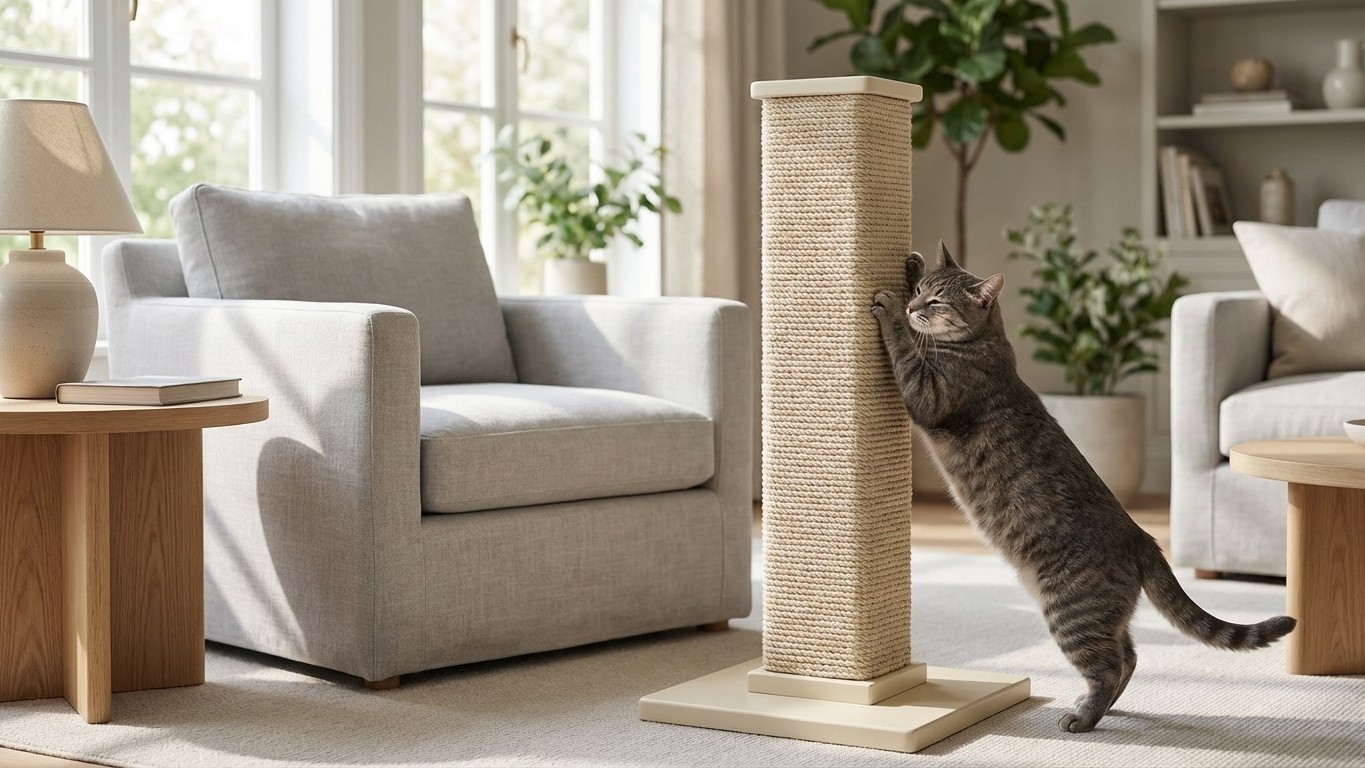
Your sofa arms have scratch marks. Your gorgeous linen armchair has frayed corners. You’ve tried the cheap sisal post from the big box store, and your cat walked right past it to attack the sectional again. Sound familiar? The problem, almost always, isn’t the cat. It’s the scratcher.
Choosing a stylish cat scratching post furniture piece that actually works requires balancing two completely different sets of criteria: yours (it has to look good in a considered interior) and your cat’s (it has to feel right, stand firm, and sit in the right spot). Get both right, and you solve one of pet ownership’s most stubborn puzzles. Get only one right, and you’re back to square one, staring at a shredded couch arm.
Why Investing in a Design Scratching Post Makes Real Sense
Scratching Is Not a Bad Habit : It’s Biology
Scratching is an intrinsic behavior for cats, deeply rooted in their natural instincts. Cats are born with retractable claws designed for climbing, hunting, and self-defense — and they need to keep those claws sharp.
Beyond claw care,
cats have scent glands in their paws, and when they scratch, they leave behind a scent mark that is unique to them — a way of communicating, marking their territory, and asserting their presence.
Think of your sofa corner as prime real estate in your cat’s mental map of the house.
New research shows that cats’ tendency to scratch is affected by stress, certain kinds of play, and how active they are at night. Furniture scratching is often a stress response, and cats who live with kids or are more playful and active at night are more likely to scratch.
Punishing the behavior?
Punishments or yelling at the cat are not helpful — they make the behavior worse, because punishing a natural behavior increases the level of stress, and therefore the probability of that behavior.
The only real path forward is redirection.
The Classic Problem: Style Versus Utility
A scratching post is an essential outlet for your cat’s natural scratching instinct, but it doesn’t have to be ugly. Nowadays, more brands are producing modern scratching posts that serve your cat’s needs, but also look tasteful in your home.
The design market has genuinely caught up with this challenge. What used to be a beige carpet-wrapped cylinder you’d hide behind the bookcase has evolved into wall-mounted sisal panels, side-table hybrids, and minimalist wood columns that could pass as Scandinavian decor.
The real risk? Buying for looks alone.
A good modern scratching post should still prioritize cat needs over human preferences.
A beautiful post your cat refuses to use is just expensive clutter. The goal is a piece that earns its place in both your living room and your cat’s daily routine, and that requires knowing what matters to each party.
What Makes a Scratching Post Both Attractive and Effective
Materials: The Sisal vs. Jute Decision
Sisal is the most common and recommended fiber for scratching posts, both in rope and woven material forms. It’s a natural material and heavy-duty, able to withstand a great deal of scratching. Sisal is cultivated from the leaves of the agave plant, which is indigenous to southern Mexico, though most of today’s sisal comes from East Africa.
From a design standpoint, its off-white to cream tones blend cleanly into neutral interiors.
There’s a meaningful distinction between sisal rope and sisal fabric.
Sisal fabric becomes softer as it is scratched, encouraging more use. It also allows a cat’s claws to slide through the material, shredding as they go — and cats love this because they feel as though they are leaving a visible mark.
Sisal rope, by contrast, creates bumps and grooves that can interrupt the scratch and even become sharp as fibers dislodge. For a post your cat will actually return to, sisal fabric tends to outperform sisal rope.
Jute is worth mentioning too.
Jute is a natural fiber that can be found in rope or rug form and makes a fine material for a scratching post. It is highly sustainable and biodegradable yet durable enough to withstand scratching wear, though its texture is softer than sisal while remaining rough enough to maintain claw health.
Some cats, particularly kittens or cats with sensitive paws, may prefer jute’s gentler surface. From a visual standpoint, jute’s golden-beige tone works well with warm wood and natural-material interiors.
One material to avoid for design-forward homes: carpet.
Carpet may be found elsewhere in your home. When you are trying to teach your cat to scratch a post and not household items, it’s best to provide a post covered in a material that isn’t found in other spots in your home. Your cat should be able to clearly tell the difference between the items they are allowed to scratch and those they are not, which is why carpet is not a good choice for many households.
Dimensions, Stability, and Placement
Height is where most budget scratchers fail.
Cat scratching posts need to be tall — your cat should be able to stand on her hind legs and fully extend her body up the side of the post. That way, she can get a great full-body stretch.
According to one survey, cats are less likely to scratch inappropriately if they have a post above 3 feet high. A taller post also keeps joints and muscles healthy.
For larger breeds,
a minimum of 24 to 30 inches is needed to allow full stretching, and for large breeds like Maine Coons, aim for 36 inches or more.
Stability is non-negotiable, and it’s the silent killer of beautiful-but-useless scratchers.
Your cat will want an extremely sturdy post. If she rises up on her hind legs, places her front feet against the post, and feels it wobble, she is likely to never attempt using it again. In the wild, trees are the most common cat scratching posts — and they don’t topple over when a cat leans into a good scratch.
Look for solid plywood or hardwood bases, not particleboard.
For scratching materials, prefer sisal rope, sisal fabric, or high-quality carpet over cardboard, and for structural materials, choose solid wood and plywood over particleboard.
Placement, even for the most design-conscious among us, cannot be driven purely by aesthetics.
According to certified animal behaviorist Mikel Delgado, “You need to have more than one scratching post, and you want to put them in locations that your cat is likely to use them. That might mean right next to your couch if the couch is a place that your cat really enjoys scratching.”
Cats like to scratch when they first wake up, so placing a post near a favorite napping spot is a good idea. You should also pay attention to which furniture your cat likes to scratch the most and place scratching posts as close to those locations as possible.
Forms and Types: Matching the Post to Your Space
The first thing to consider when buying a scratching post is whether your cat prefers vertical or horizontal surfaces. Some cats like to rear up and pull down, while others like to stretch way out along the floor and pull. Most large cat trees provide both surfaces, while the basic post is more for vertical than horizontal.
Wall-mounted scratchers are one of the most interesting options for design-forward homes.
A wall-mounted scratcher saves space, as it can be mounted onto any wall, freeing up floor space that traditional cat scratching posts often occupy.
Adding sisal rope to a cat wall promotes claw health, muscle stretching, and territorial marking — satisfying your cat’s natural instinct to scratch and saving your furniture.
Some wall-mounted designs can even be oriented horizontally or vertically depending on your cat’s preference, making them genuinely adaptable to both the room and the animal.
Design Inspirations: From Minimalist to Multifunctional
Minimalist Scratchers: Clean Lines, Natural Tones
The minimalist category has expanded considerably in recent years. Wall-mounted cylindrical sisal posts in natural, dark walnut, white, or black finishes integrate cleanly into gallery walls and entryway arrangements.
Some wall-mounted scratchers feature lovely wooden frames with excellent color contrast between the frame and the scratching material — a slim rectangular design that works well as an option for smaller spaces.
Floor-standing models in solid wood with ash or walnut veneers have emerged as a credible alternative to sculptural side tables.
The key with minimalist designs is coherence: the wood finish of the scratcher should echo the tones in your existing furniture, your coffee table legs, your shelving, your picture frames. A natural birch post paired with warm mid-century furniture reads as intentional. The same post in a cool, all-white Scandinavian space might look like a mistake.
Multifunctional Scratchers: Side Tables, Stools, and Shelves
The smartest category for design-forward homes is the multi-use scratcher.
Some modern wooden side tables are designed with graceful curves and angular lines that discreetly integrate a built-in scratcher on their backside.
Others go further:
mid-century modern scratching post and side table designs blend Scandinavian warmth, Modernist aesthetics, and Bauhaus simplicity, stylish and functional furniture pieces that serve both as a chic side table and a durable scratching post.
The sofa-arm scratcher concept is one of the more clever recent evolutions.
After buying a brand-new couch, many cat owners quickly notice their cats scratching the sofa arms — the last thing you want after investing time and energy in designing a living room is to drape new furniture in blankets or use aesthetically unpleasant solutions.
Designs that function as side tables next to the couch arm place the scratcher exactly where the cat already wants to scratch, turning a problem spot into a design asset. For a broader look at integrating these pieces into a considered interior, the pet friendly home design cat dog furniture approach offers a full framework for thinking about cat furniture as part of a cohesive design system.
DIY and Custom: The Made-to-Measure Route
Custom and DIY scratchers represent a real opportunity for those who want complete control over materials and dimensions.
You can make your own cat scratching post using materials like cardboard, sisal, and wood — DIY scratching posts can be a cost-effective and customizable option.
The approach that works best: start with a solid wood or plywood structural base (never particleboard, it won’t hold up), wrap with untreated sisal fabric or rope, and finish with hardware that matches your existing fixtures. Mounting to a wall stud rather than a baseboard gives the post the immovable stability that makes cats actually return to it. If you’re also thinking about integrating litter boxes and cat beds into your design, cat litter box furniture ideas that combine litter solutions, sleeping spaces, and scratchers into cohesive built-in units offer a full DIY approach worth exploring.
Getting Your Cat to Actually Use the Scratcher
Location Is Everything
The most common reason a stylish new scratcher fails is placement. Tucked into a corner, away from the cat’s social spaces, it simply won’t get used.
One of the reasons a cat scratches is because they are marking their territory — so scratching posts need to be in prominent locations, at first placed in the spots where they are currently choosing to scratch. You can move them somewhere more discreet once they are consistently using them.
The good news: once the habit is established, gradual repositioning (a few inches per day) usually works without disrupting the behavior.
Near favorite sleeping spots works well, since cats often stretch and scratch when they wake up. Close to furniture they already scratch is also strategic, if your cat is scratching the sofa, place the post nearby to redirect it. High-traffic areas work too, since many cats scratch to mark territory, and a post in a social space like the living room encourages use.
Catnip, Play, and Positive Reinforcement
The introduction phase matters. Don’t just place the scratcher and hope.
Sprinkle catnip to encourage sniffing and scratching, use a wand toy by dragging it along the post to make playtime fun, or add scent by rubbing a cloth on your cat’s paws and then wiping it on the post — cats like familiar smells.
The best way to train your cat to scratch more acceptable objects is to reward the behavior you want to see. If you see your cat put its paws on a scratching post, reward them with a treat, the cat will begin to associate scratching the post with rewards and will therefore be more likely to continue that behavior.
One counterintuitive tip from behaviorists: don’t throw away a well-used scratcher just because it looks rough.
Cats prefer shredded and torn objects because they can really get their claws into the material. Used posts also appeal to your cat because they smell and look familiar.
The visual shabbiness that bothers you is precisely what makes it attractive to them. The smart play: maintain a design-forward scratcher as the primary piece, and keep a worn backup nearby.
Maintaining and Replacing Your Scratcher
The main purpose of the scratching pole is to provide your cat with a safe outlet to scratch and claw — which means that over time, the sisal rope will become worn out. Luckily, modular designs make it very easy to swap your old segment for a brand-new one.
When evaluating a design scratcher for purchase, replaceability is a feature worth looking for: can you re-wrap the sisal without replacing the entire piece? Can you swap the scratching surface panel while keeping the wood base?
For upkeep, sisal fabric and natural wood are among the easiest materials to clean, a quick vacuum or wipe-down handles most debris. Avoid getting the sisal wet, which can cause fibers to break down faster. If you’re thinking about the broader picture of cat-friendly materials and furniture choices throughout your home — from scratchers to cat litter box furniture ideas that are genuinely easy to maintain, the logic is the same: natural materials, replaceable surfaces, and solid structural cores last far longer than cheap composites.
And if your household includes a hidden litter box setup too, you’ll want to apply the same principles of ventilation and durability explored in hidden litter box cabinet design — because a beautiful home with cats requires thinking through every piece, not just the obvious ones.
FAQ: Common Questions About Design Scratching Posts
Why won’t my cat use the beautiful scratcher I bought? Most likely, one of three reasons: it wobbles (cats won’t use an unstable post), it’s too short for a full-body stretch, or it’s placed somewhere your cat doesn’t naturally spend time. Start by moving it next to your couch or your cat’s favorite nap spot, and add catnip to encourage investigation.
A cat only has to try a wobbly post once to know it will never try it again, so make sure the post you choose has a sturdy base.
What materials blend best into a modern interior?
One of the defining features of modern scratching posts is their stylish design. Consider how well the post complements your home decor — many modern posts come in a variety of colors and shapes, allowing you to find one that pleases your cat and enhances your living space.
Natural sisal in cream or golden tones, untreated wood in ash, walnut, or maple, and matte black or white hardware integrate most easily into contemporary spaces. Carpet and faux fur, however visually familiar, tend to date quickly and are harder to maintain.
How do I choose a scratcher that’s both aesthetic and adapted to my cat? Look at where your cat already scratches. High marks on the wall? They prefer vertical. Low marks on the carpet? A horizontal scratcher or angled pad might serve better.
If your cat is already using an inappropriate object, examine it to gain valuable information — are the scratch marks high or low, on a vertical or horizontal surface? Use this data to help you choose the type and placement of scratching posts and pads.
Then match those functional preferences to a design format that works for your space.
The most elegant solution, it turns out, isn’t about finding a scratcher your cat will tolerate using. It’s about understanding that their scratching behavior and your design vision are not naturally in conflict, they just need a thoughtful intermediary. Which raises a question worth sitting with: what other “concessions” we make for our pets might actually be opportunities to make our homes more interesting?