
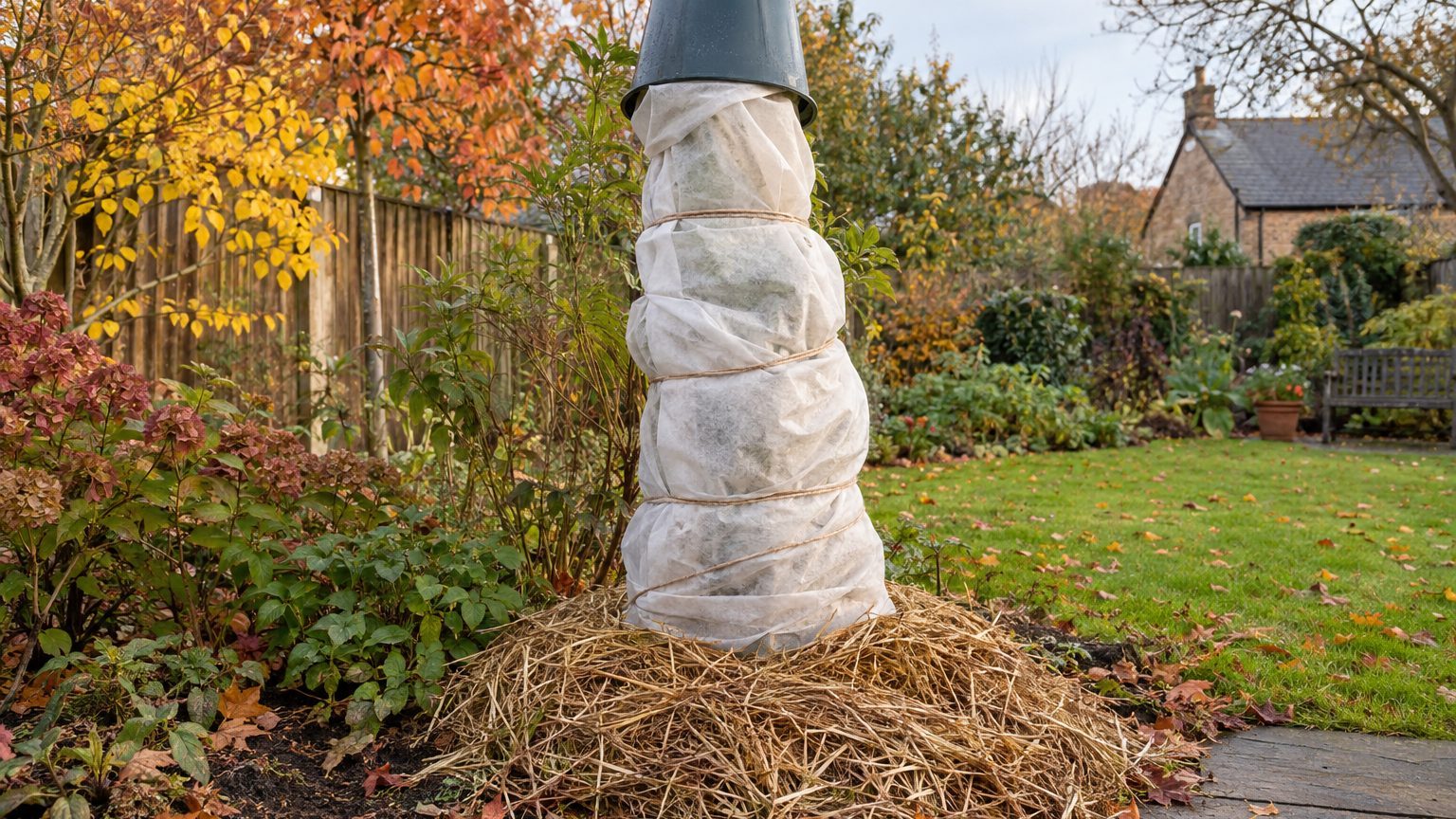
A banana plant can survive a British winter outdoors, and the variety to grow is Musa basjoo, the Japanese fiber banana. Its leaves die at the first hard frost, but with the right protection the underground rhizome and the stem survive temperatures down to about 14°F (-10°C). Most of the UK sits in roughly the same range as USDA zones 8 and 9, so the method works just as well on the Pacific Northwest coast or in the mid-Atlantic states.
Cold is rarely what kills it.
- Musa basjoo banana plants survive UK winters down to -10°C when the rhizome and stem are properly protected underground.
- Cut the stem to 2-3 feet height after leaves blacken in late autumn, making a flat top cut to prevent water pooling.
- A dry crown matters more than any insulation layer—use an upturned bucket or slate to shed rain away from the stem’s center.
Cut late, and cut with a plan
Wait for the frost to do the first part of the job. Once the leaves have turned black and collapsed, usually between late October and late November, the plant has pulled its energy down into the stem and rhizome. Cutting earlier throws away that stored reserve.
Strip off the dead leaves with a sharp knife or pruning saw, then cut the stem (the pseudostem, technically a tight bundle of leaf sheaths) down to around 2 to 3 feet. Some British gardeners leave it taller, up to 5 feet, because a taller trunk gives more insulation and can carry the plant’s growing point through to spring. A shorter stump is easier to wrap and sheds less rain into the core. I lean toward the middle: tall enough to pack with insulation, short enough to cover properly.
Make the top cut flat and clean. A ragged edge holds water, and water sitting in a cut stem is an invitation to rot.
Wrapping: warmth below, dryness above
Start at the base. Pile 6 to 8 inches of straw, dry leaves, or coarse bark mulch around the stem to shield the rhizome, which is where next year’s growth comes from. Keep the pile loose rather than packed, since compacted wet mulch turns cold and soggy.
The crown is the weak point.
Once the stem is cut, rain runs straight down into the center, and freezing water inside the trunk does the real damage. Fill the top with dry straw, then fit a cap over it. An upturned bucket, a piece of slate weighted with a brick, or a sheet of corrugated plastic all work, as long as the water drains away from the stem rather than into it. Gardeners in wet regions such as Cornwall, Wales and western Scotland often say that a dry crown matters more than any amount of fleece.
Then wrap the trunk. Horticultural fleece (frost cloth in US garden centers) goes around the stem in two or three layers, secured with twine or garden tape. Chicken wire formed into a cylinder around the stem and filled with straw is a sturdier option, and it keeps its shape through gales.
Plastic sheeting directly against the stem is a mistake. It traps condensation, keeps the trunk damp for weeks, and creates exactly the warm, wet conditions that fungus likes on mild winter days.
Leave the structure breathable at the sides and sealed at the top. That one rule covers most of what goes wrong with banana plants in damp climates.
Potted plants and the spring unwrap
A banana in a container is a different story, because roots in pots freeze far more easily than roots in the ground. Move the pot into a frost-free spot such as a garage, porch, or cool greenhouse before nighttime temperatures hit freezing. Cut back the foliage, water sparingly (barely enough to stop the compost from drying out), and keep the plant in whatever light you can give it.
Plants that stay indoors with leaves intact need a bright window and a bit more water, but the growth will be leggy until spring.
Some growers prefer the dormant approach for its simplicity. A cut-back plant in a dark shed uses almost no resources and needs checking only every few weeks.
Unwrapping should happen gradually. From late March into April, once the hardest frosts have passed, remove the cap and the top layers first so air can reach the stem. Take off the rest in stages through April and early May, keeping fleece nearby for any late cold snap. If the trunk feels firm and the cut surface looks pale and moist, the plant is alive; a soft, smelly stem means rot has set in, though even then the rhizome underneath often sends up new shoots.
New growth appears in late spring and can reach 10 feet or more by autumn, which is a startling rate of growth for a plant that looked like a pile of straw in March. A feed of balanced fertilizer in May and plenty of water through summer set it up for the next round. After two or three seasons, a well-established clump will often produce suckers (pups) that can be dug up and shared with neighbors.
Gardeners at the Royal Horticultural Society’s Wisley garden and elsewhere have been growing Musa basjoo outdoors for decades with exactly this sort of protection, and a banana that came through a hard winter is usually a bigger and tougher plant the following year.