
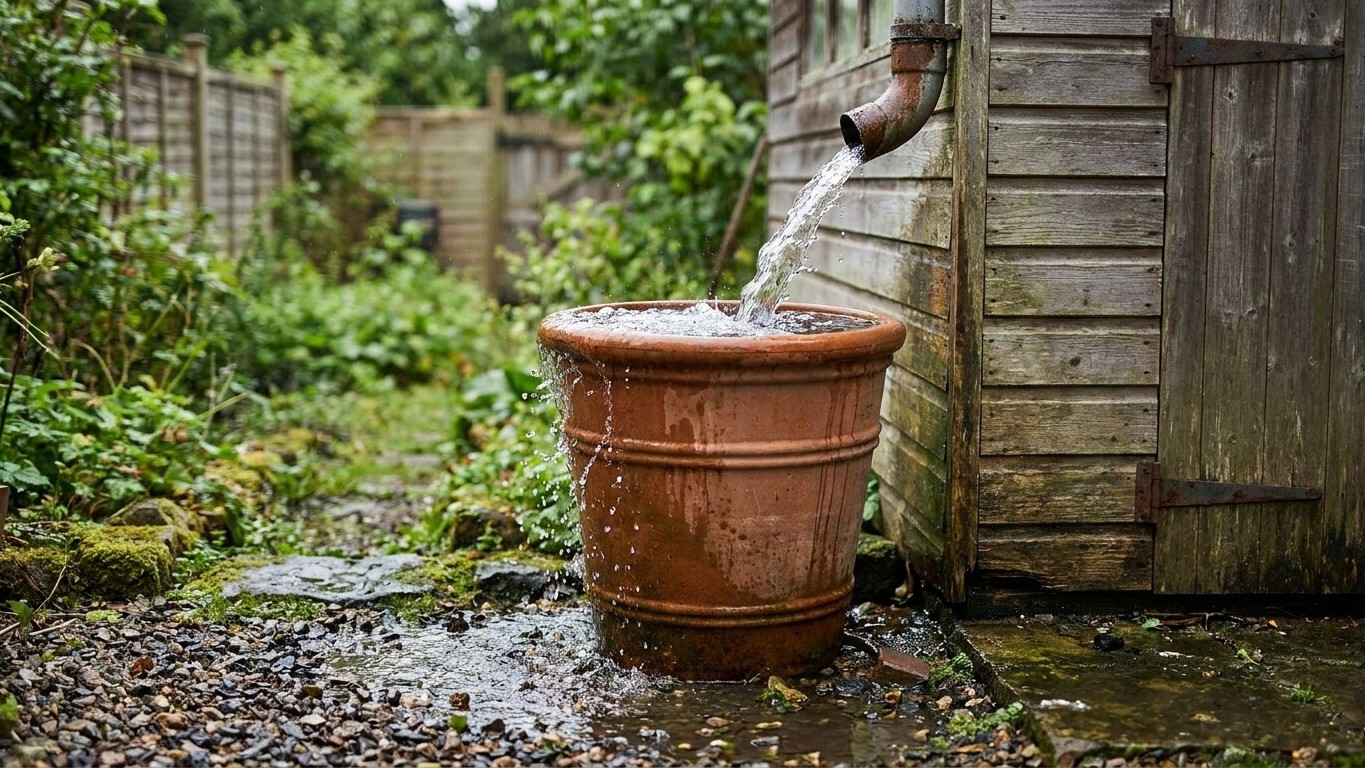
One good downpour was all it took. A single 100-litre butt filled to the brim in about fifteen minutes, and the shed’s downspout kept gushing long after that. Watching the overflow spill onto the gravel, the real lesson wasn’t how much water the barrel held. It was how much rain a modest shed roof actually produces, and how much of it, for years, had simply vanished down the drain.
Key takeaways
- A typical garden shed roof generates enough rainwater in one storm to fill a barrel faster than you’d expect
- The first few minutes of rainfall carry concentrated pollution that flows straight into storm drains
- Residential outdoor water use accounts for nearly 40% of summer consumption—yet free rainwater pours off roofs unused
The Math Nobody Bothers to Do
A shed roof looks small until you run the numbers. The standard rule of thumb used by rainwater engineers is simple: 1 mm of rain on 1 square metre of roof area produces 1 litre of water. A typical garden shed with a footprint of around 6 square metres can therefore generate 6 litres for every millimetre that falls, which sounds modest until a proper summer storm drops 20 or 30 mm in an hour.
American measurements tell the same story from a different angle. A good rule of thumb is that 1 inch of rain on a 1,000 sq ft roof yields 623 gallons of water, and you can calculate the yield of your roof by multiplying the square footage by 623 and dividing by 1,000. Scale that down to shed size and even a light shower can fill a barrel faster than expected. That’s exactly what happened here: one storm, one full butt, and a puddle forming at the base where the overflow had nowhere else to go.
Zoom out to the whole house and the numbers get almost absurd. Someone getting about 10 inches of rain over the course of the spring and summer, with an average 1,360-square-foot roof, would yield 8,160 gallons of rainwater. Even a fraction of that captured instead of wasted adds up to a season’s worth of free garden watering.
What Was Actually Going Down the Drain
The uncomfortable part wasn’t the volume. It was realizing what that runoff carries with it before it ever reaches a storm drain. As rainwater flows over a roof surface it can pick up pollutants such as bacteria from birds and other animals, and chemicals from roof materials. Shingles, flashing, moss, bird droppings, all of it gets rinsed straight into the municipal system with every hard rain.
A 2026 research review from the University of Vermont’s Sea Grant program looked specifically at what ends up in that runoff. Researchers assessed runoff from 19 small scale and 3 commercial roofs representing asphalt shingle, metal, clay tile, and tar and gravel systems, testing for 17 PAHs, phosphorus flame retardants, pyrethroid insecticides, dissolved metals, turbidity, and bacteria. The findings were reassuring in one sense and revealing in another: PAHs were routinely detected, though concentrations were far below health benchmarks, and atmospheric deposition, not the roofing material itself, was the primary source of organic contaminants.
What stood out most was the timing of that pollution. A strong first flush pollution spike was documented across roof types. In practice, that means the dirtiest water isn’t spread evenly through a storm. It’s concentrated in those first few minutes when the barrel is filling fastest, which explains why the water at the bottom of a butt often looks murkier than what falls later in the same storm.
Why That Overflow Isn’t Just Wasted Water
Letting all of that go down the drain isn’t a neutral choice either. Unless it is collected, rain water runs off impervious surfaces, such as roofs and pavement, gathering pollutants which often end up in local streams, rivers, ponds, lakes and marine waters. A shed roof is a tiny piece of that puzzle, but multiply it by every roof on the block and the picture changes fast.
The scale of what’s lost is bigger than most people assume. Water used on lawns and landscaping accounts for nearly 40 percent of residential water consumption during the growing season, according to the EPA. That’s water treated, pumped, and paid for, used to keep grass green, when free rainwater was pouring off the roof an hour earlier. The Pennsylvania State University extension service puts a similar figure on outdoor use nationally: according to the US EPA, 30% of daily water use is used outdoors.
There’s also a flood-control angle that rarely gets mentioned. Impervious surfaces prevent water infiltration back into the ground, resulting in an increased likelihood of more frequent and more severe flooding. A single barrel under a shed gutter won’t stop a flash flood, but it does shave the peak off every storm that hits it, one roof at a time.
Getting Smarter About the Next Storm
None of this means the barrel was a bad idea. It means one 100-litre butt is barely scratching the surface of what a roof, even a small one, can offer. A few adjustments make a real difference:
- A simple first-flush diverter routes the initial, dirtiest surge away from the tank before the cleaner water starts filling it.
- Linking a second or third butt with a connector kit turns overflow into extra storage instead of runoff.
- Raising the barrel on a stand adds enough gravity-fed pressure to make a hose or watering can genuinely useful.
- A simple mesh filter over the inlet keeps leaves and grit from clogging the tap.
The payoff isn’t abstract. A rain barrel will save most homeowners about 1,300 gallons of water during the peak summer months. Considering that because roofing materials may contain hazardous chemicals, some groups recommend avoiding the use of rain barrel water on edible plants, the smartest move is often to route captured rain toward lawns, ornamental beds, and container plants, and save the tap water for the vegetable patch. That one storm didn’t just fill a barrel. It exposed just how much free water, and how much invisible runoff, pours off a roof every single time it rains.
Sources : blog.enduramaxx.co.uk | watercache.com