
Everbearing strawberries can produce three separate flushes of fruit between May and October. Primocane raspberries fruit on canes grown the same year, skipping the two-year cycle traditional varieties demand. These reflowering (or remontant) berry types have changed what home gardeners expect from a single planting season, but propagating them correctly requires different timing and technique than standard June-bearing or floricane varieties.
The distinction matters because reflowering varieties set flower buds on new growth throughout the season instead of relying solely on wood from the previous year. Get the propagation method wrong, and you can accidentally push a plant back into a single-fruiting pattern, or delay production by a full year while the plant recovers from the split.
Key takeaways
- Everbearing strawberries and primocane raspberries demand opposite propagation timing than you’d expect—and getting it wrong costs an entire year of fruit
- A seemingly failed propagation might actually be the plant working exactly as designed, but only if you understand what’s happening beneath the soil
- The legal fine print around patented berry varieties could affect whether you can legally share your success with gardening friends
Strawberries: Runners Versus Division
Everbearing and day-neutral strawberry varieties send out fewer runners than traditional June bearers. That’s not a flaw. Breeders selected these plants to funnel energy into flowering rather than into vegetative spread, which means gardeners hoping to multiply their stock need patience.
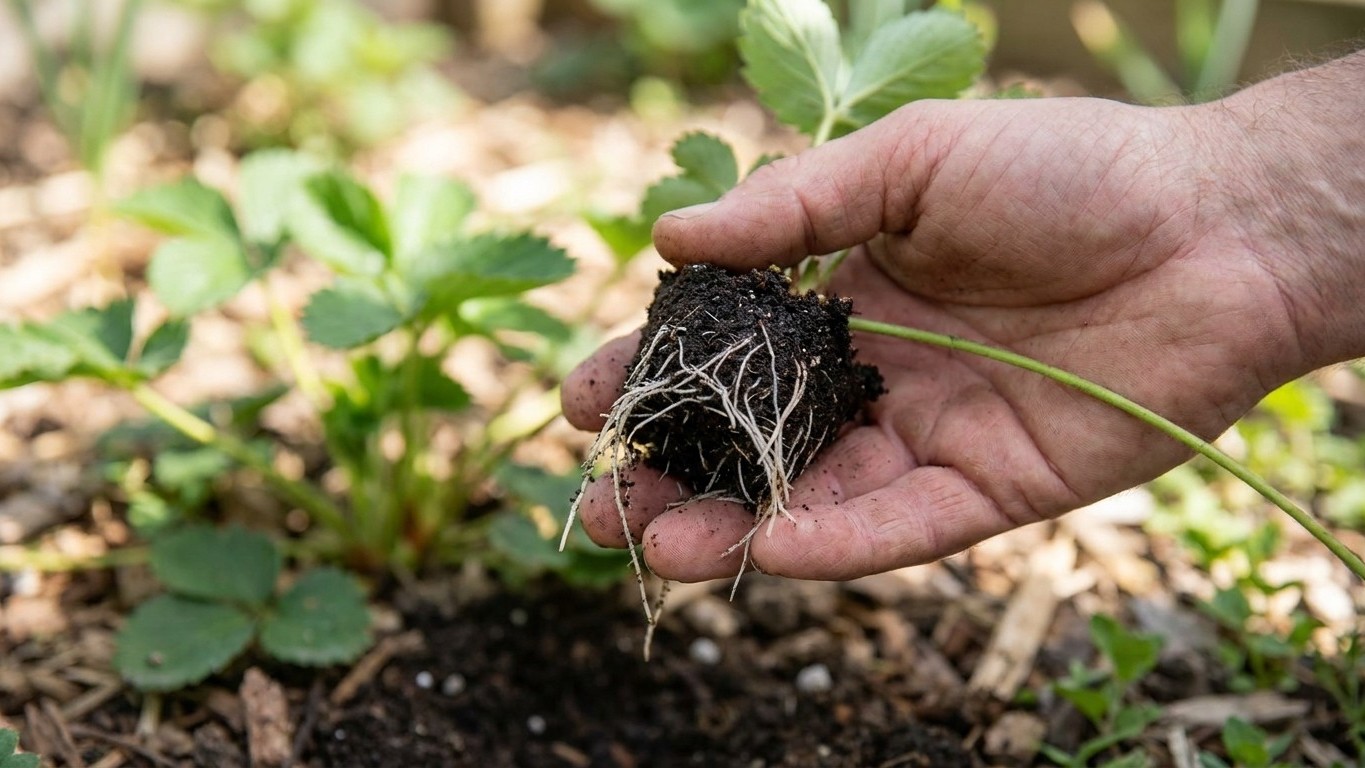
Runners that do appear should be pinned into small pots of moist potting mix while still attached to the mother plant. Cutting the connection too early stunts the daughter plant. Wait four to six weeks after the runner roots before severing it, then transplant. Michigan State University Extension recommends removing flower buds from newly separated daughter plants for the first several weeks so the plant channels resources into root establishment instead of fruit production.
Crown division offers a faster alternative for day-neutral varieties, which often produce multiple crowns on a single root system by their second year. Dig the plant in early spring or fall, split the crowns with a clean knife ensuring each section has roots and at least one growing point, and replant immediately. Divided plants typically resume flowering within six to eight weeks, noticeably faster than runner propagation.
Raspberries: Tip Layering and Root Cuttings
Primocane raspberries, the fall-bearing type that fruits on first-year canes, propagate differently than their summer-bearing cousins. Tip layering works well here: bend a flexible cane tip to the ground in late summer, bury the tip two to three inches deep, and secure it with a landscape staple. Roots typically form within six to eight weeks. The following spring, sever the new plant from the parent cane and transplant.
Root cuttings offer another route, particularly useful for gardeners wanting to multiply stock quickly without waiting on cane tips. Dig up sections of root about the thickness of a pencil during dormancy, cut them into four-inch pieces, and lay them horizontally in trays of moist sand or potting mix. Cornell Cooperative Extension notes that raspberry root cuttings taken during late winter dormancy show higher success rates than those taken in fall, largely because stored carbohydrate reserves peak just before spring growth begins.
One detail trips up a lot of first-time propagators: primocane varieties propagated from root cuttings in late winter often skip their first-year fall crop entirely, fruiting instead the following autumn. That’s not a sign of failure. It’s simply the plant rebuilding its root mass before committing energy to flowers.
Blackberries and the Trailing Varieties
Reflowering blackberry cultivars, less common than their strawberry and raspberry counterparts but increasingly available through specialty nurseries, respond best to tip layering similar to primocane raspberries. Their trailing growth habit actually simplifies the process: canes naturally arch toward the ground, making contact with soil without much intervention from the gardener.
Softwood cuttings taken in early summer, when new growth is flexible but not yet woody, root reliably in a mix of perlite and peat under high humidity. A plastic dome or bag over the cutting tray maintains the moisture level these cuttings need during the two to three weeks it takes for roots to form. Bottom heat around 70 degrees Fahrenheit speeds the process considerably, cutting rooting time by nearly half compared to cuttings left at ambient room temperature.
Timing Determines the Flowering Pattern
The single biggest factor separating successful propagation from disappointing results isn’t technique so much as timing. Reflowering varieties are photoperiod-sensitive to varying degrees, meaning day length influences when they initiate flower buds. Propagate a day-neutral strawberry too late in summer, and the resulting plant may not accumulate enough chill hours or daylight cycles to flower properly the following year.
For most reflowering berries, late winter to early spring propagation, before active growth resumes, gives plants the longest possible window to establish roots before the flowering trigger kicks in. Fall propagation works for tip-layered canes precisely because they’ve had an entire growing season attached to an established root system before separation, unlike a cutting starting from nothing.
Gardeners in colder zones, USDA zones 3 through 5 in particular, should propagate at least ten to twelve weeks before their first hard frost if working with cuttings or fresh divisions. That window gives roots enough time to anchor before winter dormancy sets in, according to guidance from the University of Minnesota Extension’s small fruit program.
What Nurseries Rarely Mention
Patented berry varieties, and there are many among the newer reflowering cultivars, come with legal restrictions on propagation. Plant patents in the United States typically last twenty years from filing, and propagating a patented variety for sale, or in some cases even for personal use beyond the original plant, technically violates that patent. Home gardeners rarely face enforcement, but it’s worth checking a variety’s patent status before sharing cuttings with neighbors or selling divided plants at a local swap.
Older, non-patented reflowering varieties, some dating back to breeding programs from the 1980s and 1990s, remain freely propagable and often perform just as well in home gardens as newer patented releases. A little research into a variety’s origin, usually available through the nursery’s plant tag or catalog description, saves both legal headaches and, frankly, some unnecessary guilt over a hobby that’s supposed to be relaxing.