
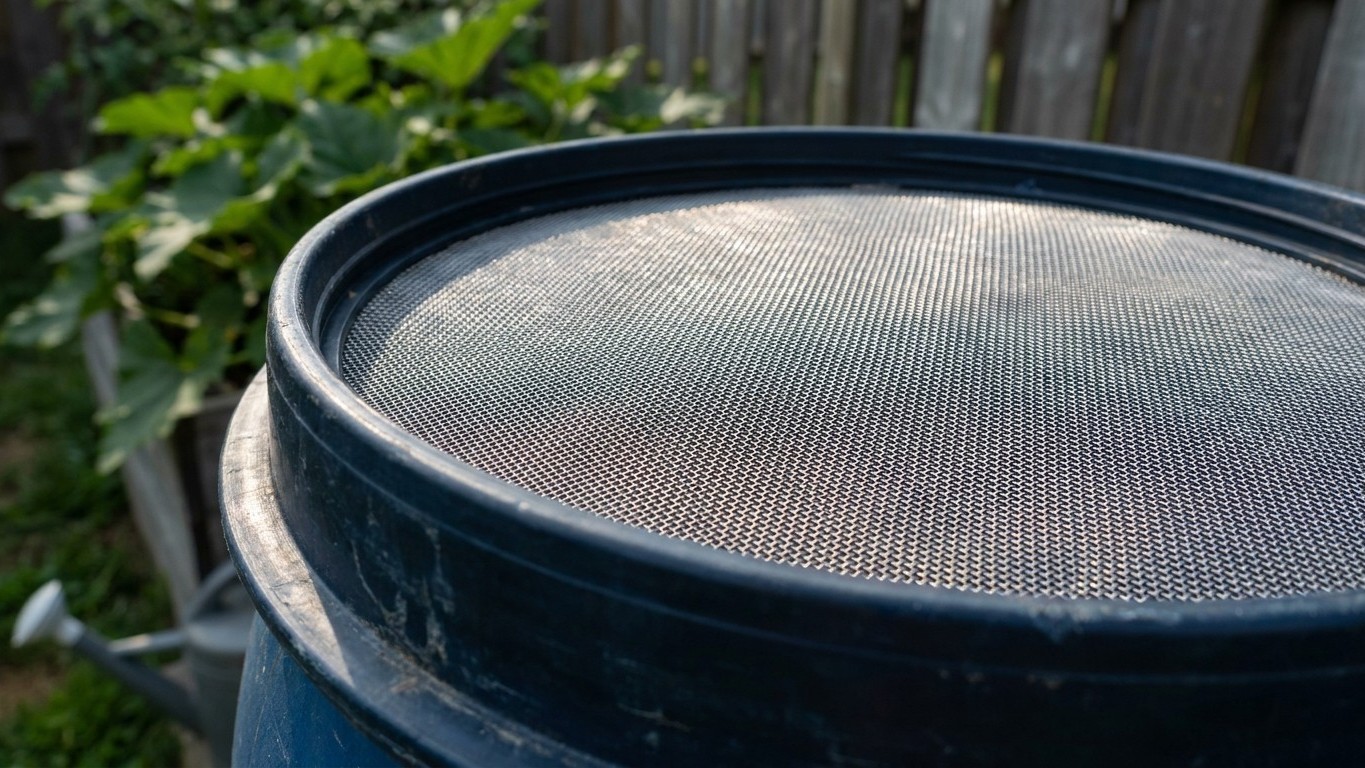
The neighbor isn’t fussing over compost bits or maple leaves clogging his rain barrel. He’s blocking mosquitoes from laying eggs in it, and the difference matters more than you’d think.
A rain barrel sitting in full sun all summer is basically a five-gallon nursery. A single tablespoon of stagnant water is enough for a female mosquito to deposit 100–200 eggs, eggs that hatch within 24 to 48 hours under warm conditions. Scale that up to a 50-gallon water butt with an open top, and you’re not preventing a nuisance. You’re running a breeding facility.
Key takeaways
- A 50-gallon water butt can become a mosquito breeding facility faster than you’d think—eggs to adults in less than a week
- Not all mesh works: standard garden netting fails, but 18-20 holes per inch screen stops mosquitoes cold
- The stakes go beyond itchy ankles—unscreened barrels pose public health risks and may violate local codes
Why a barrel beats a puddle, from a mosquito’s point of view
Mosquitoes don’t need much space, and they’re picky in ways that make rain barrels almost ideal. They prefer to lay eggs in warm water in sunny areas, and in water that’s protected from predators, such as containers or spots under vegetation. A water butt tucked against a house wall, warmed by afternoon sun, checks every box on that list. Add organic debris (a few decomposing leaves, some pollen, grass clippings blown in), and it gets even more attractive, because larvae feed on organic matter in the water, such as algae, bacteria, and decaying plant matter, and standing water rich in organic matter is more likely to become a breeding ground.
The turnaround speed is what catches most people off guard. Under the right summer conditions, an egg can become a flying, biting adult in about a week. A mosquito’s life cycle is quick. From egg to adult can take less than a week in warm, wet, still conditions. Miss one lid-check after a heatwave, and you can go from an empty barrel to an active swarm before you’ve finished mowing the lawn twice.
Why “fine” mesh is doing the actual work, not any mesh
Here’s where a lot of well-meaning barrel owners get it wrong: they staple on garden netting or leftover screen from a broken window and assume the job is done. It isn’t. Large-mesh screens and perforated tops will not keep mosquitoes out. The openings are way too big to prevent mosquito breeding. Mosquitoes are small enough to slip through gaps that look sealed to the human eye.
What actually works has a specific spec. Standard window screen with 18 to 20 holes per inch is tight enough to block adult mosquitoes from reaching the water to lay eggs while still allowing rainwater to flow through. Some rainwater harvesting guidelines go even finer: best practice (and local code, where applicable), requires 1/16″ mesh covering all openings on a rainwater catchment system. That’s the fine, almost stocking-like weave your neighbor is stretching over the opening, not the loose green netting sold for keeping birds off berries.
A single layer isn’t always enough, either. Rain barrel programs run by mosquito control districts often recommend doubling up. Intake openings should always be kept covered with screen and tightly sealed, and a double layer of fine mesh window screen is necessary to keep mosquitoes out. There’s also a sneaky failure point people overlook: overflow ports and decorative rims. Some rain barrels have design elements that can hold water or a rim that allows water to overflow and collect above the screen, so it’s best to choose a barrel with a smooth top or keep depressions from filling. A mosquito doesn’t care that your main opening is perfectly screened if there’s a puddle sitting in a decorative groove two inches away.
What’s actually at stake beyond the itch
This isn’t just about avoiding a few bites while watering the tomatoes. Standing water problems scale into public health issues fast. Old tires are so effective at breeding mosquitoes that species carrying West Nile virus and La Crosse encephalitis are frequently traced back to tire piles, and an unscreened water butt behaves the same way, just with better landscaping around it. City and county vector control agencies take this seriously enough to publish checklists: property owners are required to remove all standing water from their property in some municipalities, rain barrels included.
It isn’t only mosquitoes, either. Anyone who’s lifted the lid off a water butt in August knows the small flies and midges that seem to appear from nowhere. Biting midges have similar breeding habits and are found wherever it’s damp, and even with fairly well-fitted lids, they often find their way in, with one female capable of laying hundreds of eggs. A loose lid alone was never going to cut it. That’s the part most people miss when they assume a barrel with a snap-on cap is automatically sealed.
Beyond the mesh: backup moves worth stealing
Mesh handles the entry point, but a few extra habits close the remaining gaps. Vector control programs and pest specialists tend to recommend the same short list, and it’s worth borrowing:
- Draw the barrel down regularly rather than letting it sit full and undisturbed for weeks, since a water butt normally only requires a clean interior and regular drawing off of water to stop it becoming stagnant.
- Scrub the interior walls occasionally, since eggs and larvae cling there even after the water’s been used, and periodically scrubbing the inside removes mosquito eggs that are attached to the walls.
- Treat the water directly if a barrel can’t be emptied often. Liquid larvicides can be applied directly to the water, and tablet, pellet, granular, and briquet forms work the same way.
- Watch the mesh itself for wear. Fiberglass mesh is vulnerable to tearing, especially with exposure to weather, so a screen that worked fine in June can develop gaps by September.
None of this requires replacing the barrel or buying anything exotic. It’s a five-minute check, done once a week, that turns a rainwater catchment system from a liability into exactly what it’s supposed to be: free water for the garden, not a nursery for the thing that’s been biting your ankles at dusk. Next time you spot a neighbor’s water butt wrapped in gauzy fabric, that’s not overcaution. That’s someone who read the fine print on what “standing water” actually means.
Sources : nyc.gov | hawxpestcontrol.com