
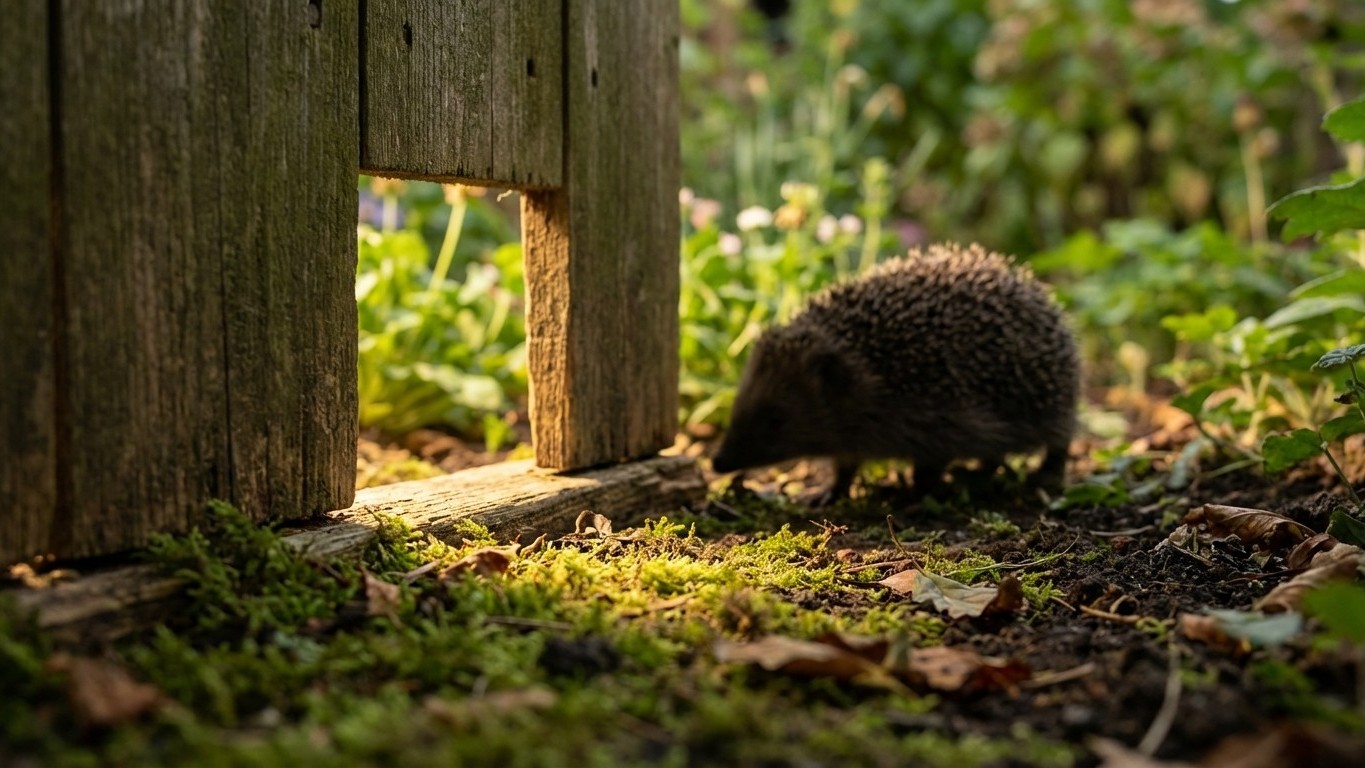
A single opening, roughly the size of a paperback book. That’s all it took to Transform a sterile, silent backyard into a space teeming with hedgehogs, frogs, and ground-nesting bees. The concept is almost embarrassingly simple, yet millions of fenced-in gardens across the United States remain completely cut off from the local wildlife networks that once moved freely through neighborhoods before solid barriers became the norm.
Key takeaways
- Suburban fences have created ecological islands, cutting off wildlife from food, mates, and shelter
- A tiny 5-inch gap at the fence base allows hedgehogs, toads, and ground beetles to move freely between gardens
- Gardens with wildlife connections report measurable improvements in resident wellbeing and neighborhood biodiversity
The Invisible Wall We Built Without Noticing
Solid fencing exploded in popularity over the past few decades, driven by privacy trends, HOA requirements, and a general preference for clearly defined property lines. Vinyl privacy fences, solid wood panels, composite barriers, all perfectly reasonable choices for keeping the dog in or the neighbors’ view out. But there’s a side effect nobody talks about: these structures don’t just define space, they sever it. A continuous fence line turns your backyard into an island, and islands, ecologically speaking, tend to go quiet.
Hedgehogs travel up to two miles a night foraging for food. Toads move between water sources and hunting grounds across dozens of yards. Even the humble field mouse, often unloved, plays a role in seed dispersal and serves as prey for owls and foxes that might otherwise vanish from your neighborhood entirely. When every yard is walled off, these animals are essentially trapped in shrinking pockets, unable to find mates, food, or shelter. Population by population, the wildlife that once animated a neighborhood simply fades.
The numbers paint a stark picture. The U.S. has lost roughly 30% of its bird populations since 1970, according to a Cornell Lab of Ornithology study, that’s about 3 billion birds, a number so large it barely registers emotionally. Ground-level mammals have fared no better. And while habitat loss on a national scale is a genuine catastrophe, there’s a smaller, more personal version of that same problem playing out in suburban backyards every single day.
What a Hedgehog Highway Actually Does
The “hedgehog highway” movement started gaining traction in the UK, where wildlife conservation groups began encouraging homeowners to cut or create small gaps at the base of their fences, roughly 5 inches by 5 inches, to allow small mammals to pass freely. The idea spread through neighborhood networks, social media, and eventually local councils, with some towns registering thousands of connected gardens on dedicated maps. The logic transfers directly to American contexts, even if the species are different.
In practice, a small gap at ground level doesn’t just benefit hedgehogs (where they exist) or their North American ecological equivalents like opossums and skunks. It creates a corridor. Ground beetles, essential for natural pest control, can migrate between gardens. Toads, which eat an astonishing number of slugs and mosquito larvae, can access water features and damp corners they’d otherwise never reach. Even box turtles, increasingly rare across the Eastern U.S., benefit from being able to move between connected green spaces without having to cross pavement.
A garden that participates in this kind of connectivity doesn’t need to be large or particularly “wild.” A neatly maintained suburban backyard with a small gap in the fence can become a waypoint in a larger living network, and that changes everything about how you interact with the space.
Making It Work Without Sacrificing Privacy or Pets
The most common objection is obvious: gaps in fences create escape routes for dogs or, in some cases, invite unwanted visitors. Both concerns are fair and both have practical solutions. A gap at the very base of a fence, no more than 5 inches high, is large enough for hedgehogs, toads, and small ground mammals, but not for a medium or large dog. For smaller dogs or cats, a removable plug (a small block of wood, a brick) can close the gap when the pet is outside and be removed at other times.
Placement matters too. A gap near dense plantings, a log pile, or a water feature gives arriving wildlife somewhere to go immediately, rather than exposing them to open lawn. Think of it less as a hole in a fence and more as a front door, one that happens to face a network of connected green corridors rather than a sidewalk. The gap works best when it’s at least a foot away from the fence’s corner posts, positioned close to low cover like shrubs or tall grass.
Some homeowners have gone further, joining neighborhood mapping initiatives that track connected gardens and identify where the “missing links” in the local wildlife network are. Apps and community platforms now exist specifically for this, allowing you to visualize which properties are participating and which ones create a break in the chain. The social dimension turns a solitary act of conservation into something genuinely collaborative.
The Shift That Happens When Wildlife Returns
Ask anyone who has watched a hedgehog trundle through their gap for the first time, or spotted a toad sitting comfortably beneath their raised bed — and they’ll describe something that’s hard to quantify. It’s not just satisfaction at having done a good thing. The garden feels different. Alive in a way it wasn’t before.
There’s research to support what feels intuitive: exposure to wildlife, even fleeting and modest, has measurable effects on mood, stress levels, and attention restoration. A 2019 study published in BioScience found that daily encounters with birds correlated with better self-reported wellbeing, even in urban settings. When you shift from a sealed yard to a connected one, you’re not just adding animals to the landscape. You’re adding yourself to an ecosystem.
The gap in the fence costs nothing. A chisel, five minutes, and the willingness to accept that your property line was never as absolute as the fence made it seem. What’s more interesting to sit with is the reverse question: how much wildlife was never missing from your garden, but simply waiting, just on the other side of a board?