
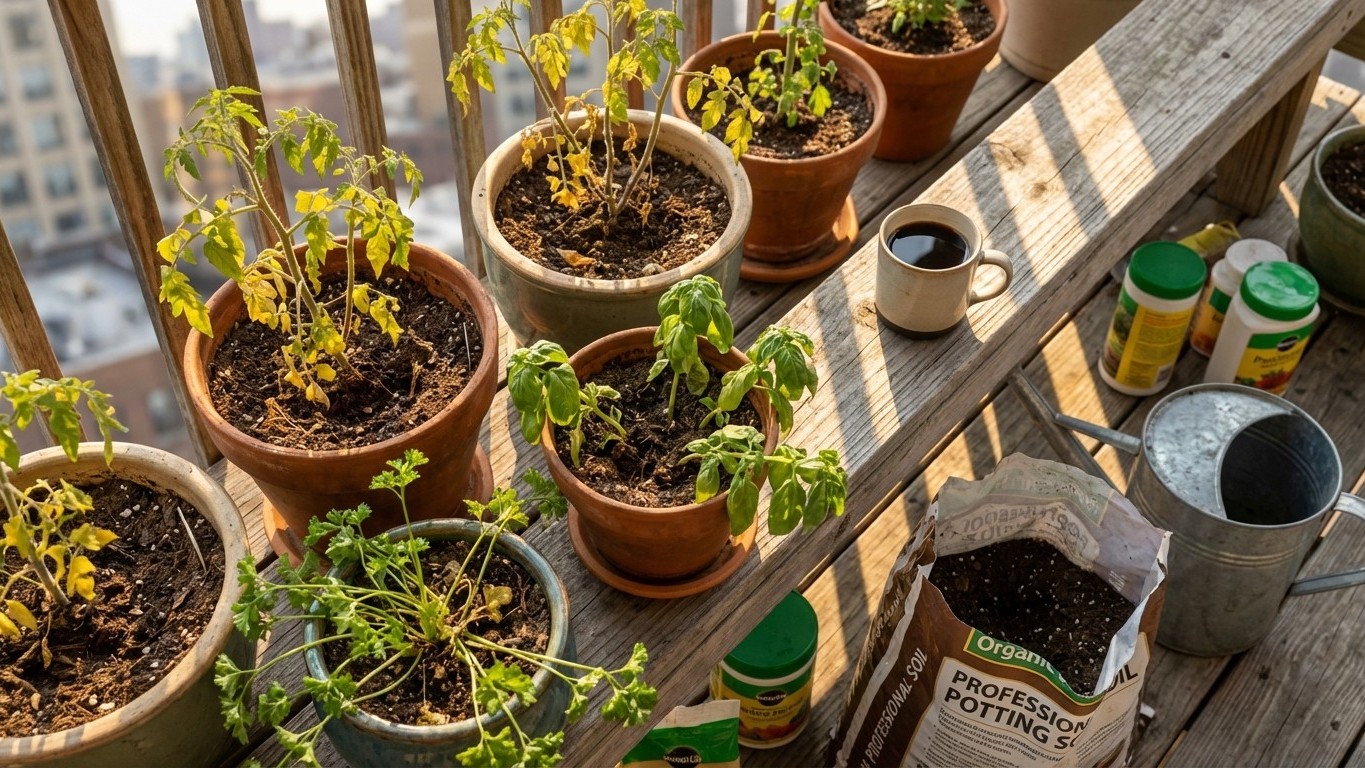
Picture a crisp summer morning: coffee in hand, you step onto your balcony and notice your tomatoes look slightly wilted, your herbs are drooping, and the soil in your biggest planter has pulled away from the sides of the pot. Sound familiar? Urban balcony gardening is one of the most rewarding ways to reconnect with the natural world from an apartment, but it punishes inattention faster than almost any other form of growing. Limited soil volume, urban heat, wind exposure, and the relentless summer sun create a microclimate that demands you think differently about three things above all else: your substrate, your watering habits, and your fertilization routine. Get these three right, and they function as an integrated system. Get any one wrong, and the other two can’t compensate.
This guide is built for the urban gardener who has a small balcony, a big appetite for homegrown food and flowers, and limited time to troubleshoot plant problems. Whether you’re container gardening in a small space balcony urban setting for the first time or looking to sharpen a routine that already half-works, you’ll find concrete techniques you can apply this weekend.
Experts consistently say improper watering is the number one reason container gardens fail, so learning how to water container plants on a balcony is crucial. For busy gardeners, self watering containers for balcony garden can be a game-changing solution. Equally important is establishing a proper container gardening fertilizer schedule for vegetables to ensure your plants get the nutrients they need in the confined space of a pot. Let’s fix that from the ground up, starting with what goes into the pot before a single drop of water is added.
The Right Substrate: Building Healthy Foundations in Every Pot
Garden soil is usually heavy, has poor drainage, often contains weed seeds, and is terrible in a planter.
That’s the blunt reality. Scooping dirt from your garden bed into a pot isn’t lazy shortcutting — it’s a recipe for compacted, waterlogged roots that suffocate rather than thrive.
Unlike garden soil, potting mixes are specifically engineered to promote drainage, aeration, and moisture retention, all of which are critical for root health.
On a balcony, with no underground buffer, root health is everything. Creating the best soil mix for balcony container gardening involves understanding these specific requirements. If you’re still struggling with drainage issues despite using quality potting mix, learn how to improve drainage in balcony pots for better results.
Choosing Between Commercial Mixes and DIY Blends
The easiest way to ensure healthy plants is to use a commercially formulated premium potting mix rather than in-ground soil. Potting mixes have the optimum structure and texture for container growing, balancing water retention, drainage, and aeration, and also contain slow-release fertilizer.
That said, not all commercial mixes are equal, and a smart urban gardener quickly learns to read ingredient labels.
Choose a potting soil made of peat moss, pine bark, and perlite or vermiculite, as these ingredients help balance moisture retention with good drainage.
If you’d rather dial in the exact blend for your crops, mixing your own is absolutely viable.
Peat moss or coco coir are great for water retention and aeration.
Perlite is a natural ingredient that prevents soil compaction and adds aeration and drainage.
Vermiculite helps the soil retain moisture, keeps the mix light and fluffy, improves drainage, and prevents compaction.
For balcony use specifically, coco coir often wins over straight peat because
it has greater water retention and doesn’t repel water like peat can, a real advantage on hot days when you can’t check on your pots mid-afternoon.
One detail many gardeners miss:
the smaller the soil volume the plants have to grow in, the more important the properties of the substrate.
A raised bed gives roots room to self-regulate. A 10-inch pot on a south-facing balcony in August does not. For a deeper dive into recipes and ingredient ratios specific to outdoor containers, explore our guide to the best soil mix for balcony container gardening.
Balcony-Specific Constraints: Weight, Drainage, and Longevity
Weight matters more than most new balcony gardeners realize.
Lightweight materials like plastic or fabric grow bags are easier on your balcony load than ceramic or stone.
Fabric grow bags, in particular, have become a go-to for urban growers because they fold flat for off-season storage and provide excellent passive aeration at the root zone.
Premium substrates are enhanced with natural additives such as sand or perlite (a volcanic rock expanded by heat) to improve drainage and aeration.
And never skip drainage holes.
Excess water should be able to escape; otherwise roots can drown. If a pot’s soil stays waterlogged for too long, the roots lose access to oxygen and start rotting.
Place a sealed saucer underneath to protect your downstairs neighbors, but empty it after every watering session.
Substrates also degrade.
Potting mixes will break down over time, so it’s best to repot plants with fresh potting mix at least every two years.
A practical workaround:
mix last year’s growing media 50:50 with fresh growing media and/or compost the following year.
This keeps costs manageable without starting from scratch every spring.
Watering Container Plants on a Balcony: The Method Matters More Than the Calendar
This is the section most gardeners need most. And the first thing to understand is that “water twice a week” is almost meaningless as advice.
Improper watering tends to be the most limiting factor in container gardening success. The amount needed and frequency of watering will vary based on the plant type, the size of the plant, and size of the container, as well as the location of the planter and the overall volume of potting soil.
your routine has to be built from observation, not from a schedule pinned to the fridge.
Reading Your Plants and Your Pots
The most reliable watering check costs nothing: your finger.
Stick your finger about an inch into the potting mix. If it feels dry at that depth, it’s time to water; if it’s still moist, wait a day.
For a more precise read, a basic moisture meter eliminates guesswork entirely and pays for itself in saved plants within a single season.
Container size is a direct predictor of watering frequency.
Few gardeners dream of watering tiny containers three or four times a day, as they dry out almost as soon as they get wet. On a balcony, bigger is better — you should opt for the largest possible containers.
A single large planter holding tomatoes, basil, and chives together dries out far more slowly than three separate small pots, and grouping plants also creates a slightly more humid microclimate through collective transpiration.
When to Water, and How
Timing changes everything.
Water your container plants in the early morning, especially on hot days. Morning watering will provide your plants with sufficient moisture for the entire day, and they’ll be less likely to dry out in the heat.
Evening watering is sometimes recommended for containers but carries a real risk:
when potted plants are irrigated in the evening, their leaves remain wet overnight, which causes fungal diseases.
Morning wins, almost always.
Technique matters as much as timing.
When watering, make sure the water penetrates down through the container rather than just the surface of the potting soil. Let the water slowly make its way through the plant container until extra water drains away.
A slow, deep pour beats a quick splash every time. If your soil has dried to the point where it’s pulled away from the pot walls,
allow the container to sit in drained water for about a half an hour
to rehydrate from below. Then discard any standing water after 30 minutes. For a complete seasonal breakdown of how to water container plants on a balcony, including summer heat protocols and drought-stress signs, our dedicated guide goes deeper.
The Balcony Factor: Wind, Heat, and Limited Water Access
A garden bed has the luxury of consistent soil temperature and natural rainfall. A balcony pot has neither.
Underwatering can be just as damaging as overwatering, especially in balcony gardens exposed to heat, wind, and direct sun.
Wind accelerates evaporation dramatically:
in windy dry weather, pots dry out faster
, sometimes requiring you to water in the morning and check again by midday during a heat wave.
Balcony containers can dry out faster than garden beds, especially in heat or wind. During peak summer, you might need to water once or even twice a day.
Two practical strategies help. First,
mulch the top of containers to retain moisture and reduce watering frequency. A generous layer of organic mulch in your container garden helps keep the soil moist for an extended period after watering.
Straw, wood chips, or even a layer of gravel all work, and they also reduce soil temperature in dark-colored pots that absorb heat aggressively. Second, group your pots together in sheltered corners to reduce direct wind exposure. The difference in evaporation rate between a pot in the open and one tucked against a wall can mean watering once versus three times a day.
Reducing Oublis and Evaporation: Self-Watering Pots, Ollas, and Drip Systems
Life gets busy. Travel happens. A well-designed passive system is worth more than a perfect routine that only works when you’re home.
Self-watering planters hold water in a chamber underneath with a wick system connected to the bottom of the potting mix, which keeps it moist longer.
This reservoir approach is a genuine game-changer for balcony vegetable growers, particularly for water-hungry crops like peppers and cucumbers. Discover which scenarios genuinely justify the investment in our guide to self-watering containers for balcony garden.
For gardeners with outdoor tap access,
drip or low-flow irrigation, also known as micro-irrigation, is a watering system designed to provide just the right amount of water to your plants right where they need it.
Battery-operated timers attached to small drip kits can run on a gravity-fed bucket system if no pressure connection exists.
Automatic irrigation systems can water your container plants at a set time and frequency, eliminating the need for manual intervention, allowing you to enjoy trips while your plants are consistently getting the hydration they need.
Fertilizing Balcony Containers: Nourishing Without Overdoing It
Container plants can’t forage.
Feeding container plants is even more important than for those growing in a garden plot. Since their roots aren’t in the ground, they can’t go deeper or spread out to find all the nutrients they need. Containerized plants are completely dependent on us to provide everything they need to grow and thrive.
And here’s the catch: every time you water deeply, which is the right thing to do,
you need to fertilize plants regularly, as watering results in the leaching of nutrients from containers.
The nutrients you added at planting time wash out steadily through the season.
Organic vs. Mineral: Which Works Better on a Balcony?
Fertilizers can be organic, derived from natural or once-living sources like blood, fish and bone or seaweed extract, or inorganic, created in a laboratory. Deciding which type to use is very much personal choice, but the main differences revolve around how quickly the plant can absorb the nutrients and the impact on soil health. Generally, inorganic feeds have a faster impact, but organic feeds encourage long-term soil health.
For balcony growing specifically, organic fertilizers have a practical edge.
Synthetic fertilizers are made of salts, which can quickly build up in the soil and cause major damage. It’s also very easy to burn plants when using synthetic fertilizers, which is a very common problem for containerized plants.
In a limited soil volume with no drainage buffer deeper than the pot itself, salt accumulation is a real threat.
Organic fertilizers are just as effective as chemical ones, will not burn, and supply the required macronutrients (N-P-K) as well as a large selection of minerals, micronutrients, amino acids, and vitamins.
Building a Seasonal Fertilization Calendar
The smartest approach layers two types of fertilizer. Start at planting time:
incorporate slow-release fertilizer pellets into your potting mix. You want polymer-coated slow-release pellets that dissolve at varied rates; most brands feed plants for at least 60 days, but some supply a steady stream of nutrients for up to 120 days.
This covers the early season without any further effort.
Once plants hit their productive stride, supplement with liquid feeds.
Most liquid fertilizers should be applied every two to four weeks throughout the growing season.
For heavy feeders like tomatoes, peppers, and cucumbers, go closer to every two weeks.
Long-season vegetable crops such as tomato, cucumber, eggplant, and pepper may need to be lightly fertilized every 2 weeks to produce a continuous harvest.
Leafy greens and herbs need far less, once a month is generally fine. Stop fertilizing entirely in late summer or early fall as plants slow down; late feeding encourages soft growth that won’t harden before cooler weather arrives.
One golden rule:
don’t add fertilizer to dry plants. Water your container vegetables first, then wait an hour or two before applying fertilizer. This helps prevent root burn.
And always mix fertilizer at the lower end of the recommended dose if in doubt. Over-fertilization, not under-fertilization, is the more common balcony mistake. For the full seasonal breakdown with specific dosing by crop type, our container gardening fertilizer schedule for vegetables covers every stage of the growing calendar.
Practical Tips, Common Mistakes, and Reading Your Plants
Recognizing Water Stress Before It Becomes a Crisis
The symptoms of overwatering and underwatering can look confusingly similar. Both can cause wilting. The soil tells the truth.
If the soil feels soggy or waterlogged, the plant is likely overwatered. If it’s bone dry, it’s underwatered. Overwatered leaves feel soft and limp, while underwatered leaves are crispy and dry.
Overwatering is the more insidious threat because it progresses underground where you can’t see it.
If a plant is overwatered, it will likely develop yellow or brown limp, droopy leaves as opposed to dry, crispy leaves. Wilting leaves combined with wet soil usually mean that root rot has set in and the roots can no longer absorb water.
Check roots if in doubt:
healthy root systems are bright white or yellow, while waterlogged roots are black or brown.
Underwatering on a hot balcony moves fast.
Key indicators include: leaves that dramatically droop but perk up quickly after watering; browning that begins at the tips and edges and spreads inward; soil that feels dry and pulls away from the sides of the pot; and leaf texture that becomes papery or crisp, especially on older leaves.
When you spot these signs, water deeply and immediately, and consider whether your current container or substrate is holding enough moisture for the conditions.
Grouping, Scheduling, and the Weekly Check-In
One of the simplest organizational moves with outsized impact:
group plants with similar moisture needs together. This makes your routine more efficient and helps prevent over- or underwatering individual plants. Cluster herbs and leafy greens, which enjoy consistent moisture, in one area. Place succulents and cacti in a separate zone where they won’t be exposed to excess water.
A brief weekly check-in, five minutes is enough, prevents most problems before they require intervention. Run through these basics:
- Check soil moisture with your finger or a moisture meter in each pot
- Inspect leaf color and texture for early signs of stress
- Empty any saucers that have accumulated standing water
- Top-dress with a small amount of compost if soil level has dropped
- Note which pots seem to dry out fastest and consider moving or upsizing them
Seasonally, revisit your substrate.
The better the substrate’s water retention capacity, the less frequently the plant has to be watered.
If your soil is hydrophobic, compacted, or more than two seasons old, refresh it rather than trying to compensate with more frequent watering.
FAQ: Your Top Questions Answered
How do I know if my container plants on the balcony are getting enough water? The most reliable method remains the finger test: push your finger an inch into the soil. If it’s dry at that depth, water thoroughly until you see flow from the drainage holes. Visual cues also matter:
when water is too scarce, the plant shows stress by conserving every drop it can. The leaves droop, edges brown, and the soil dries out, leaving a parched environment for the roots.
If the leaves perk up quickly after watering, you were late but not too late. If they stay limp after watering and the soil was wet, you may have an overwatering problem, not a drought problem.
What watering frequency should I follow during summer on a city balcony? There is no single answer, but here is a useful baseline.
Watering 2–3 times a week is a starting point. Keep soil moist and increase frequency as temperatures rise.
In July or August on a sunny, windy balcony, daily watering is often necessary for vegetables, and twice-daily checks on very small pots are not unusual during heat waves.
Your balcony watering routine should adapt to the weather. Different seasons bring different temperatures and rainfall, which affect how quickly your potted plants dry out.
Should I mix fertilizer into my watering can for potted plants? Yes, and this is one of the most practical techniques for busy gardeners.
To compensate for the loss of nutrients in a soilless mix, you should fertilize with a diluted liquid or soluble fertilizer every second watering.
Some gardeners use a weak dose each time they water so they don’t have to remember a schedule. In this case, add about 1/4 to 1/5 of the recommended amount to your watering can.
This “little and often” approach, combined with slow-release granules at planting time, gives container vegetables a steady, gentle nutrient supply that closely mimics natural soil fertility cycles.
Building Your Urban Garden as a System
Substrate, watering, and fertilization aren’t three separate problems to solve in isolation. They’re one system, and they interact constantly. A high-quality, well-draining potting mix reduces both overwatering risk and nutrient loss through leaching. Regular, deep watering paired with organic liquid feeds replenishes what drainage removes. Mulching and self-watering containers flatten out the peaks and valleys of the wet-dry cycle that stresses roots on hot balconies. Get all three working together, and your balcony becomes remarkably forgiving.
The urban gardener’s real advantage, often overlooked, is proximity. You walk past your plants every day. You notice drooping before it becomes dying, yellowing before it becomes losing the plant. That attention, more than any product or system, is what separates thriving balcony gardens from struggling ones. The question worth sitting with: which of the three pillars in your current setup is doing the least work, and what would shift if you addressed that one gap first?