
Every April, millions of Americans kneel in their gardens, armed with tools or bare hands, on a mission to evict the same yellow-flowered “invader” from their beds. The dandelion. Gone before it even had a chance to finish its work. And here’s the thing most of us never stop to consider: that weed you’re pulling out may be the single most useful plant in your yard for building rich, productive vegetable soil.
Key takeaways
- The ‘weed’ you’ve been destroying is actually sending a message about your soil’s health
- Dandelion roots pull minerals from deep underground that fertilizer bags can’t replicate
- Growing dandelions near tomatoes can prevent disease and accelerate ripening
Your Soil Is Sending You a Message You Keep Ignoring
Dandelions don’t appear randomly. They generally indicate poor soil that is low in calcium and compacted, but their taproots are actively doing the job of breaking up that very soil. Think of them less as a problem and more as a first responder. When weeds arrive, it’s often an index of what is wrong with the soil. Weeds with deep taproots, such as dandelions, indicate compacted soil lacking in water, air, and nutrients — but they are also nature’s way of repairing the soil for a more stable, healthy system. In the case of dandelions, their deep, strong roots also help break up that very compacted soil. That’s not a nuisance. That’s a free service.
Especially in poor soils, dandelions are pioneers, softening, enriching, and preparing land for future planting. They show up exactly where they’re needed most. Ripping them out every spring is a bit like firing the contractor before the foundation is finished.
The Underground Work No Fertilizer Bag Can Match
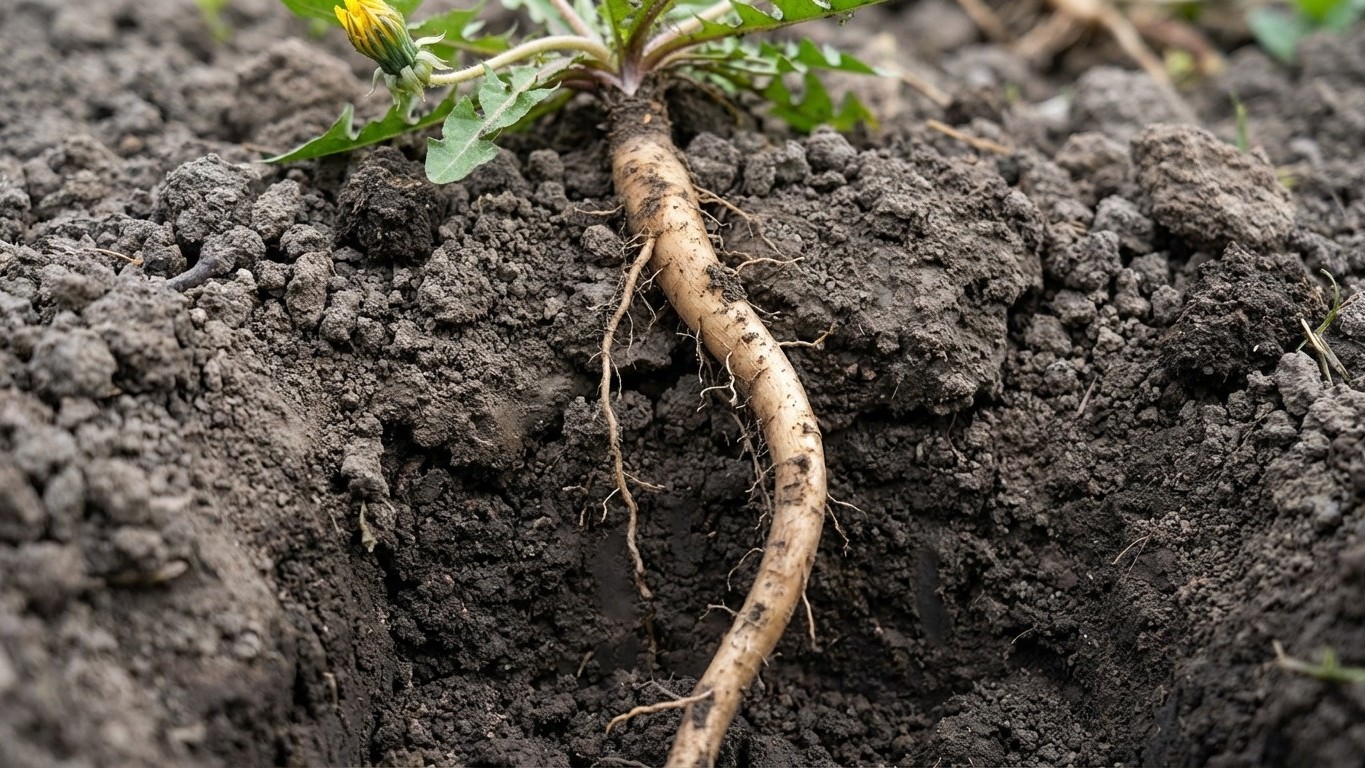
Deep taproots act as “organic crowbars,” contributing to dandelions’ excellent dynamic nutrient accumulation. They push through heavy or compacted soil that thwarts the roots of grasses and other plants, enabling rainwater to penetrate deeper, resulting in less runoff. Over time, dandelions create drainage pathways in compact soils, which can prevent the stagnation of ground water and potential puddling, making them particularly beneficial if you’re growing root vegetables like beets, carrots, or potatoes in dense soil.
The real magic, though, is what Happens with minerals. Dandelion (Taraxacum officinale) is known for its ability to gather nutrients like calcium, iron, and potassium, with its deep taproot pulling these nutrients from deeper soil layers. In permaculture, these plants have a name: dynamic accumulators. Dynamic accumulators improve soil health by recycling nutrients naturally. These plants use deep roots to pull minerals like potassium, calcium, and phosphorus from subsoil layers, and when their leaves decompose, the nutrients return to the topsoil, benefiting nearby plants without synthetic fertilizers. No bag of amendments required.
The mineral profile of a dandelion leaf is striking. Dandelion accumulates sodium, silica, magnesium, calcium, potassium, phosphorous, iron, and copper. That’s essentially a multivitamin for your vegetable bed, made entirely for free by a plant you’ve been throwing in the compost bin (if you were lucky) or in the trash. Decaying dandelion roots provide channels for rain and air to penetrate, and those tunnels become highways for earthworms and beneficial soil microbes. Good soil biology follows.
What Happens When You Let Dandelions Work Alongside Your Vegetables
The benefits don’t stop at soil structure. Dandelions possess a deep, strong taproot that breaks up hard soil, benefiting weaker-rooted plants nearby and drawing up nutrients from deeper than shallower-rooted plants can access. They will also excrete minerals and nitrogen through their roots, attract pollinators with their nectar, release ethylene that triggers nearby fruits to ripen, and serve as an important food source for insects and birds. That last point surprises most people. A dandelion near your late tomatoes may actually speed up ripening. Dandelions give off ethylene gas which can cause fruits and flowers to ripen quickly, handy for late tomatoes.
Speaking of tomatoes: researchers have found that dandelions can protect tomato plants from a disease called Fusarium wilt that often attacks tomato plant roots, because dandelions have naturally allelopathic properties against pathogens via compounds they release into the soil. Fusarium wilt is the kind of problem that can quietly devastate an entire summer crop, and a “weed” growing nearby is one of the best defenses against it. Letting a few dandelions grow near your tomato beds, harvested before they go to seed, is one of the lowest-effort disease prevention strategies in the garden.
Dandelion flowers benefit many species of insects that visit them for pollen and nectar. Many tiny insects that live on the bounty of flowers in their adult states eat or parasitize garden pests in their larval stages, and a surfeit of food near the garden for these “beneficials” can enable very good control of some pests. Your tomatoes, squash, and beans all benefit when the local pollinator population is well-fed, and dandelions are now a naturalized plant throughout the entire country. They’ve found a niche in nature — because they’re one of the first plants to flower in spring, they play an important role as an early source of pollen and nectar for bees and other pollinating insects.
How to Keep Dandelions Working For You (Without Losing Control)
Letting dandelions grow doesn’t mean surrendering your garden to a yellow sea. The key is timing and management. One flower seed head can set over 100 seeds, so for a tidier garden, cut the leaves back monthly and tuck them under the mulch, or lay them on top of the soil to naturally decompose. Leave the roots intact, the plant will either regrow, or the roots will decay, enriching the soil and attracting beneficial soil organisms. The roots are the engine. Remove the flowers before they turn to seed, keep the roots in the ground, and the dandelion goes on working quietly below the surface.
You can even turn harvested leaves directly into liquid fertilizer. Rotted down in rainwater, dandelion leaves and roots can yield the minerals sodium, silicon, manganese, calcium, potassium, phosphorous, iron, and copper, a homemade mineral tea that costs nothing and takes minimal effort. The “chop and drop” method, which involves cutting plants and letting them naturally decompose on the soil, works especially well if you harvest leaves just before flowering, when nutrient levels are at their peak.
One practical note worth keeping in mind: people with urban soils or soils long used in conventional agriculture and orchards should test for soil lead and arsenic before eating any plant grown in those beds, dandelions included. The plant itself is healthy, the concern is what the soil may contain. You can leave dandelions in an area of poor soil, and they will actually improve it, even if you don’t end up eating the leaves themselves.
The dandelion has been with us for a very long time. It is believed that the dandelion was first brought to the U.S. by the Pilgrims on the Mayflower, not by accident, but because of its medicinal purposes. It spent centuries being valued before a few decades of lawn-perfection culture turned it into public enemy number one. The question now is whether we’re ready to let it do the job it came here to do — or whether next April, the trowel comes out again, right on schedule.
Sources : english.pravda.ru | epicgardening.com